 how-to
Can Rental Trailers Really Optimize Fleet Efficiency?
Last Updated: October 24, 2026
Quick Summary
Rental trailers optimize fleet efficiency by turning a fixed cost into a variable one: you pay for capacity only when you need it, cutting idle time and freeing capital. They fit best when hauling demand spikes and dips, since you switch capacity on for a job and off after.
- Below roughly 30% utilization, ownership's fixed costs usually outweigh the convenience of owning a trailer.
- Above roughly 60% utilization, ownership math starts to favor buying over renting.
- Batch pickups and deliveries by route to cut empty miles and turnaround time.
- Track cost per haul, use rate, empty miles, turnaround time, and downtime from your first rental.
- A hybrid of owning a base fleet and renting the surge is usually cheapest when demand is uneven.
Table of Contents
- Why Rental Trailers Change Fleet Efficiency Math
- Trailer Use Strategies That Move the Needle
- Renting Versus Buying Trailers: A Decision Framework
- Seasonal Trailer Rentals and Surge Demand Planning
- Fleet Efficiency Metrics to Track From Day One
- Preventive Maintenance, Trailer Readiness, and Downtime Control
- How to Evaluate a Rental Trailer Vendor
- Reserve Your Next Haul With 402 Car Hauler Rentals
- Frequently Asked Questions
Why Rental Trailers Change Fleet Efficiency Math
Optimizing fleet efficiency with rental trailers comes down to one idea: you pay for capacity only when you need it.
A rental trailer turns a fixed cost into a variable one: book it for the haul, use it, return it.
Fleet efficiency measures how much useful work each asset delivers relative to what it costs to own and run.
The Idle Asset Problem
Most trailers earn their keep only a few days a month. The rest of the time they take up yard space and still need tires, lights, and registration.
- Insurance and registration run whether the trailer moves or not
- Storage space has a cost, even in your own lot
- Tires and lights age out from sitting, not just from use
Where Rental Capacity Fits
Rental capacity fits best when hauling needs spike and dip. If you move cars every week, owning may still win.
The key is matching supply to real demand: flexible capacity you switch on for a job and off after. For a closer look at ongoing options, see this guide to long term trailer rental in Omaha.
Trailer Use Strategies That Move the Needle
Trailer use is the share of available time a trailer actually hauls a load. Higher use means each trip carries more of the fixed cost, the whole game in fleet efficiency.
Scheduling and Load Optimization
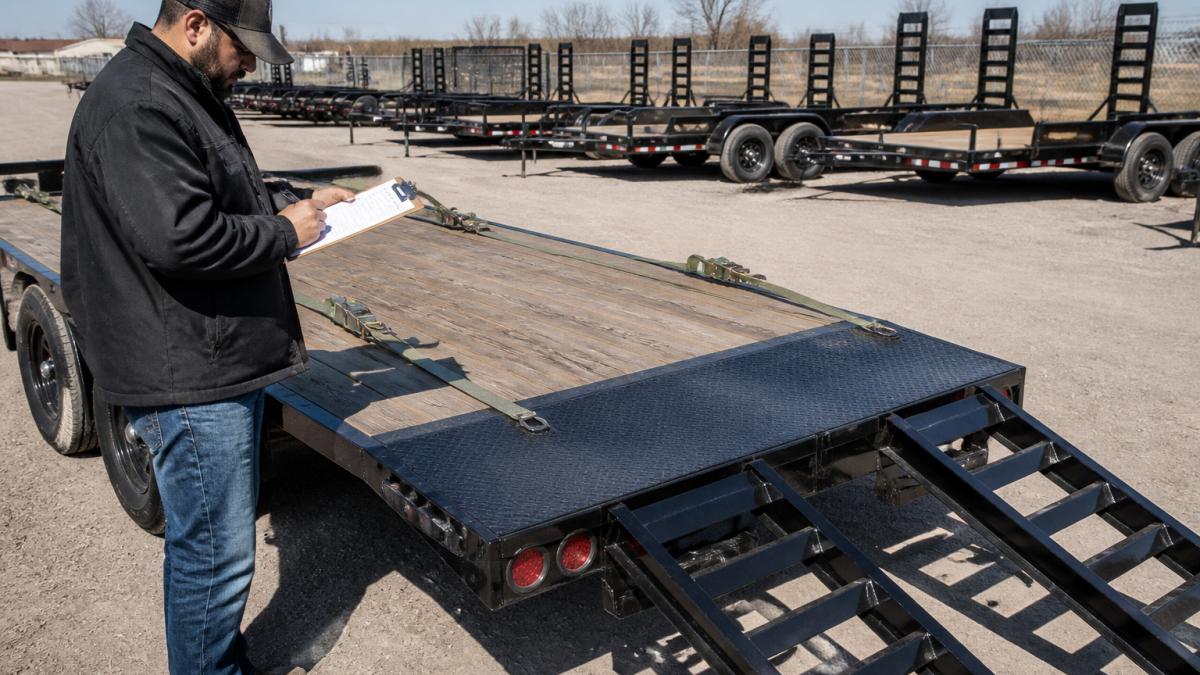
The biggest gains come from planning, not buying more gear. Group trips so one trailer handles several jobs in a single window, cutting empty miles and turnaround time.
- Batch pickups and deliveries by route to cut empty miles
- Match the trailer size to the load so you don't haul air
- Book back-to-back jobs within one rental window
A common mistake is renting for a single short haul and letting the trailer sit all day. If you've paid for the day, use the day.
Renting Versus Buying Trailers: A Decision Framework
This framework compares renting, leasing, and owning on four variables: demand pattern, utilization, maintenance exposure, and total cost of ownership (TCO).
Step 1: Map Your Demand Pattern
Before comparing prices, chart how often you haul. Pull the last 12 months of trips, sort by week, and you'll land in one of four patterns:
- Flat and frequent: roughly the same number of hauls every week. Ownership or a lease tends to win because fixed costs spread across steady use.
- Seasonal spikes: long stretches of low activity punctuated by short, intense windows (auction weekends, show season, moving season). Rental wins because you pay only for the spike.
- Lumpy and unpredictable: demand arrives with little warning. Rental wins on flexibility, but you need availability guarantees from the vendor.
Write down your peak-week and average-week trailer counts. The gap between them is the capacity you should rent rather than own.
Step 2: Calculate Utilization
Utilization is the share of available days a trailer actually hauls a load:
Utilization = loaded haul days ÷ total days the trailer is available
Small operations often sit in the low double digits, a trailer that moves a few days a month. Below roughly 30% utilization, ownership's fixed costs (insurance, registration, storage, depreciation, maintenance) usually outweigh the convenience. Above roughly 60%, ownership math starts to favor buying. Between those bands, run the Step 4 TCO comparison.
Step 3: Compare Maintenance Exposure
Owning a trailer means you carry every repair, tire replacement, light and brake job, and inspection. Renting shifts most of that exposure to the vendor, but only if the contract says so. Ask before counting maintenance as a rental advantage:
- Who pays for tires, brakes, lights, and ramp repairs during the rental?
- Who handles scheduled inspections, and are they documented between rentals?
- What is the damage policy, and how is "normal wear" defined?
If the vendor covers maintenance and inspections, the rate already includes a maintenance reserve. If not, add an estimated repair reserve to your rental cost before comparing.
Step 4: Build a Total Cost of Ownership Comparison
TCO is the only fair comparison. Build it side by side for renting, leasing, and owning over the same 12-month horizon.
Ownership TCO includes:
- Purchase price or loan payment, spread across the planning horizon
- Insurance and registration
- Storage or yard space
Lease TCO includes:
- Monthly lease payment
- Mileage or usage caps and overage charges
- Maintenance responsibilities per the lease terms
Rental TCO includes:
- Daily, weekly, or monthly rental rate
- Mileage charges, if any
- Repositioning or delivery fees
Divide each TCO by expected loaded hauls to get a cost per haul. Choose the lowest cost per haul at your realistic demand level, not the lowest sticker price.
Step 5: Match the Option to the Situation
| If your situation is... | Lean toward... | Why |
|---|---|---|
| Hauling a few times a month, low utilization | Renting | Avoids idle cost, insurance, storage, and upkeep |
| Steady, near-daily hauls, high utilization | Buying | Fixed cost spreads over heavy use |
| Sharp seasonal spikes | Renting | Flexible capacity for surge demand without year-round overhead |
| Need to preserve capital for core operations | Renting or leasing | No large upfront outlay |
| Specialized one-off loads | Renting | No need to own a niche trailer |
| Multi-year, predictable hauling needs | Leasing | Lower upfront cost than buying with predictable payments |
For a broader look at business-use options, see our guide to renting trailers for business use.
The honest trade-off: buying gives you total control and no booking step, but renting wins whenever demand is uneven, which is most small operations.
Seasonal Trailer Rentals and Surge Demand Planning
Seasonal trailer rentals solve the demand spike problem.
Plan the surge before it hits. If you need certainty for a fixed weekend, learn how to guarantee trailer availability so a booked trailer is actually there when you arrive.
Watch out: waiting until the week before a show to book is the fastest way to get shut out during peak demand.
Fleet Efficiency Metrics to Track From Day One
Fleet efficiency metrics show whether your rental strategy is working. Track a few from the first rental to spot waste early.
- Cost per haul: total rental cost divided by loads moved
- Use rate: hours hauling divided by hours rented
- Empty miles: distance driven without a load
Keep the numbers simple. A short log beats a fancy dashboard you never update. Before you start, know which trailer rental fees to expect so your cost per haul stays accurate.
Preventive Maintenance, Trailer Readiness, and Downtime Control
Trailer readiness protects operational continuity. A trailer that fails inspection mid-job costs a missed delivery and a wasted rental day. Good vendors check tires, lights, brakes, straps, and ramps before every handoff.
Ask what the inspection process looks like. The FMCSA sets towing and equipment safety rules any reputable operation should respect.
- Confirm tires, lights, and brakes before you tow
- Check straps and ratchets for wear
- Test ramps and tie-down points
How to Evaluate a Rental Trailer Vendor
A rental trailer is only as reliable as the vendor behind it. Evaluate partners on six dimensions, service coverage, availability guarantees, equipment condition, technology integration, contract flexibility, and problem resolution, and get each answer in writing.
1. Service Coverage and Response Times
Ask where the vendor's yards sit relative to your hauling lanes and how fast they can deliver or recover a trailer. A nearby yard means faster repositioning and lower delivery charges. Confirm:
- Which locations serve your regular lanes
- Delivery and pickup windows, and whether they are guaranteed or estimated
- Roadside assistance response time, and whether it is 24/7
2. Availability Guarantees
Peak-season availability is where rental relationships succeed or fail. Ask:
- Can the vendor guarantee a specific trailer type on a specific date?
- What is the remedy if a booked trailer is not available, substitute equipment, credit, or refund?
- How far in advance should you reserve during peak windows?
A vendor who cannot describe a written availability commitment will leave you short during the week you need capacity most.
3. Equipment Condition and Inspection Records
Ask to see the inspection process, not just hear about it. A reputable vendor should be able to describe:
- Pre-rental inspection checklist (tires, lights, brakes, straps, ratchets, ramps, tie-down points)
- Documentation of inspections between rentals
- Age and service history of the trailers in the fleet
The FMCSA sets towing and equipment safety rules that any reputable operation should respect. A vendor who can explain their readiness checks in detail is a vendor who takes downtime seriously.
4. Technology Integration
If you run dispatch, TMS, or telematics software, ask whether the vendor can integrate:
- Online booking and real-time availability
- Digital rental agreements and invoices
- Trailer tracking or GPS visibility during the rental
Integration matters most when you rent frequently. Manual booking and paper invoices create administrative drag that erodes the efficiency gains you rented the trailer to capture.
5. Contract Flexibility
Read the contract before you sign, not after a problem. Confirm:
- Minimum rental periods and whether partial days count as full days
- Extension and early-return policies, including any fees
- Mileage caps and overage rates
Flexible terms matter for project work with an open timeline. Review flexible car trailer rental terms so you know what to expect before you sign.
6. Problem Resolution and Fee Transparency
Ask how disputes are handled and which fees apply beyond the daily rate. A vendor who answers these plainly is worth keeping:
- What is the policy if a strap or part fails during the rental?
- Which fees apply beyond the daily rate, cleaning, fuel, damage, administrative?
- Who is the point of contact when something goes wrong after hours?
A vendor who answers all six dimensions in writing is a vendor you can build a repeat rental strategy around. One who deflects is telling you what the relationship will feel like when a trailer fails on a Friday afternoon.
Reserve Your Next Haul With 402 Car Hauler Rentals
The challenge is simple: keep capacity matched to real demand without paying for idle gear.
At 402 car hauler rentals, we make that easy. You get reliable trailer rentals, flexible terms, and competitive rates built for project cars and race vehicles.
Get started with 402 car hauler rentals and reserve a trailer that's ready when your next haul is.
Frequently Asked Questions
How can rental trailers improve fleet efficiency?
Rental trailers add capacity without adding permanent assets. You pay only for the days you haul, so capital stays free and you avoid insurance, storage, and depreciation on equipment that sits idle. They also cover surge periods, like auction weekends or show season, when your own trailer count falls short. The key is matching rental volume to actual demand and tracking utilization so you rent for the right number of days rather than defaulting to a weekly rate.
When should a fleet rent trailers instead of buying them?
Rent when demand is uneven, when a haul is a one-off, or when the capital cost of a trailer would take years of steady use to justify. Buying makes sense when a trailer runs most weeks and you need it configured to your exact specs. A simple test: estimate how many days per month the trailer would actually be loaded and moving. If that number is low or unpredictable, renting versus buying trailers usually tips toward renting.
How do you measure trailer utilization?
Track loaded days divided by available days for each trailer, then compare that against empty miles and turnaround time at the dock. A trailer that is booked but sitting in the yard is not utilized. Log dispatch dates, return dates, and any maintenance holds. Review the numbers monthly so seasonal trailer rentals and surge periods show up as patterns rather than surprises, and use those patterns to size your next reservation.
What should fleet managers check before choosing a rental trailer vendor?
Inspect the equipment first: straps, ramps, tires, lights, and tie-down points should be sound, not patched together. Ask how availability is guaranteed for a booked date, what the damage policy covers, and whether the rate includes everything or adds fees later. A short trial rental on a low-stakes haul tells you more about reliability than any brochure.
Ready to move your car without the overhead of ownership? Reach out to 402 car hauler rentals and lock in your booking.