 ultimate-guide
Flexible Car Trailer Rental Terms: What to Know
Table of Contents
- What Flexible Car Trailer Rental Terms Actually Mean
- Key Rental Terms: Daily, Weekly, and Monthly Rates
- Short Term Trailer Rental Options for Flexible Schedules
- Liability, Insurance, and the Damage Waiver Explained
- What to Check in a Car Hauler Rental Agreement Template
- Best Practices for Renting Race Car Trailers
- Conclusion: Secure a Rental That Fits Your Hauling Needs
- Frequently Asked Questions
Last Updated: September 6, 2026
What Flexible Car Trailer Rental Terms Actually Mean
Flexible car trailer rental terms are the conditions that let you adjust your rental duration, pickup time, or return date without penalty, covering everything from the daily rate to the mileage allowance and damage waiver. Most operators advertise a base price, but the terms define what you actually pay and what you are responsible for if a strap breaks or your project car restoration runs long.
A rental agreement is a legally binding contract that specifies the rental duration, the load capacity, and the duties of each party. Before you sign anything, confirm whether the trailer is offered in as-is condition or inspected before each rental.
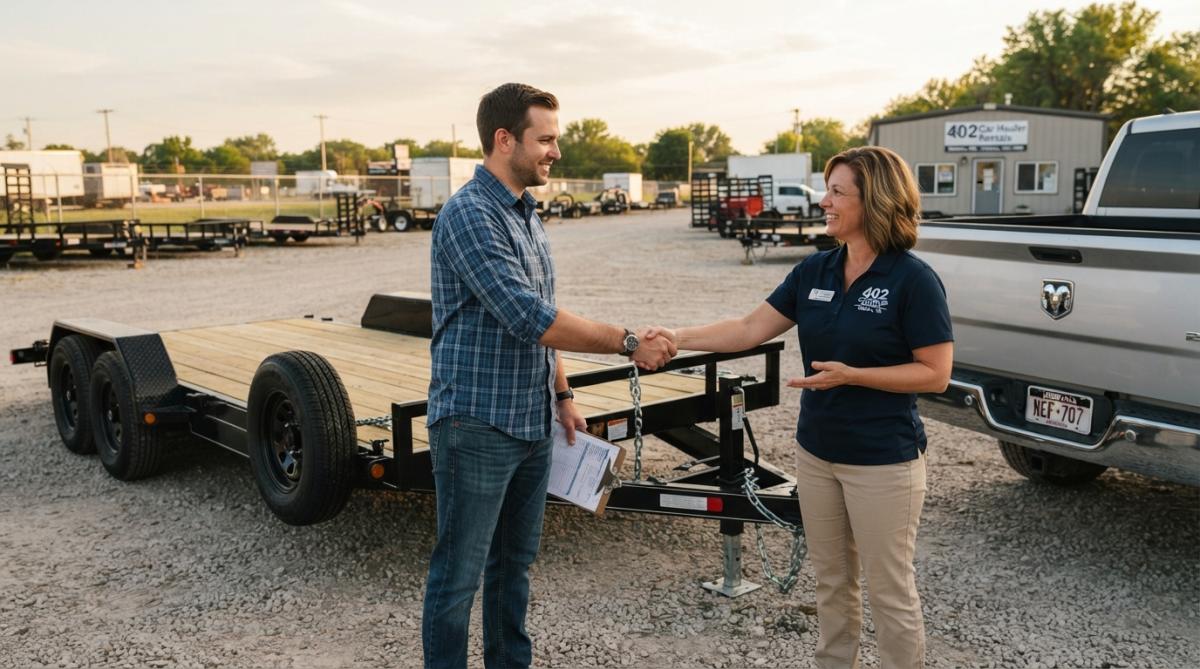
What most guides miss is that "flexible" cuts both ways. It may mean you can extend a rental easily, but it also means the operator can adjust availability if you do not hold a confirmed reservation.
Key Rental Terms: Daily, Weekly, and Monthly Rates
Rate structures follow predictable patterns. Daily rates suit single-day hauls, weekly rates reduce the per-day cost for multi-day projects, and monthly rates apply when you are storing a trailer on your property for several weeks.
| Rental Term | Typical Use Case | What to Confirm |
|---|---|---|
| Daily | Single vehicle pickup | Late return fee threshold |
| Weekly | Car show weekend plus travel | Mileage allowance cap |
| Monthly | Restoration project | Maintenance responsibility |
Understanding Mileage Allowances and Late Returns
Mileage allowances vary by operator and trailer type. Some agreements include unlimited miles; most cap you at a set distance before per-mile charges apply. The late return fee is usually tied to a specific hour, so clarify whether the rental period ends at a fixed time or a full 24-hour cycle.
Short Term Trailer Rental Options for Flexible Schedules
Short term trailer rental options work best when your timeline is uncertain. Many independent operators offer adjustable windows where you can book a base period and extend in day increments rather than committing to a fixed return.
The practical difference comes down to how the operator handles availability. A common approach is first-confirmed, first-served: you reserve a specific weekend, and the trailer is held for you. If your project slips, you need to know whether the operator can swap you to an open slot or whether you forfeit the reservation. Ask about cancellation policy terms before you pay a deposit.
Liability, Insurance, and the Damage Waiver Explained
Liability insurance and a damage waiver are not interchangeable, and confusing the two is the most common source of out-of-pocket cost for renters.
Liability Coverage: What It Pays For
Liability coverage responds to harm you cause to other people or their property while the trailer is hitched to your vehicle. In most states, your personal auto policy's liability limits extend to a towed trailer, but that extension is not automatic in every policy. Before you sign, call your auto insurer and ask two questions: (1) Does my policy cover a non-owned trailer with a GVWR over 3,000 pounds? and (2) What is my combined single limit for bodily injury and property damage while towing?
If your personal policy does not extend coverage, the rental operator's liability policy may step in as secondary coverage, but only up to the state's minimum financial responsibility limits, which in most states range from $10,000 to $25,000 for property damage. Renters who carry only state-minimum coverage on their own truck should ask whether an umbrella or excess liability option is available.
The Damage Waiver: What It Actually Covers
A damage waiver is not insurance. It is a contractual agreement where the operator waives its right to collect from you for physical damage to the trailer itself, in exchange for a fee, typically $10 to $25 per day at independent operators, or 10% to 15% of the daily rate at national chains.
But the waiver has exclusions, and those exclusions are where renters get burned. Standard waivers do not cover:
- Overloading, exceeding the trailer's GVWR or the towing vehicle's rated capacity voids the waiver entirely.
- Improper loading, cargo that shifts because it was not secured with rated straps or chains is excluded.
- Off-road use, taking the trailer on unpaved surfaces, even a gravel driveway, is often excluded.
- Driver negligence, backing into a low overhang or curb is frequently classified as negligence, not an accident.
- Tire and brake wear, blowouts from under-inflation or worn brake pads are maintenance items, not covered damage.
The Claims Process: What Happens When Damage Occurs
If the trailer is damaged during your rental, the operator's process typically follows this sequence: you report the damage at return, the operator performs a walk-around inspection, and a damage assessment is generated. If you purchased the waiver and the damage falls within its scope, you walk away. If you declined the waiver, the operator will charge your security deposit or send you an invoice for the repair cost.
A common pattern at independent operators is to require a damage report within 24 hours of the incident, even if you are still on the road. Failing to report promptly can void even the waiver you purchased.
State-Specific Considerations
Liability requirements vary by state. For example, some states require a separate trailer liability policy when the trailer's GVWR exceeds a certain threshold, while others treat the towing vehicle's policy as primary automatically. The Federal Motor Carrier Safety Administration guidance on towing and load securement outlines the cargo securement standards you must meet on public roads, but it does not address state-level insurance minimums. Ask the rental operator which state's law governs the agreement, that is usually stated in the contract's choice-of-law clause, and confirm whether your coverage is sufficient for that jurisdiction.
The Bottom Line on Coverage
The financially safe position is to carry your own liability coverage with adequate limits, purchase the damage waiver for the trailer itself, and document the trailer's pre-existing condition with photos before you hitch up. That combination covers the two biggest risks, harm to others and damage to the trailer.
What to Check in a Car Hauler Rental Agreement Template
A rental agreement is a legally binding contract, and the template you are handed is written to protect the operator first. Your job is to read it as an adversary would, looking for the clauses that shift risk onto you.
The GVWR and Load Capacity Clause
The agreement should state the trailer's Gross Vehicle Weight Rating in pounds, not just a vague description like "car hauler." The GVWR is the maximum loaded weight the trailer is rated to carry. A typical 18-foot car hauler has a GVWR of 7,000 to 10,000 pounds, but the payload capacity, the weight of the car itself, is the GVWR minus the trailer's own weight, which is usually 2,200 to 3,000 pounds (curtmfg.com). If the agreement lists only the GVWR without the trailer's empty weight, ask for the manufacturer's spec sheet.
The Towing Vehicle Requirements Clause
This is the clause that most rental templates bury or omit entirely, and it is the one that creates the most liability for renters. A proper agreement should require you to confirm that your towing vehicle's manufacturer-rated towing capacity exceeds the combined weight of the trailer and its load. It should also specify the minimum hitch class, for a 7,000-pound trailer, that is a Class IV hitch with a 2-inch receiver.
If the agreement does not include a towing vehicle requirements clause, that is a red flag. It means the operator has not protected itself against the most common cause of trailer damage: an undersized tow vehicle. Ask the operator to add a line confirming your vehicle's specifications.
The Indemnification and Hold Harmless Clause
Nearly every rental agreement contains an indemnity clause that holds you responsible for damage to the trailer, to third parties, and to the operator's property regardless of fault. This is standard, but the scope matters. A fair clause limits your responsibility to damage during your rental period and excludes damage caused by the operator's own negligence. An unfair clause extends your liability to damage that existed before pickup or results from the operator's failure to maintain the equipment.
The Late Return and Extension Clause
Flexible rental terms live or die by this clause. Look for the specific hour the rental period ends, most operators use a 24-hour cycle from pickup time, but some use a fixed clock time like 5:00 PM. The late fee is typically $25 to $50 per hour or a full day's rate if you exceed the return window by more than two hours. The extension clause should state how much notice you must give, usually 24 hours, and whether extensions are subject to availability.
The Security Deposit and Damage Fee Schedule
The security deposit is typically $200 to $500 for a car hauler, held as a credit card authorization rather than a charge. The agreement should state how long the hold lasts after return, usually 5 to 10 business days, and what constitutes "normal wear" that will not be deducted. Normal wear includes minor scuffs on the deck and light tire wear. It does not include a bent fender, a torn tarp, or a broken strap. The damage fee schedule should list specific charges: a replacement strap costs $15 to $30, a new fender runs $75 to $150, and a tire replacement is $100 to $200.
The Cancellation and Refund Policy Clause
Cancellation terms vary more than any other clause. Some operators refund the full deposit with 48 hours notice; others charge a restocking fee of $50 to $100; and some forfeit the entire deposit if you cancel within 24 hours of pickup. The agreement should state the cancellation window in hours, not vague language like "reasonable notice."
The Pre-Rental Inspection Checklist
Before you sign, walk the trailer with the operator and document its condition. Use this checklist and photograph every item:
- Tires: Check tread depth, sidewall cracks, and air pressure. A spare tire should be present and inflated.
- Lights: Verify all turn signals, brake lights, and running lights work when connected to your vehicle's harness.
- Hitch and coupler: Confirm the coupler size matches your ball (typically 2-5/16 inches for car haulers) and that the safety chains and breakaway cable are intact.
- Deck and ramps: Look for cracked wood, rusted metal, or bent ramps. Test that ramps latch securely in the stowed position.
- Tie-down points: Confirm at least four rated D-rings or stake pockets are present and not corroded.
- Brakes: If the trailer has electric brakes, test the brake controller while moving at low speed.
The Federal Trade Commission guidance on rental contracts advises consumers to get all terms in writing before signing. Apply that advice literally: ask for the agreement template in advance, review it at home, and bring your questions to the lot. The operator who welcomes that review is the operator who offers genuinely flexible terms.
Best Practices for Renting Race Car Trailers
Best practices for renting race car trailers start with matching the trailer to your tow vehicle. A trailer rated for 7,000 pounds is useless if your truck has a towing capacity of 5,000 pounds.
Towing Vehicle Compatibility and GVWR Compliance
Check your owner's manual for the towing capacity, then confirm the trailer's gross vehicle weight rating. The combined weight of the trailer, the car, and your gear must stay under the lower of the two figures.
Conclusion: Secure a Rental That Fits Your Hauling Needs
The best rental terms are the ones you understand before you sign. Confirm the rate structure, the mileage allowance, the damage waiver scope, and the cancellation policy in writing.
402 car hauler rentals offers reliable trailer rentals with flexible terms and competitive rates for project cars, race vehicles, and business hauling in the Omaha area. Get started with 402 car hauler rentals and secure a trailer that fits your schedule.
Frequently Asked Questions
What documentation is required to rent a car hauler?
You typically need a valid driver's license, proof of insurance for your towing vehicle, and a major credit card for the security deposit. Some rental providers may require a commercial license for trailers over a certain gross vehicle weight rating. It is best to confirm the specific driver license requirements with the rental company when you book.
Can I adjust my rental dates if my project timeline changes?
Many providers offer flexible car trailer rental terms that allow date adjustments. The key is to communicate early. Some may allow you to extend a daily rate to a weekly or monthly rate if your needs change, but this depends on trailer availability. Always ask about the cancellation policy and any fees for modifying your reservation before you commit.
What is the difference between liability insurance and a damage waiver?
Liability insurance covers damage you cause to other people or property while towing. A damage waiver protects you from paying for repair costs to the rental trailer itself if it is damaged during your rental period. Review your auto insurance policy or credit card benefits to see if they cover trailer rentals, but a waiver may still be a good option to reduce your financial risk.
What happens if the trailer breaks down while I am using it?
Your rental agreement should outline the process for mechanical failures. Reputable rental companies offer breakdown assistance and will either repair the trailer or arrange for a replacement. You are generally not liable for mechanical issues that are not caused by misuse. However, you are responsible for damages resulting from improper loading, overloading beyond the gross vehicle weight rating, or an accident.