 how-to
How to Calculate Tongue Weight for Rental Trailers
Table of Contents
- What Tongue Weight Means and Why It Matters for Rental Trailers
- How to Measure Trailer Tongue Weight: Step-by-Step Methods
- Trailer Tongue Weight Percentage: The 10-15% Rule for Bumper-Pull Trailers
- How to Calculate Tongue Weight from Loaded Trailer Weight
- Load Balance and Cargo Position: Adjusting Tongue Weight After You Measure
- Rental Trailer Towing Checklist: Verify Vehicle, Hitch, and Trailer Limits
- Conclusion
- Frequently Asked Questions
Last Updated: October 19, 2026
What Tongue Weight Means and Why It Matters for Rental Trailers
Tongue weight is the downward force a loaded trailer places on the hitch ball of your tow vehicle.
Here is the part most renters miss: tongue weight is not the same as trailer weight.
That is why the NHTSA trailer towing safety guidance treats load balance as a core safety issue, not a nice-to-have. Too little tongue weight causes sway.
How to Measure Trailer Tongue Weight: Step-by-Step Methods
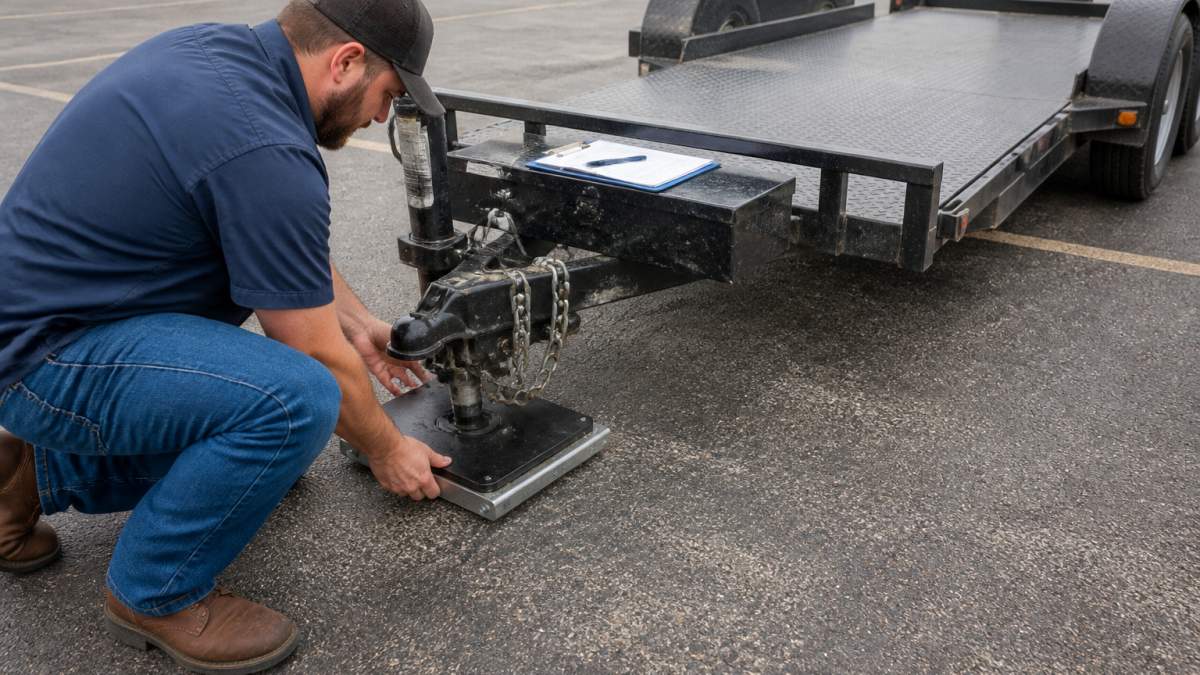
At a rental pickup you usually have three measurement paths: a dedicated tongue-weight scale, a public vehicle scale combined with a lever setup, or a bathroom scale with a lever bar.
What to Ask the Rental Provider Before You Measure
Ask these questions at the counter, not at the curb:
- Does the provider have a tongue-weight scale or hitch scale available to loan or rent?
- Is there a public scale nearby, and does the provider have directions or a preferred location?
- What is the trailer's empty weight, and is it printed on the data plate or only in the rental agreement?
- Does the provider require you to return the trailer with a specific tongue-weight range, or do they only check total loaded weight?
- Are there restrictions on where you can measure, for example, no jacking on their pavement or no blocking of the exit lane?
Write the answers on the rental agreement or photograph them. If the provider supplies a scale, confirm it is rated for the tongue weight you expect. A 500-pound bathroom-style scale will not read a 900-pound tongue weight safely.
Using a Tongue Weight Scale or Hitch Scale
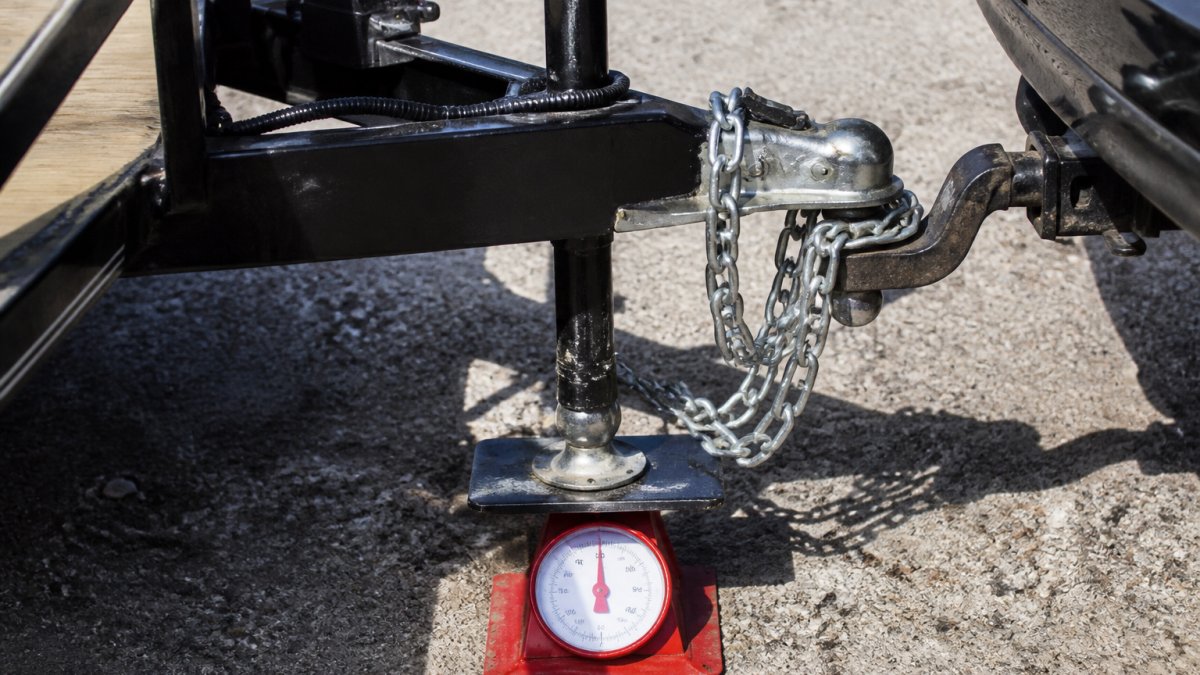
A dedicated tongue-weight scale reads directly in pounds and is the most accurate option for a rental. Most rental yards and auto parts stores carry them, and some providers loan one out.
- Load the trailer the way you plan to tow it.
- Park on level ground and chock the trailer wheels.
- Raise the trailer tongue with the jack until the coupler clears the ball.
- Slide the scale under the coupler and lower the jack until the full weight rests on the scale.
- Read the number. That is your tongue weight.
Do not let the jack carry any load during the reading. The scale must take the full coupler weight or the number is useless. If the scale tops out or the reading looks erratic, stop and switch to a public scale.
Measuring with a Public Vehicle Scale
A public scale gives you loaded trailer weight, which you can convert to a tongue-weight target. You cannot read tongue weight directly from a platform scale, but you can get the loaded weight and apply the percentage rule.
- Drive the loaded trailer onto the scale and record the total weight.
- Unhook the trailer and weigh the tow vehicle alone if you need to separate vehicle and trailer weight.
- Subtract the empty trailer weight from the loaded trailer weight to get cargo weight.
- Multiply the loaded trailer weight by your target percentage (10% to 15% for a bumper-pull rental).
Public scales are usually certified and give a reliable loaded weight, but they do not tell you how the load is balanced on the tongue.
How to Weigh a Trailer with a Bathroom Scale
No scale on hand? A bathroom scale plus a lever gets you close, but only if you respect the safety limits.
- Place a sturdy pipe or block as a fulcrum on level ground.
- Set a length of strong beam across it, with the coupler resting at one end.
- Position the bathroom scale under the short end.
- Measure the distance from the fulcrum to the coupler, and from the fulcrum to the scale.
- Multiply the scale reading by that distance ratio.
If the coupler sits 3 feet from the fulcrum and the scale sits 1 foot from it, multiply the reading by 3. A 200-pound scale reading means 600 pounds of tongue weight. Keep the beam level for an accurate result.
Trailer Tongue Weight Percentage: The 10-15% Rule for Bumper-Pull Trailers
The target trailer tongue weight percentage for a bumper-pull trailer is 10% to 15% of the loaded trailer weight.
That range is not arbitrary. Below 10%, the trailer's rear end gets light and starts steering the truck. Above 15%, you are pushing your hitch rating and your rear axle toward their limits.
| Trailer Type | Tongue Weight Target | Why |
|---|---|---|
| Bumper-pull (conventional) | 10-15% of loaded weight | Balances sway control against hitch load |
| Weight-distribution hitch setup | 10-15%, measured after hitching | Distributes load across both axles |
| Gooseneck | 15-25% of loaded weight | Load sits over the rear axle |
| Fifth-wheel | 15-25% of loaded weight | Same geometry as gooseneck |
Aim for the middle of the range, around 12% to 13%, and you leave yourself room to adjust cargo either direction.
How to Calculate Tongue Weight from Loaded Trailer Weight
Calculating tongue weight starts with one number: the loaded trailer weight. Get that from a public scale or the rental provider's documented weight, then apply the percentage.
- Weigh the empty trailer, or use the weight on the rental paperwork.
- Weigh the trailer fully loaded, with the car or cargo strapped down.
- Subtract empty from loaded to get your cargo weight.
- Multiply the loaded trailer weight by 0.12 for a 12% target.
A 6,000-pound loaded trailer at 12% needs 720 pounds of tongue weight. At 10% it needs 600. At 15% it needs 900. Pick your target inside that window and confirm your hitch and tow vehicle can handle it.
Worked Examples for Common Rental Loads
These examples use the same formula with different trailer sizes and cargo positions. Adjust the numbers to your actual scale readings.
Example 1: Single-axle utility trailer with a small car
- Empty trailer weight: 1,200 pounds
- Loaded trailer weight: 4,200 pounds
- Cargo weight: 3,000 pounds
- Target tongue weight at 12%: 504 pounds
- At 10%: 420 pounds; at 15%: 630 pounds
If your hitch is rated for 500 pounds, you are at the edge at 12% and over at 15%.
Example 2: Tandem-axle car hauler with a project car
- Empty trailer weight: 2,000 pounds
- Loaded trailer weight: 7,000 pounds
- Cargo weight: 5,000 pounds
- Target tongue weight at 12%: 840 pounds
- At 10%: 700 pounds; at 15%: 1,050 pounds
This is where payload and rear axle rating matter.
Example 3: Enclosed rental trailer with tools and equipment
- Empty trailer weight: 2,500 pounds
- Loaded trailer weight: 5,500 pounds
- Cargo weight: 3,000 pounds
- Target tongue weight at 12%: 660 pounds
- At 10%: 550 pounds; at 15%: 825 pounds
Enclosed trailers are sensitive to cargo position because the load is hidden.
Adjusting the Calculation for Cargo Position
The percentage rule assumes the load is centered over or slightly ahead of the trailer axle. If you move cargo rearward to reduce tongue weight, you also reduce stability. A common pattern is to aim for 12% to 13% and adjust in small increments, re-measuring after each move.
Use a tongue-weight calculator if you want the math done for you, but understand the formula first. The calculator is only as good as the loaded weight you feed it.
Load Balance and Cargo Position: Adjusting Tongue Weight After You Measure
If your measurement lands outside 10% to 15%, fix it with cargo position before you touch anything else. Moving weight forward increases tongue weight. Moving it back decreases it.
- Tongue weight too low (under 10%): move the car or cargo forward, toward the coupler.
- Tongue weight too high (over 15%): shift cargo rearward, but never behind the trailer axle.
- Always: keep the heaviest part of the load centered over or slightly ahead of the trailer axle.
- Never: load all the weight at the rear to "lighten" the tongue. That is how trailer sway starts.
Load balance matters as much as the total. A trailer with the right total weight but poor cargo position will still sway. Check your hitch-to-axle distance and keep the load centered side to side as well.
Rental Trailer Towing Checklist: Verify Vehicle, Hitch, and Trailer Limits
Tongue weight is one of four limits, and the lowest one wins. Check all four before you pull off the lot.
- Trailer GVWR: the maximum the loaded trailer can weigh. Confirm on the trailer's data plate.
- Tow vehicle towing capacity: from your owner's manual, not a forum.
- Hitch capacity: the hitch rating stamped on your receiver, including the weight-distribution rating if you use one.
- Payload and rear axle rating: tongue weight counts against your truck's payload, along with passengers and gear.
- Ball mount and ball rating: confirm the ball matches the coupler size and its rating exceeds your tongue weight.
- Tire pressure: on the trailer and the tow vehicle, set to spec cold.
- Lights and brakes: test running lights, turn signals, and trailer brakes before you leave.
- Provider documentation: photograph the trailer's data plate and note the empty weight on your rental agreement.
That last item matters more than renters think. If a provider hands you a trailer with a bent tire stop or worn straps, document it before you tow. At 402 car hauler rentals, we note condition on the agreement.
Conclusion
The math is simple, but the stakes are not. Measure loaded, stay inside 10% to 15% for a bumper-pull rental, and check all four limits before you hitch up. Most towing problems start with a number nobody checked.
If you are hauling a project car or race vehicle around Omaha, 402 car hauler rentals keeps well-maintained trailers ready with flexible booking terms and competitive rates.
Frequently Asked Questions
What is considered tongue weight on a trailer?
Tongue weight is the downward force the trailer coupler exerts on the tow vehicle's hitch ball when the trailer is loaded and level. It is not the same as total trailer weight. For rental trailers, you measure it at the coupler with a tongue weight scale or a bathroom scale setup. Getting it right keeps the tow vehicle and trailer balanced, reducing sway and improving steering control.
How much tongue weight should a rental trailer have?
For most bumper-pull rental trailers, aim for 10-15% of the loaded trailer weight on the tongue. If your loaded trailer weighs 5,000 lb, that means 500-750 lb of tongue weight. Check the rental provider's hitch rating and your tow vehicle's hitch capacity before you load. Too little tongue weight causes sway; too much can overload the hitch and rear axle.
How do you measure tongue weight without a tongue-weight scale?
Use a bathroom scale and a lever system: place a sturdy pipe under the coupler, support one end on a block, and put the scale under the other end at a measured distance. Multiply the scale reading by the leverage ratio to get tongue weight. Alternatively, use a commercial truck scale: weigh the tow vehicle alone, then weigh it with the loaded trailer coupled but not on the scale, and subtract. Both methods work for rental trailers.
Does cargo placement change trailer tongue weight?
Yes. Moving cargo toward the front of the trailer increases tongue weight; moving it toward the rear decreases it. For a typical car hauler, position the vehicle so its center of gravity sits slightly ahead of the trailer axle. After adjusting, re-measure tongue weight to confirm it stays within 10-15% of loaded trailer weight. Small shifts, such as 6-12 inches, can change tongue weight by 50-100 lb or more.