 how-to
Is It Safe to Tow a Car With a Strap? What to Know
Table of Contents
- Is It Safe to Tow a Car With a Strap? The Short Answer
- Tow Strap vs Recovery Strap: They Are Not the Same Tool
- Tow Strap Weight Rating: How Much Can One Strap Handle?
- How to Attach a Tow Strap to a Car
- Safety Checklist Before You Tow a Car With a Strap
- Safe Alternatives to Towing With a Strap
- Conclusion
- Frequently Asked Questions
Last Updated: October 18, 2026
Is It Safe to Tow a Car With a Strap? The Short Answer
No. Towing a car with a strap is not safe for normal road transport, and we would not recommend it. A strap can move a stuck vehicle a short distance at low speed, but it is the wrong tool for hauling a car down a road. The key question is not whether a strap can pull weight. It is whether a strap can control a rolling vehicle, and it cannot.
People buy a strap rated for thousands of pounds and assume that rating means road-ready. It does not.
Below, we break down why straps fall short, what the ratings actually mean, and the safer path for getting a car from one place to another.
Tow Strap vs Recovery Strap: They Are Not the Same Tool
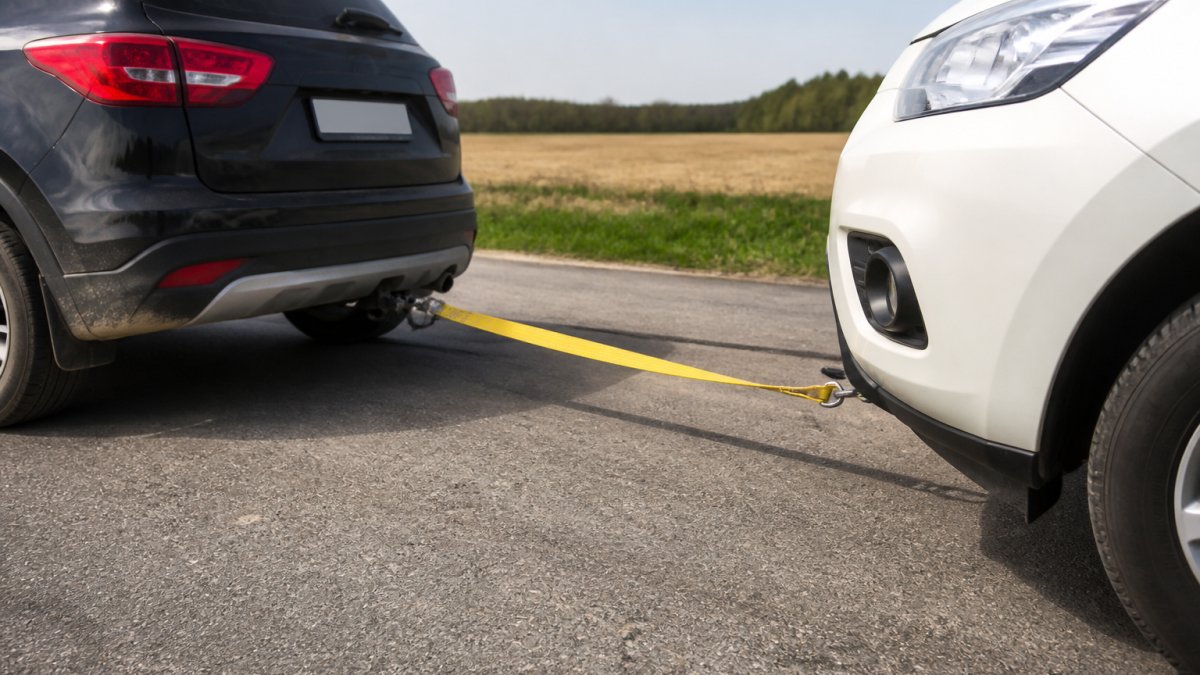
A tow strap is a flat, non-stretching webbing strap used for short, slow pulls. A recovery strap is an elastic strap built to stretch and snap a stuck vehicle free. They look similar on a shelf, which is exactly why people confuse them.
Here is the practical difference:
- Tow strap: Little to no stretch. Used for steady, controlled pulls over short distances.
- Recovery strap: Stretches under load, then recoils. Used to yank a stuck vehicle out of mud or snow.
- Chain or cable: Rigid, heavy, and dangerous if it snaps. Never use one with slack.
The stretch matters more than most people realize. A recovery strap stores energy and releases it. That recoil is helpful when freeing a stuck truck. It is dangerous when you are dragging a car at road speed behind another vehicle.
Tow Strap Weight Rating: How Much Can One Strap Handle?
A tow strap weight rating tells you the load a strap can handle in a controlled pull, not the speed or distance you can tow at. Ratings are usually printed as a working load limit and a break strength. The working load limit is the number that matters for safe use.
What the numbers do not tell you:
- How the strap behaves at highway speed
- Whether it can keep a car tracking straight behind you
- How it holds up under repeated shock loads
A strap rated well above your car's weight can still fail in real towing. Heat, abrasion, UV damage, and sharp edges all weaken webbing over time. A strap that sat in a truck bed for two summers is not the strap on the label.
Check every strap before use:
- No cuts, fraying, or melted spots
- Stitching intact at both loops
- No fading or stiffness from sun damage
- Rating tag still readable
- No knots tied in the webbing
How to Attach a Tow Strap to a Car
Attaching a tow strap correctly starts with a solid mounting point, not the bumper. Modern cars have designated tow hooks or tie-down points, and those are the only places a strap should connect. Bumper covers, suspension parts, and steering components will bend or tear under load.
The steps:
- Find the factory tow hook or tie-down point in the owner's manual.
- Inspect the mounting point for rust or damage.
- Thread the strap loop through the point, not around a sharp edge.
- Use a proper shackle or clevis where the strap meets metal.
- Keep the strap free of twists and knots.
- Drape a heavy blanket or jacket over the strap's midpoint.
That last step is not decoration. If a strap breaks, the weight keeps the loose end low instead of letting it fly. It is one of the simplest safety habits in towing, and one of the most skipped.
Even with perfect attachment, a strap leaves the towed car with no brakes and no steering control of its own. That is the core problem no attachment method solves.
Safety Checklist Before You Tow a Car With a Strap
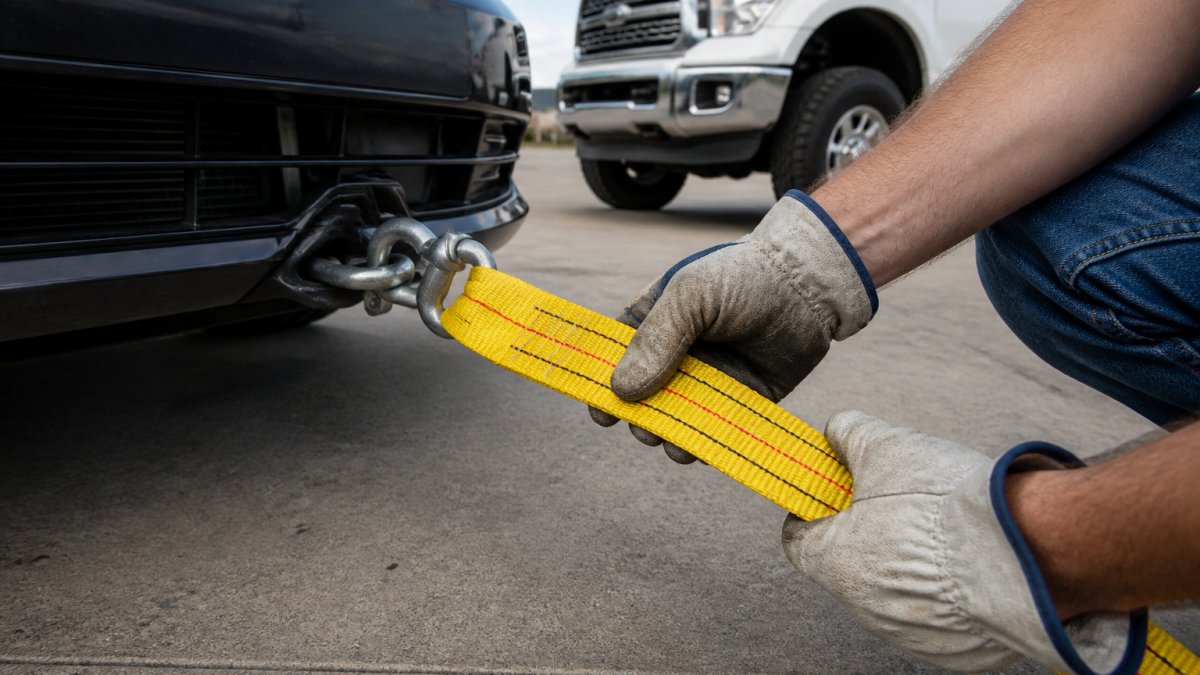
If you are moving a car at all, run this list first. It applies whether you use a strap for a short pull or load the car on a trailer.
- Confirm the strap type and check its rating tag
- Inspect the strap for cuts, fraying, and sun damage
- Verify the mounting points on both vehicles
- Check tire pressure and that wheels roll freely
- Confirm the towed car is in neutral with the parking brake off
- Agree on hand signals with the driver
- Keep people clear of the strap line
- Have a spotter for any tight maneuvering
Speed changes everything. A strap pull at walking pace across a lot is one thing. A strap pull at road speed is another, and that is where things go wrong.
Safe Alternatives to Towing With a Strap
The safe alternative to towing with a strap is a proper trailer or a rigid tow bar. Each fits a different job.
| Method | Best For | Main Limitation |
|---|---|---|
| Car hauler trailer | Moving a car any real distance | Needs a capable tow vehicle |
| Flatbed trailer | Non-running or damaged cars | Loading requires ramps and care |
| Rigid tow bar | Short, controlled moves | Towed car still needs attention |
| Tow dolly | Front-wheel-drive cars | Rear wheels still roll on the road |
| Tow strap | Slow pulls on private ground only | No control at road speed |
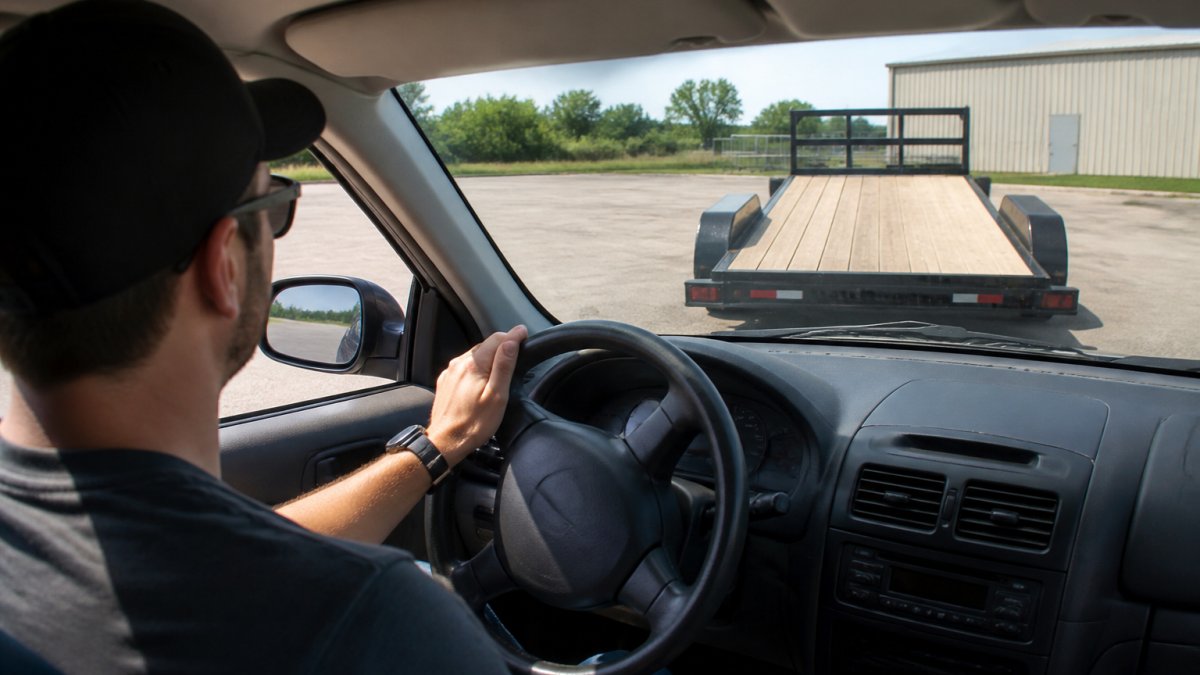
For classic cars, race cars, and project vehicles, a trailer is the answer. It keeps all four wheels off the road, protects the car from road debris, and removes the strap question entirely. Trailers also let you move a car that does not run, which a strap cannot do safely.
This is where we come in. Our trailer rentals suit everything from a project car to a race vehicle, with flexible terms for restorations that do not follow a fixed schedule. If you are weighing a strap against a trailer, the trailer wins every time for road transport.
Conclusion
The hard part of moving a car is not the pull. It is control, and a strap gives you almost none. We would rather see you load the car on a trailer than gamble on a strap at road speed.
If you need to move a project car, race vehicle, or customer car, 402 car hauler rentals can help. Our trailers are built for exactly this work, our terms flex around your timeline, and our rates stay competitive. Get in touch with us to book the right trailer and haul your car the safe way.
Frequently Asked Questions
Is it safe to tow a car with a tow strap?
It can be done for very short, low-speed pulls, but it is not a safe way to move a car any real distance. A tow strap has no braking control, no steering control, and no way to keep the towed car from rolling into the tow vehicle. It is best treated as an emergency recovery tool for a few hundred feet at walking pace, not a substitute for a trailer or a proper tow dolly.
What is the difference between a tow strap and a recovery strap?
A recovery strap is designed to stretch and store energy so a stuck vehicle can be yanked free, then it returns to its original length. A tow strap is built with little or no stretch so it can hold a steady load while flat-towing. Using a recovery strap to tow a car on pavement causes it to bounce and snap, which puts shock loads on the attachment points and can break them.
How do you attach a tow strap to a car?
Use the factory tow hook or a properly rated recovery point bolted to the frame, never a bumper, tie-down loop, or suspension part. Loop the strap through the point and secure it with the correct shackle or hook, then check that the strap is not twisted or rubbing on sharp edges. On the tow vehicle, attach to a rated hitch point, and keep the strap off the ground with a slight sag so it does not snap tight.
How fast can you drive while towing a car with a strap?
Keep it under about 10 to 15 mph and only for short distances on quiet roads. Above that, the towed car has no way to brake in sync with the tow vehicle, and any slack in the strap turns into a snap load when it goes tight. Most states also require a licensed driver in the towed car to steer and brake, so plan the route and keep it slow.
Is a trailer safer than towing a car with a strap?
Yes, by a wide margin. A car hauler trailer carries the full weight of the vehicle on its own axles, brakes, and lights, so there is no strap to snap and no second driver needed. For anything beyond a short emergency pull, renting a trailer is the safer and often cheaper route once you factor in strap wear, tickets, and damage risk.