 how-to
Trailer Hitch Safety Chains: Best Practices Guide
Table of Contents
- Why Trailer Hitch Safety Chains Matter and What They Must Do
- Trailer Safety Chain Rating: Matching Chain Strength to Your Load
- How to Attach Trailer Safety Chains to the Tow Vehicle
- Trailer Safety Chain Length: Measuring Slack and Testing Turning Clearance
- Crossing Chains Beneath the Tongue: Setup and Common Mistakes
- Trailer Safety Chain Inspection: A Pre-Trip Routine That Catches Failures
- DOT Requirements, State Rules, and What Happens If a Trailer Separates
- Frequently Asked Questions
Last Updated: October 17, 2026
Why Trailer Hitch Safety Chains Matter and What They Must Do
Trailer hitch safety chains are the backup connection between your trailer and tow vehicle, designed to catch the trailer if the coupler fails or bounces off the hitch ball.
The chains have one job: keep the trailer tongue from hitting the road if the primary connection lets go. They must hold the tongue up and keep the trailer tracking behind you long enough to stop. A loose or missing chain turns a minor hitch failure into a runaway trailer.
Below, we break down how to rate, attach, measure, cross, and inspect trailer hitch safety chains so your next haul stays predictable.
Trailer Safety Chain Rating: Matching Chain Strength to Your Load
A trailer safety chain rating must meet or exceed the gross weight of the loaded trailer. Never rate the chain to the empty trailer. The chain, hooks, and attachment points all count toward that number.
Most states follow the same principle: the chains and their attachments need to be strong enough to control the trailer at its heaviest. So start with the loaded weight, not the dry weight.
- Weigh the trailer loaded, or use the trailer's gross vehicle weight rating (GVWR)
- Match chain capacity to that figure, not the empty weight
- Replace any chain that is thinner or lighter than the original
Reading Working Load Limit Labels and Combined Ratings
Working load limit (WLL) is the maximum load a chain is designed to carry in normal service. It is stamped on the chain or its tag.
The combined rating is the total capacity of both chains working together. Since the chains share the load, the pair's combined rating is what matters for the trailer. Check the tag on each chain and confirm the pair meets the trailer's loaded weight.
How to Read Chain Markings and Pick a Safety Margin
Chain markings are easy to misread, and that is where most rating mistakes start.
A practical way to read a setup:
- Find the WLL on each chain's tag or stamp. If there is no legible marking, treat the chain as unknown and replace it.
- Confirm both chains carry the same WLL. If they differ, the lower number governs the pair.
- Add the two WLLs to get the combined working load limit.
- Compare the combined WLL to the loaded trailer weight (or GVWR). The combined figure should meet or exceed it.
A common pattern is to size the pair so the combined WLL is at or above the trailer's GVWR, not just its current load. That leaves margin for fuel, gear, and passengers in the tow vehicle, and it keeps the setup legal if you later haul heavier.
Two details trip people up:
- Per-chain vs. pair. A tag that reads "WLL 5,000 lb" describes one chain. Two of them together give a combined 10,000 lb, but only if both are the same grade and size and both attachment points are rated for it.
- Hooks and attachment points count. A 5,000 lb chain on a 2,000 lb hook is a 2,000 lb setup. Check the hook rating and the receiver loop rating, not just the chain.
If the numbers do not line up, do not split the difference with a heavier chain on one side. Replace the pair so both sides match, and confirm the attachment points are rated for the same load.
How to Attach Trailer Safety Chains to the Tow Vehicle
To attach trailer safety chains, hook each chain to a solid point on the tow vehicle's hitch or frame, not to the ball or ball mount. The connection must be structural, not decorative.
Follow these steps:
- Park on level ground and set the tow vehicle's parking brake
- Lower the trailer coupler onto the hitch ball and latch it
- Find the two attachment loops on the hitch receiver or frame
- Hook the right chain to the right loop and the left chain to the left loop
- Confirm each hook is fully seated and the latch is closed
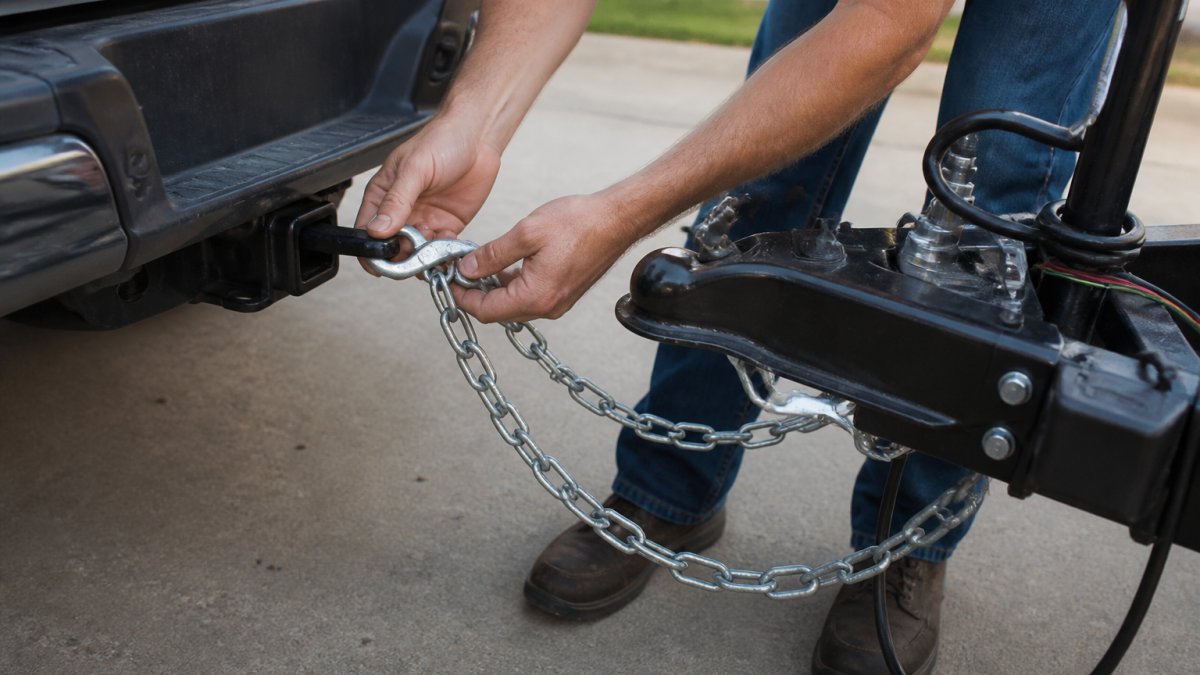
Choosing the Right Hooks and Attachment Points
S-hooks are common and quick, but they can bounce off a thin loop. Clevis hooks with a pin or a safety latch stay put better on rough roads. Whatever hook you use, it must close fully around the attachment point.
Good attachment points share three traits:
- Bolted or welded to the frame or receiver
- Thick enough that the hook cannot slip off
- Positioned so the chain pulls straight, not at a sharp angle
Never hook to a bumper, a license plate bracket, or a thin tie-down loop. Those are not structural.
Trailer Safety Chain Length: Measuring Slack and Testing Turning Clearance
Trailer safety chain length should let the chains cross under the tongue while leaving just enough slack to turn. Too short and the chains snap on tight turns. Too long and they drag or catch the road.
Here is how we measure it:
- Hook both chains to the tow vehicle with the trailer straight
- Let the chains hang with a small amount of slack, enough to clear the ground
- Turn the wheel fully to each side and watch the chains
- Trim or re-hook so the chains never pull tight or touch the tires
A common mistake is cutting chains too short to stop them dragging. That fixes the drag and creates a worse problem: chains that bind and snap during a sharp turn.
A Practical Measurement Method
You do not need a special tool, but you do need a repeatable routine. A common pattern among experienced towers is to set the chains so they hang with a small amount of slack when the trailer is straight, then verify that slack at full steering lock.
A workable procedure:
- Park on level ground, chock the trailer wheels, and set the tow vehicle's parking brake.
- Hook both chains to the receiver loops and cross them under the tongue.
- With the trailer straight, check that the lowest point of each chain clears the ground by a comfortable margin, enough that a dip or driveway transition will not scrape it.
- Have a helper turn the steering wheel to full lock in each direction while you watch from outside.
- At full lock, confirm neither chain pulls tight, kinks, or contacts the tires, the tongue jack, or the trailer frame.
- If a chain pulls tight before full lock, it is too short for that setup. If it drags on the ground when straight, it is too long.
If you need to shorten a chain, do it in small increments and re-test at full lock after each change. Cutting once and hoping is how people end up with chains that bind.
Testing Turning Clearance at Full Articulation
Full lock in a parking lot is a good start, but it does not always reproduce the worst case. A sharper test is to simulate a tight turn with the trailer at an angle:
- With a helper spotting, slowly move the tow vehicle forward and turn until the trailer reaches a sharp angle to the tow vehicle.
- Watch the chains from outside. They should stay crossed, stay clear of the tires and tongue, and never pull taut.
- Repeat in the opposite direction.
If the chains bind or the hooks start to twist at sharp angles, the length or the attachment point is wrong. Re-hook to a different loop or adjust length before you tow.
A final check: after any adjustment, confirm the hooks are still fully seated and the latches are closed. A chain that is the right length but hooked poorly is still a failure waiting to happen.
Crossing Chains Beneath the Tongue: Setup and Common Mistakes
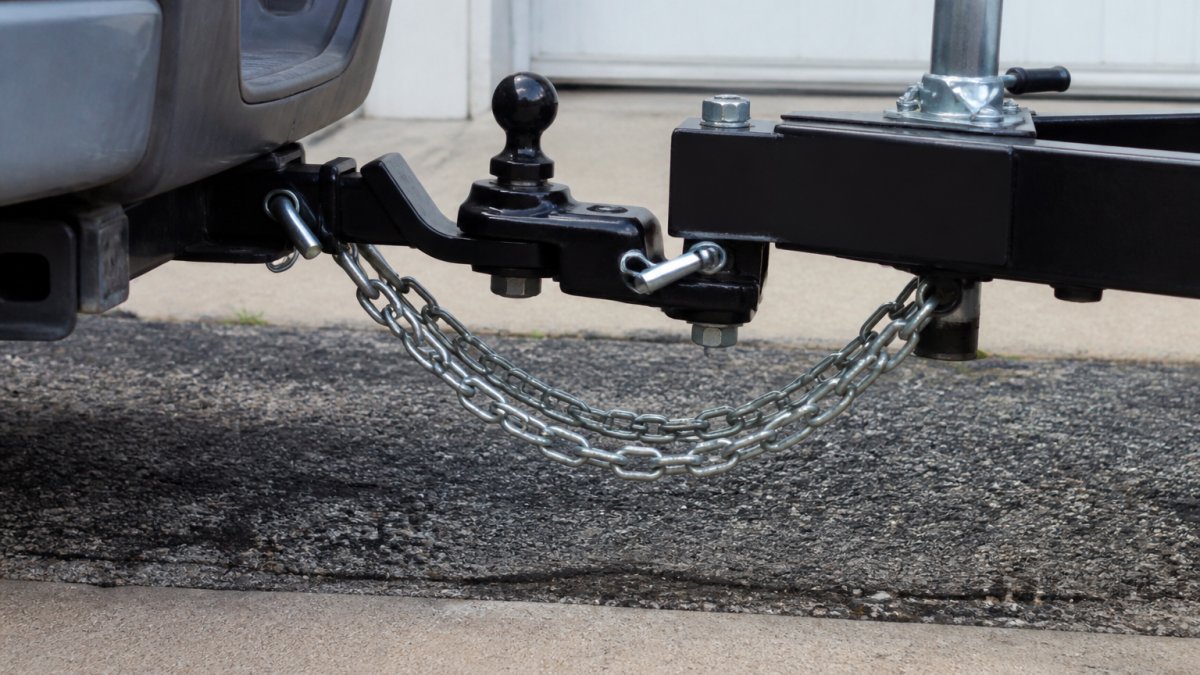
Crossing the chains beneath the trailer tongue forms a cradle that catches the tongue if it drops. The left chain hooks to the right side of the tow vehicle, and the right chain hooks to the left. They cross in an X under the coupler.
This matters because a crossed pair traps the tongue instead of letting it dive into the pavement. An uncrossed pair can let the tongue hit the road and dig in.
Common crossing mistakes:
- Chains crossed but left so long they drag
- Chains hooked to the same side, forming no cradle
- One chain crossed and one straight
- Hooks twisted so the chain binds on itself
Cross them every time, even on short trips.
Trailer Safety Chain Inspection: A Pre-Trip Routine That Catches Failures
Trailer safety chain inspection is a quick walk-around you do before every tow. It catches wear before it becomes a failure on the highway.
Check these points each time:
- Cracks or bends in any link
- Stretched or spread links that no longer sit flat
- Rust or corrosion that thins the metal
- Worn hooks with a latch that will not close
- Loose or missing attachment bolts
Replace any chain with a cracked, stretched, or badly rusted link. Do not patch a chain with wire or tape. Store chains coiled and off the ground so they do not rust between trips.
DOT Requirements, State Rules, and What Happens If a Trailer Separates
Federal rules require safety chains on most trailers, and states add their own details on strength, crossing, and attachment.
Rules vary by state and by trailer type, so confirm the specifics for your setup before a long haul. For the federal baseline, see the Federal Motor Carrier Safety Administration rules on trailer connections.
If a trailer separates from the coupler, the crossed chains catch the tongue and keep it off the road. Do not slam the brakes.
Our flexible terms fit project timelines that do not run on a fixed schedule.
Frequently Asked Questions
Should trailer safety chains be crossed?
Yes. Cross the chains in an X pattern beneath the trailer tongue so they cradle the coupler if it lifts off the hitch ball. Crossing also shortens the effective length slightly, which helps keep chains off the road. Attach the left chain to the right side of the tow vehicle and the right chain to the left side. Check that the chains do not bind or rub on the ball mount when you turn.
How long should trailer safety chains be?
Trailer safety chain length should let the chains support the tongue before it hits the ground while leaving enough slack to make tight turns without binding or dragging. A common target is a few inches of slack with the trailer level and straight. Test turning clearance in an empty lot at low speed, then shorten or adjust the hooks if a chain pulls tight or scrapes the road surface.
How do you determine the right safety chain rating?
Match the trailer safety chain rating to the loaded trailer weight and never use chains rated below it. Check the working load limit stamped on the chain and hooks, and confirm the combined rating of both chains meets or exceeds the trailer's gross weight. Replace chains with stretched links, spreading links, corrosion, or damaged hooks rather than repairing them, since a weakened chain will not hold in a separation.
What should you do if a trailer becomes disconnected while towing?
If the coupler separates from the hitch ball, the crossed chains should catch the tongue. Ease off the accelerator without braking hard, keep the wheel straight, and pull to the shoulder gradually so the trailer does not swing into traffic. Once stopped, set the parking brake, inspect the chains, coupler, and hook connection for damage, and do not resume towing until the attachment is repaired and rechecked.