 ultimate-guide
Renting Trailers for Race Cars: A 2026 Guide
Table of Contents
- Open vs. Enclosed Car Hauler Rental: Which Type Fits Your Needs
- Race Car Trailer Rental: Dimensions, Weight Capacity, and Specs
- Towing Vehicle Compatibility: Matching Your Truck to the Trailer
- How to Load a Race Car onto a Trailer Safely
- Towing Safety Tips for Race Car Haulers
- Legal and Insurance Requirements for Race Car Trailer Rentals
- What to Expect When Renting Trailers for Race Cars
- Frequently Asked Questions
Last Updated: September 1, 2026
Renting trailers for race cars isn't as straightforward as grabbing a utility trailer from a hardware store. Race vehicles sit low, weigh more than expected, and demand specific loading equipment, towing capacity, and tie-down configurations. Get any of those wrong and you're looking at a damaged car before reaching the track. This guide from 402 Car Hauler Rentals covers trailer types, weight ratings, towing compatibility, loading procedures, legal requirements, and what to watch for when you book.
Open vs. Enclosed Car Hauler Rental: Which Type Fits Your Needs
The first decision is choosing between an open car hauler and an enclosed trailer. That choice shapes cost, protection, loading height, and tow vehicle requirements.
Open Car Haulers: When They Make Sense
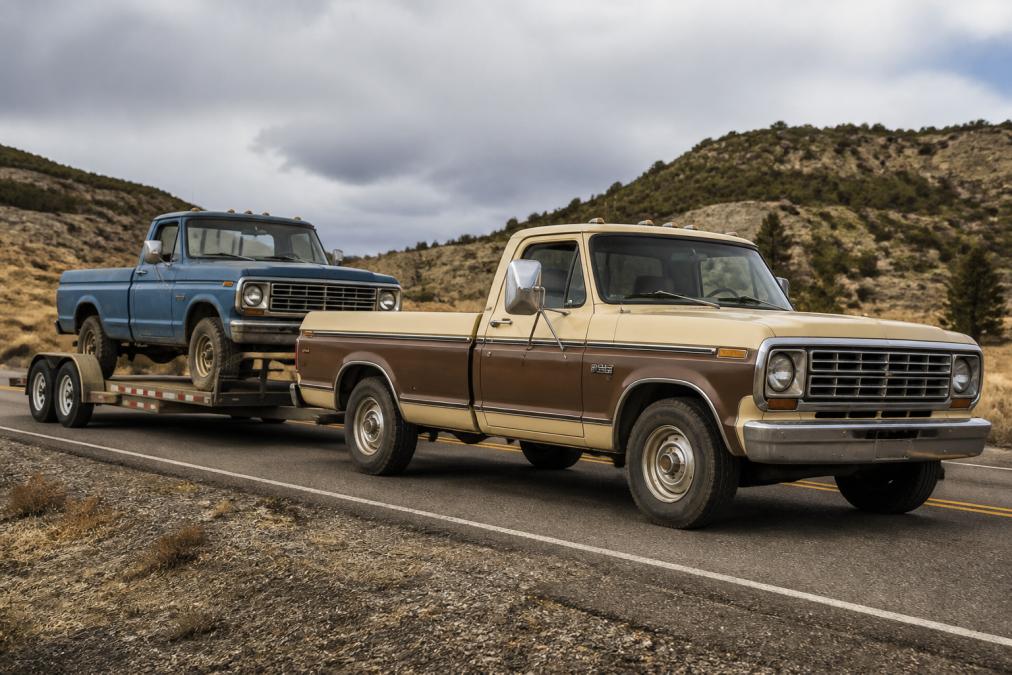
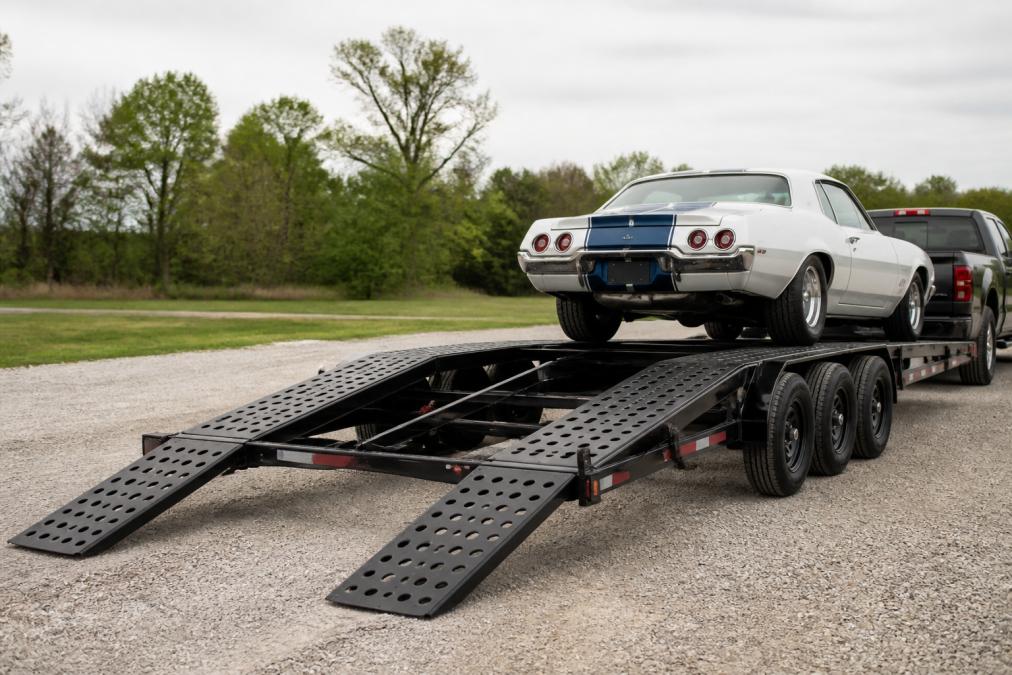
An open car hauler is a flatbed or two-level deck trailer with no walls or roof. For short regional hauls on dry days, open haulers are practical and lighter, reducing gross vehicle weight rating demands on your tow vehicle. However, exposed transport means road debris, weather, and fuel or brake fluid contamination, significant risk for show cars or vehicles with custom paint. Open haulers also offer no security if you're stopping overnight.
Enclosed Car Hauler Rental: Full Protection for Race Vehicles
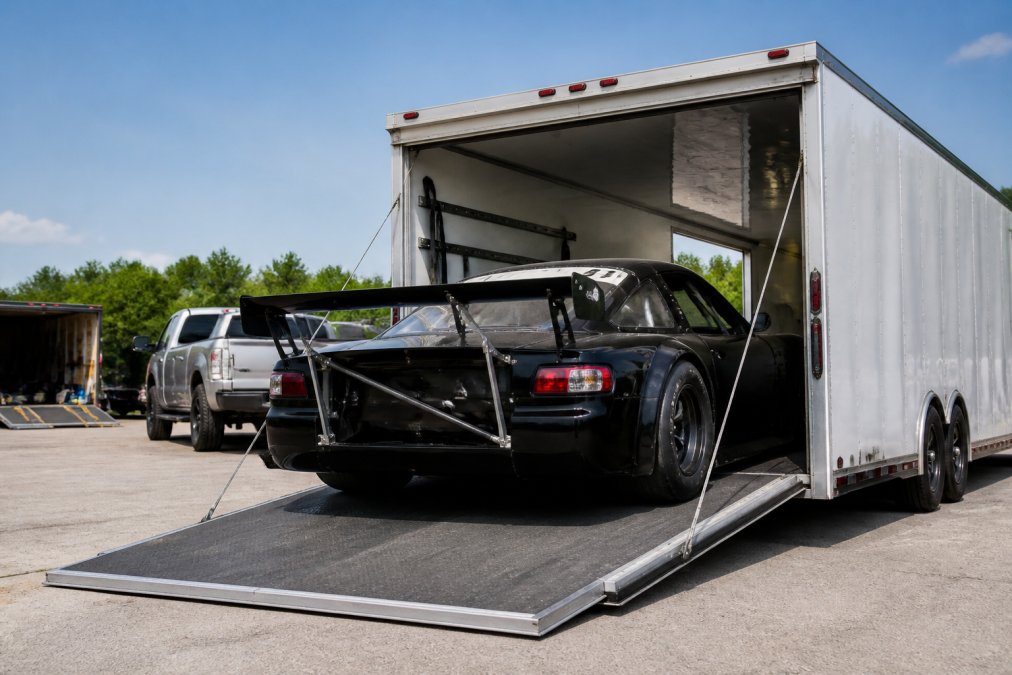
An enclosed car hauler is the standard choice for serious race car transport. The aluminum or steel enclosure protects from weather, road debris, and theft, with built-in d-rings for tie-down straps, interior lighting, and side or rear ramp doors. Enclosed trailers run heavier than open haulers, so your tow vehicle's towing capacity must account for both trailer weight and car payload. A loaded enclosed trailer with a race car can exceed 10,000 lbs combined, eliminating half-ton trucks without proper configuration. For race car logistics where the vehicle represents significant investment, the enclosed option justifies the rental rate difference.
Race Car Trailer Rental: Dimensions, Weight Capacity, and Specs
Understanding trailer specifications before booking prevents arriving with a car that won't fit or a tow vehicle that can't legally pull the load.
Gross Vehicle Weight Rating and Payload
Gross vehicle weight rating (GVWR) is the maximum total weight a trailer is designed to carry, including the trailer itself. Payload is what remains after subtracting the trailer's empty weight from the GVWR, the actual cargo capacity for your race car and equipment.
A typical enclosed car hauler in the 20-24 foot range carries a GVWR between 9,990 and 14,000 lbs, with usable payload commonly between 5,000 and 7,500 lbs after accounting for trailer weight. Most stock-bodied race cars and purpose-built track vehicles fit within that range, but modified cars with heavy roll cages, fuel cells, and ballast can approach the upper limit. Always confirm the trailer's GVWR and empty weight before booking, then weigh your race car. Overloading a trailer is a federal violation and creates serious towing instability at highway speeds.
Trailer Dimensions and Low-Clearance Considerations
Interior height is the specification that catches people off guard. Many enclosed car haulers have interior clearance between 6 feet and 6 feet 6 inches. A car with a roof-mounted light bar, tall wing, or raised air intake can exceed that clearance. Measure your vehicle's tallest point before assuming it fits.
Interior width typically runs 96 to 102 inches, with length options commonly ranging from 16 to 28 feet for single-car configurations. Race cars with long wheelbases or extended front splitters require confirmation of usable deck length. Low-clearance loading ramps are a separate concern, race cars with front splitters sitting 2-3 inches off the ground require ramps with shallow entry angles, and some trailers offer dovetail rear sections or adjustable ramp angles for this purpose.
Towing Vehicle Compatibility: Matching Your Truck to the Trailer
Matching your tow vehicle to the trailer is where many renters make costly assumptions. Not every truck that "looks big enough" is rated for the job.
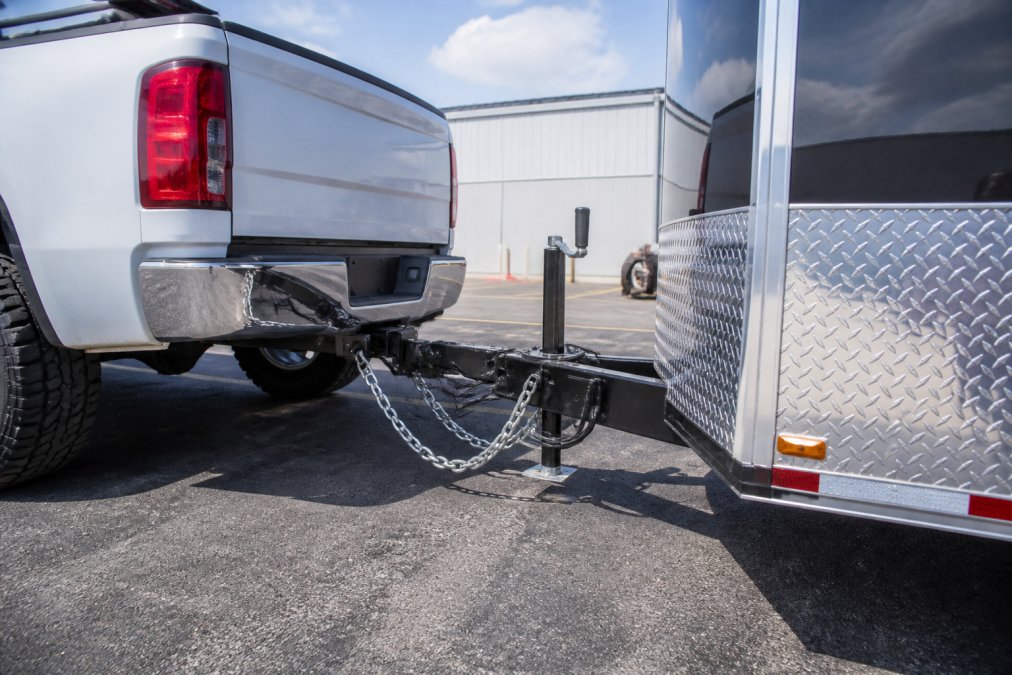
The three numbers that matter are towing capacity, payload capacity, and tongue weight rating. Towing capacity is the maximum weight your truck can pull. Payload capacity is how much weight the truck bed and cab can carry, including passengers and gear. Tongue weight, typically 10-15% of the trailer's total weight, is the downward force the trailer hitch places on the truck's rear axle.
A three-quarter-ton or one-ton truck is the practical minimum for most enclosed car hauler rentals loaded with a race vehicle. Many half-ton trucks are rated for 10,000-13,000 lbs towing capacity, but their payload ratings and tongue weight limits often fall short when factoring in a loaded enclosed trailer. Your truck's tow rating is listed on the door jamb sticker or in the owner's manual. If tongue weight exceeds your truck's hitch rating, you need a different tow vehicle or trailer configuration.
Electric brakes are another compatibility requirement. Most enclosed trailers over 7,000 lbs GVWR require a brake controller in the tow vehicle to activate the trailer's electric brakes. Without one, stopping distance increases dramatically and you may be operating illegally depending on your state.
How to Load a Race Car onto a Trailer Safely
Loading a race car is where damage most commonly occurs, and most is preventable with proper preparation and patience.
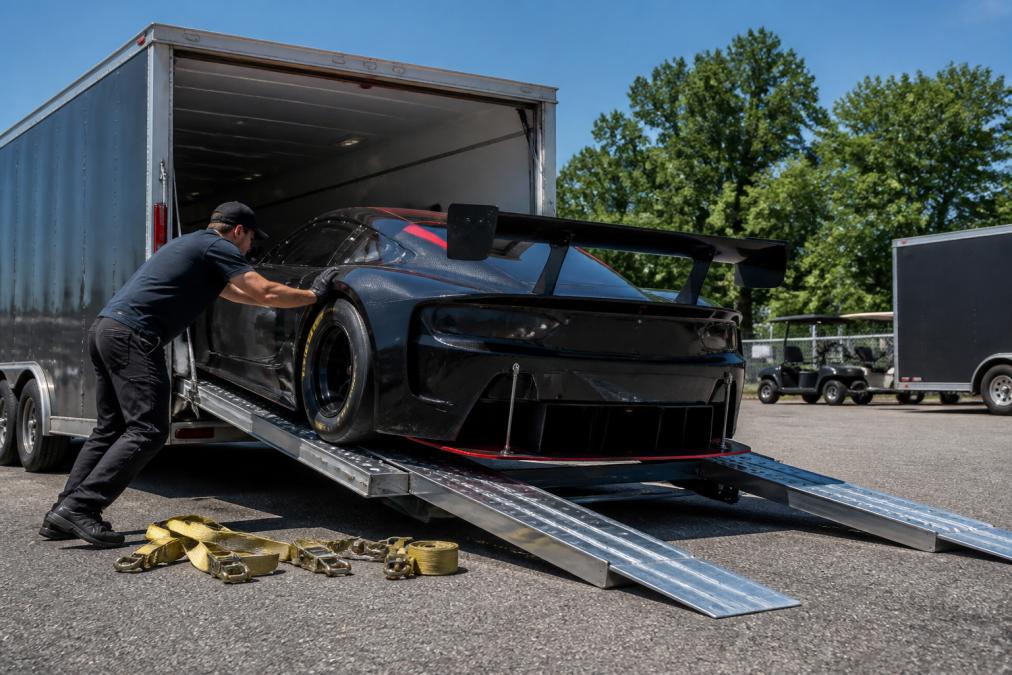
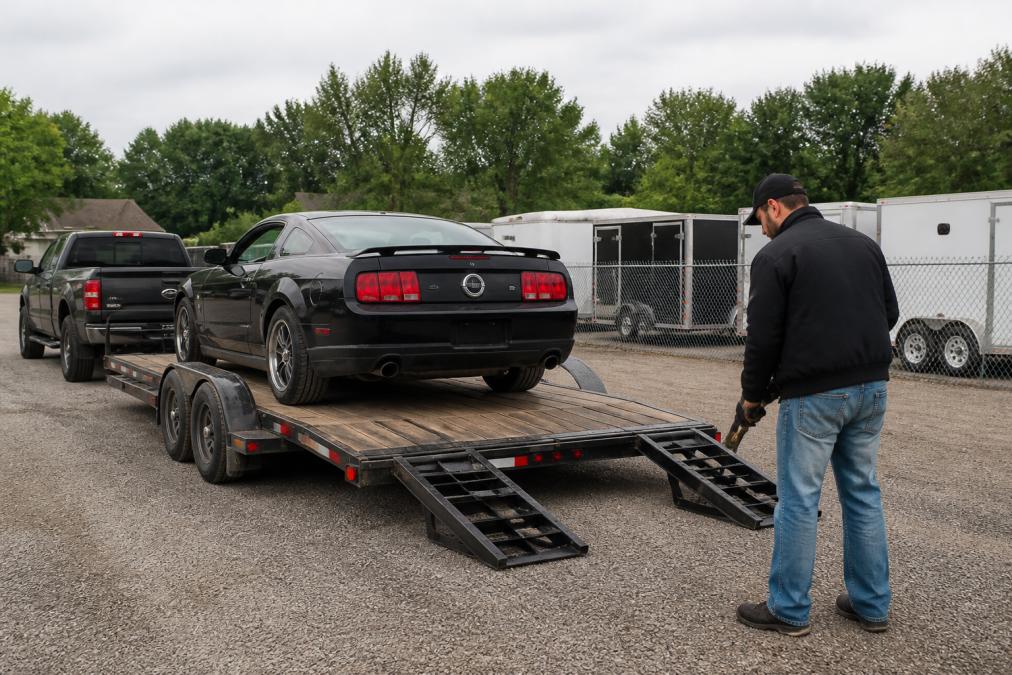
Position the trailer on level ground before loading. A trailer parked on a slope creates an uneven ramp angle that can bottom out a low-clearance vehicle. Chock the trailer wheels and confirm the coupler is locked to the hitch before anyone drives onto the deck. Walk the ramps before loading to check for bent sections, cracked welds, or anti-slip surfaces that have worn smooth.
Drive the car up slowly with a spotter guiding from outside. For cars with very low front ends, approach boards or foam ramp extensions can bridge the gap between ground and ramp entry angle. Once positioned, confirm the car is centered on the deck with weight distributed evenly side to side.
Tie-Down and Securing Techniques
Proper tie-down technique is non-negotiable for vehicle transport. Use four tie-down straps anchored to d-rings on the trailer floor, with straps running to the vehicle's designated tie-down points, typically the frame, subframe, or dedicated tow hooks. Never attach straps to suspension components, body panels, or exhaust systems.
Ratchet straps are the industry standard. Use straps rated for at least 3,333 lbs working load limit each, providing 13,332 lbs combined restraint capacity across four points. Tighten each strap until the vehicle's suspension compresses slightly, the car should be held firm, not bouncing freely on its springs.
Towing Safety Tips for Race Car Haulers
Towing a loaded car hauler requires different driving than running empty. Combined weight changes braking distance, cornering behavior, and how the rig responds to wind gusts from passing trucks.
Keep following distances at least double what you'd use without a trailer. A loaded enclosed trailer can add 50-100 feet to stopping distance at highway speeds, depending on road conditions and whether the trailer's electric brakes function correctly. According to Federal Motor Carrier Safety Administration towing safety guidance, brake failure and improper load securement are among the leading causes of trailer-related crashes.
Reduce speed in crosswinds. Enclosed trailers act as large sails, and gusts from passing semis can push a loaded rig significantly off line. Check mirrors every 30 seconds while moving and watch for trailer sway, which typically starts as gentle oscillation and can escalate quickly. If sway develops, ease off the throttle gradually, do not brake hard, which can amplify oscillation.
Pre-Trip Trailer Inspection Checklist
Run this checklist before every trip:
- Coupler locked and hitch ball pin secured
- Safety chains crossed under the tongue and connected
- Breakaway cable attached to tow vehicle
- Electric brake controller tested and responsive
- All trailer lights functional: brake, turn, running, reverse
- Tire pressure checked on all trailer tires, including spare
- Lug nuts torqued to spec on all trailer wheels
- Ramps secured in travel position
- All tie-down straps tight and not rubbing on sharp edges
- Doors latched and locked
- Load distribution confirmed (60% of payload forward of trailer axle)
A spare tire mounted on the trailer is often overlooked until you're on the highway. Confirm the trailer includes a spare and that it's properly inflated before departure.
Legal and Insurance Requirements for Race Car Trailer Rentals
Operating a trailer above certain weight thresholds triggers federal and state legal requirements that most drivers aren't aware of. Getting this wrong can mean fines, impoundment, or personal liability in an accident.
According to FMCSA commercial vehicle regulations, trailers with a GVWR over 10,000 lbs fall under specific federal safety regulations when used in interstate commerce. For private non-commercial transport, state rules govern and vary. Most states require trailers over a certain weight to have functioning electric brakes, safety chains, and proper lighting, all standard on quality rental trailers.
Most states do not require a special license to tow a trailer for personal use, provided combined vehicle weight stays under 26,001 lbs. The NHTSA vehicle safety and towing standards provides guidance on federal towing standards that apply regardless of state.
Insurance is where renters most commonly underestimate exposure. Your personal auto insurance may extend to a rented trailer, but coverage for the vehicle being transported is separate. Many personal auto policies exclude vehicles in transport. Confirm with your insurer before the rental date. For a vehicle representing significant value, adding a short-term inland marine policy specifically for the race car during transport is worth the cost.
What to Expect When Renting Trailers for Race Cars
The rental process for a car hauler is more involved than renting a moving van, and understanding what to expect prevents last-minute surprises.
Booking lead time matters more than most realize. Enclosed car hauler rentals are in high demand around major race weekends and car show dates. Booking two to three weeks in advance is reasonable; for peak season weekends, earlier is better. At 402 Car Hauler Rentals, flexible booking terms accommodate projects with shifting timelines.
At pickup, expect a walk-around inspection with the rental provider. Document any existing damage with photos before taking possession. This protects you from being held responsible for pre-existing issues on return.
Rental rates for car hauler trailers vary based on trailer type, size, and rental duration. Contact 402 Car Hauler Rentals directly for current rates, the website lists available options, and the team can match you to the right trailer for your vehicle and tow setup. A reputable rental provider will itemize all charges upfront: the base daily or weekly rate, any deposit, mileage considerations if applicable, and the late return policy.
| Consideration | What to Confirm Before Booking |
|---|---|
| Trailer type | Enclosed vs. open; interior height and length |
| GVWR and payload | Confirm against your race car's weight |
| Tow vehicle compatibility | Towing capacity, tongue weight, brake controller |
| Rental duration | Daily vs. weekly rate; flexibility for schedule changes |
| Insurance coverage | Personal auto policy extension; cargo coverage |
| Inspection process | Walk-around documentation; existing damage policy |
| Legal requirements | State brake and lighting requirements; license class |
The condition of the trailer matters as much as the price. Worn tie-down straps, bent ramp sections, and underinflated tires are signs of poor maintenance. Before committing to any rental, ask how recently the trailer was inspected and whether straps and ramps are rated for your vehicle's weight. A well-maintained trailer from a provider who knows car hauling is worth more than the cheapest option available.
For more guidance on safe vehicle transport practices, the National Highway Traffic Safety Administration vehicle safety resources covers federal standards for trailer equipment and towing safety.
Transporting a race car safely comes down to matching the right trailer to your vehicle, confirming your tow setup is rated for the load, and securing the car correctly before moving. Those three things eliminate the majority of transport incidents. 402 Car Hauler Rentals offers reliable enclosed and open trailer options with flexible rental terms and competitive rates, specifically designed for race car and specialty vehicle transport. Reach out to the team to confirm availability, discuss your vehicle's specifications, and get a clear quote before your next event.
Frequently Asked Questions
Is an enclosed or open trailer better for transporting race cars?
Enclosed trailers are the stronger choice for most race vehicles. They protect against road debris, weather, and theft during transit, which matters for high-value builds. Open car haulers cost less and work fine for short hauls or vehicles that aren't show-ready, but any race car with a custom paint job, aerodynamic bodywork, or exposed components is better off inside an enclosed unit. The added protection usually justifies the difference in rental rate.
How do I determine the correct weight capacity for my race car trailer rental?
Start with your race car's curb weight, then add fuel, tools, and any gear you're hauling. That total must fall below the trailer's payload rating. The trailer's gross vehicle weight rating (GVWR) minus its own empty weight gives you the usable payload. Always leave a buffer of at least 10% below the rated limit. Your tow vehicle's towing capacity must also exceed the fully loaded trailer weight, including the trailer itself.
What towing equipment is necessary when renting a trailer for a race car?
At minimum, you need a properly rated trailer hitch, a matching ball size, safety chains, and working trailer lights. For heavier enclosed trailers, electric brakes on the trailer are standard, which means your tow vehicle needs a brake controller installed. A weight-distribution hitch is worth adding if the loaded trailer pushes your tow vehicle's rear axle rating. Confirm all connections before every trip, not just the first one.
Are there specific tie-down requirements for race vehicles?
Race cars typically sit lower than street vehicles and often lack standard tow hooks, so axle straps or soft loops are the right approach rather than hooking directly to bodywork. Use at least four tie-down straps rated for the vehicle's weight, attached to d-rings on the trailer floor. Each strap should be tightened until the suspension compresses slightly, removing any bounce. Check tension after the first 15 to 20 minutes of driving, as straps can loosen once the load settles.