 ultimate-guide
How to Choose a Car Hauler: 2026 Buyer's Guide
Table of Contents
- Open vs Enclosed Car Trailer: Which One Fits Your Haul?
- Matching Trailer Size and Weight Capacity to Your Vehicle
- Car Hauler Rental Requirements You Need to Meet
- How to Safely Load a Car on a Trailer
- Insurance, Liability, and DOT Compliance for Car Haulers
- What First-Time Buyers Get Wrong (and What to Ignore)
- Conclusion: Picking the Right Car Hauler for Your Next Haul
- Frequently Asked Questions
Last Updated: September 22, 2026
Open vs Enclosed Car Trailer: Which One Fits Your Haul?
Choosing between an open and enclosed car trailer is the first real decision in learning how to choose a car hauler: protection versus cost and weight. An open car trailer is a flat-deck platform that carries a vehicle exposed to the elements; an enclosed car trailer adds walls, a roof, and a rear ramp door that shield the load.
When an Open Trailer Makes Sense
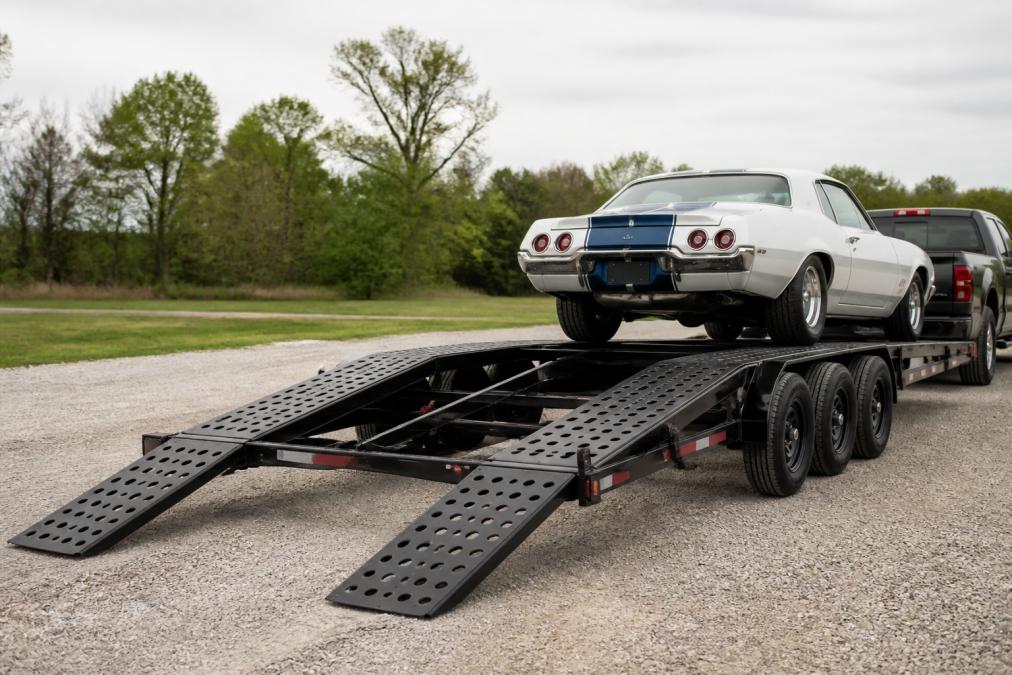
Open trailers win on weight, price, and simplicity. With no box structure, an open car hauler weighs less, so a smaller tow vehicle can handle it and fuel costs stay lower. Loading is straightforward: drive up the ramps, position the car, and strap it down.
When to Pay More for an Enclosed Trailer
Enclosed car trailers protect the load completely and double as secure storage between events, carrying tools, spares, and a winch inside the box rather than on an open deck.
| Factor | Open Trailer | Enclosed Trailer |
|---|---|---|
| Load protection | Exposed to weather and debris | Fully shielded |
| Weight | Lighter, easier to tow | Heavier, needs more tow vehicle |
| Cost | Lower | Higher |
| Best for | Track cars, projects, occasional hauls | Classics, show cars, frequent towing |
Matching Trailer Size and Weight Capacity to Your Vehicle
Matching trailer capacity to your tow vehicle is where most buyers get it wrong, and it starts with reading three numbers correctly. Get these wrong and you either overload your truck or buy a trailer you cannot safely pull.
Reading GVWR, Payload Capacity, and Curb Weight
GVWR (Gross Vehicle Weight Rating) is the maximum total weight the trailer is designed to carry, including its own weight plus the cargo. Payload capacity is what remains for the car after you subtract the trailer's own weight from the GVWR. Curb weight is the empty weight of the vehicle you are hauling.
Axle Ratings, Suspension, and Deck Height
A single-axle trailer suits lighter cars, but a dual or tandem axle setup carries weight more evenly and tracks straighter at highway speed. Leaf springs are durable; torsion axles sit lower and tow flatter.
Car Hauler Rental Requirements You Need to Meet
Renting a car hauler means meeting the rental company's requirements before you drive off the lot, and the rules cover your tow vehicle and paperwork, not just the trailer. Counters are strict because a mismatched setup leaves the rental company sharing liability for an unsafe combination.
Towing Vehicle, Hitch, and Brake Controller Checks
Your tow vehicle must be rated for the loaded trailer weight, not the empty trailer. Run the math before you book:
- Start with the trailer's GVWR, not its empty weight. A tandem-axle open trailer commonly carries a GVWR around 7,000 lb, and an enclosed trailer can run 10,000 lb or more.
- Subtract the trailer's own weight to find payload, then confirm your car plus fuel, tools, and spares fits under that number.
- Compare the loaded total to your vehicle's tow rating, printed in the owner's manual and on the driver's door jamb sticker. The door jamb figure reflects your specific truck's configuration, not the model line's marketing number.
- Check the hitch class. A Class III receiver (2-inch) handles most open car hauler rentals; a Class IV (2-inch, heavier rating) is often required for loaded enclosed trailers. A 1-1/4-inch Class II receiver will not accept most car hauler couplers at all.
- Confirm the ball size. Car haulers typically use a 2-inch or 2-5/16-inch coupler. Showing up with the wrong ball is the single most common reason renters are sent home.
Before any rental, verify:
- Your vehicle's towing capacity exceeds the loaded trailer weight, with margin
- The hitch and receiver size match the trailer coupler, and the ball is torqued to spec
- A working brake controller is installed and tested if the trailer has electric brakes
- Safety chains cross under the coupler in an X pattern, not straight
- A breakaway kit with a charged battery is present and the lanyard is connected
- Running lights, brake lights, and turn signals all function on the trailer
Rental Paperwork, Deposits, and Return Conditions
Rental companies also screen the driver and paperwork, and terms vary enough that it pays to ask before you reserve.
- Driver's license and age minimums. Most rental locations require a valid license and set a minimum age, often 25 for towing equipment. Some accept 21 with a surcharge.
- Proof of insurance. You will typically need to show that your auto policy extends to a rented trailer, or purchase the rental company's damage waiver. Confirm which before you arrive.
- Security deposit. A credit card hold is standard, and the amount scales with the trailer's value. Debit cards are sometimes refused for towing rentals.
- Mileage and return rules. Some rentals include unlimited miles; others cap daily mileage and charge per mile over. Trailers usually must be returned clean and empty, and debris left on the deck can trigger a cleaning fee.
- One-way vs. round-trip. One-way rentals are available in some markets but carry a higher rate and a drop fee. If you are relocating a car, price both options.
Federal Motor Carrier Safety Administration guidance on trailer safety
How to Safely Load a Car on a Trailer
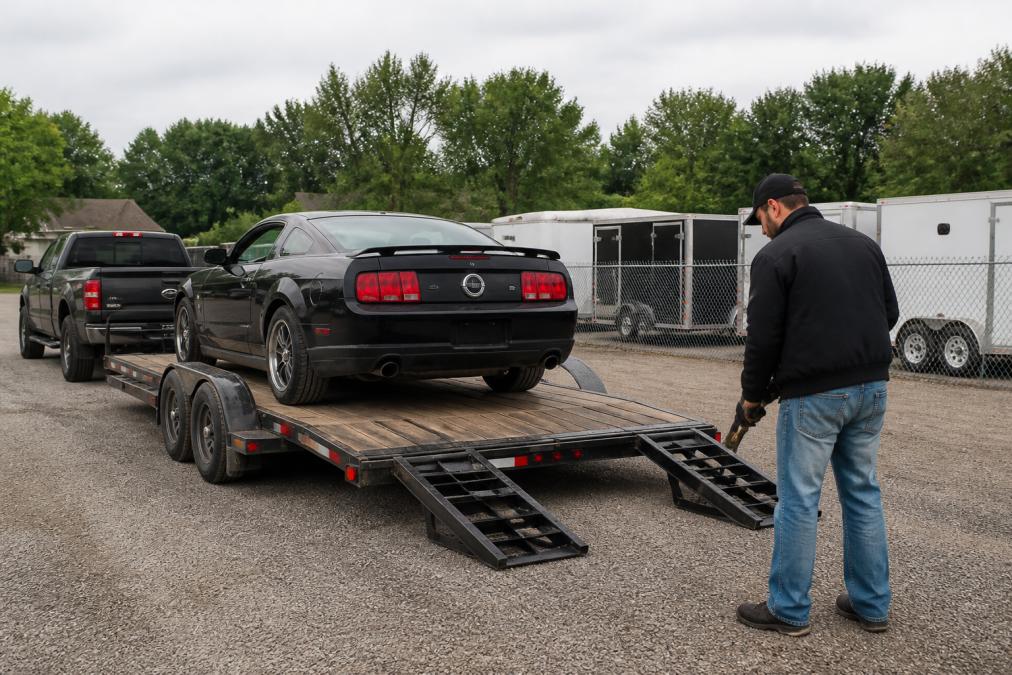
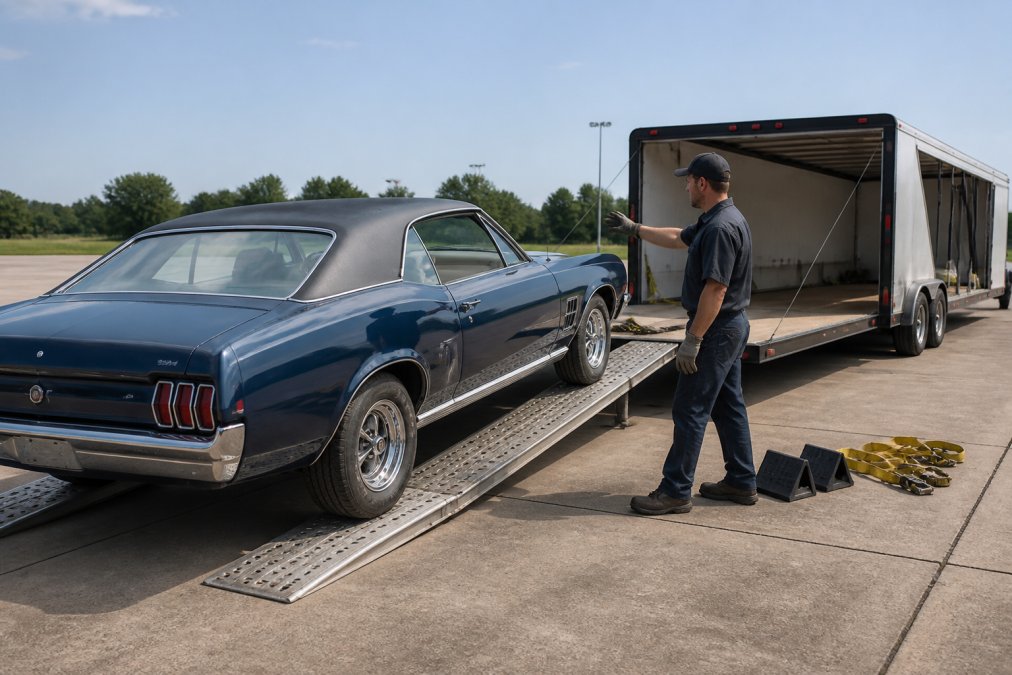
Safe loading follows a fixed sequence every time, and skipping a step is how cars slide off decks. The goal: center the weight, lock the wheels, and secure the vehicle at four points.
Tie-Down Points, D-Rings, and the 60/40 Rule
Use four tie-down points minimum, attached to D-rings or dedicated frame anchor points, never to sheet metal or suspension parts that can bend. Cross the straps front to rear for stability.
Insurance, Liability, and DOT Compliance for Car Haulers
Insurance and liability are the topics most car hauler guides skip, and they cost the most when something goes wrong. The core problem: coverage does not automatically follow the trailer. Your personal auto policy is written around the vehicle you drive, and a trailer is treated differently depending on whether it is attached, what it carries, and whether you are paid to haul.
How Coverage Actually Attaches
Liability generally follows the tow vehicle while the trailer is connected. If you rear-end someone with a loaded car hauler in tow, your auto liability responds first. The complications start with the trailer and the cargo.
- Physical damage to the trailer. Your auto policy may not cover a trailer you do not own, and it may cap coverage on one you do. Rental companies often require you to buy their damage waiver or show that your policy extends to the rented unit.
- Damage to the car being hauled. This is the gap most owners miss. Your auto policy on the tow vehicle typically does not cover the cargo. The hauled car's own policy may respond only if it carries comprehensive coverage and the loss fits the policy terms. A dedicated trailer or cargo policy closes this gap.
- Liability for the load. If a strap fails, a wheel comes loose, or the car shifts and strikes another vehicle, you may be responsible for the load. Proper tie-downs and a working breakaway system are not just safety equipment, they are your defense in a claim.
- Business use. If you haul cars for hire, for a dealership, or as part of a business, a personal auto policy will likely exclude the loss. Commercial auto or a commercial trailer policy is the correct coverage.
When DOT Rules Apply
DOT compliance applies mainly to commercial operations, but the line between personal and commercial is easier to cross than most owners realize. The Federal Motor Carrier Safety Administration sets the framework, and states enforce registration, lighting, and equipment standards on top of it.
- Personal, non-commercial hauling. If you are moving your own car and not being compensated, you generally fall outside federal motor carrier rules. State registration and equipment requirements still apply.
- Commercial hauling. If you transport vehicles for compensation, cross state lines in furtherance of a business, or operate a vehicle above certain weight thresholds, federal rules on driver qualification, hours of service, and vehicle marking can apply. The thresholds are weight- and commerce-based, not just size-based.
- Equipment standards that apply to everyone. Trailer lighting, reflective tape, safety chains, and breakaway systems are enforced regardless of whether the haul is commercial. A missing taillight or a cracked safety chain is a stop-and-fix violation.
What First-Time Buyers Get Wrong (and What to Ignore)
Ignore pressure to buy the biggest trailer on the lot. Match capacity to your real hauling needs and leave a safety margin. A well-matched mid-size trailer you can tow confidently beats an oversized one you cannot.
Conclusion: Picking the Right Car Hauler for Your Next Haul
The hardest part of choosing a car hauler is resisting the urge to buy on size and price alone. Get the weight math right, confirm your tow vehicle and brake setup, and match the trailer to how you actually haul.
Frequently Asked Questions
What is the 60/40 rule on trailers?
The 60/40 rule means placing about 60% of the cargo weight in front of the trailer's axles and 40% behind them. This keeps enough tongue weight on the hitch to prevent sway at highway speeds. For a car hauler, that usually means pulling the vehicle forward until its engine sits over or slightly ahead of the axles, then confirming tongue weight falls in the recommended 10-15% of total trailer weight range.
What is the best length for a car hauler trailer?
Most full-size cars, trucks, and SUVs fit on a 16- to 20-foot deck. Compact cars and project vehicles often work on an 18-foot trailer, while extended-cab trucks and long-wheelbase classics may need 20 feet or more. Measure your vehicle's overall length, add 12-18 inches for strap clearance and positioning, then match that figure to the deck length. A beaver tail or tilt bed can help if ground clearance is tight.
What safety equipment is essential for car hauling?
At minimum you need four rated tie-down straps or chains, D-rings or dedicated tie-down points, safety chains, a breakaway kit with battery, and working trailer lights. Electric brakes with a brake controller are required on most trailers rated above 3,000 pounds GVWR. Carry wheel chocks, a spare tire, and a lug wrench. Check straps for fraying before every trip, since worn webbing is one of the most common causes of load shift on the road.
How much weight can my vehicle safely tow?
Check your owner's manual for the tow rating, then subtract the weight of passengers, cargo, and the trailer itself from the gross combined weight rating (GCWR). A half-ton pickup typically tows 7,000-12,000 pounds when properly equipped, but that figure drops with tongue weight, payload, and axle ratio. Never exceed the lower of the tow rating or GCWR, and confirm your hitch receiver class matches the loaded trailer weight.
What are common car hauler problems?
The most frequent issues are tire blowouts from underinflation or age, brake controller failures, loose or frayed tie-down straps, and trailer sway caused by improper tongue weight. Wiring problems that kill lights or brakes are also common, especially on rental units that see heavy use. Inspect tires, lights, brakes, and straps before every haul, and report any damage to the rental provider immediately so it is documented before you leave the lot.
What is the difference between open and enclosed car haulers?
Open car haulers cost less, weigh less, and are easier to load, making them ideal for short trips and vehicles that can handle weather exposure. Enclosed trailers protect the vehicle from rain, road debris, and theft, and they hold value better for show cars or restorations. Enclosed units also weigh more and need a stronger towing vehicle, so match the trailer type to your car's condition and your route.
Do I need insurance to rent a car hauler?
Most rental providers require proof of auto insurance that extends to towed trailers, and some offer supplemental coverage for an added fee. Your personal auto policy may cover liability while towing, but it often excludes damage to the rented trailer itself. Ask the rental company what their policy covers, what your policy needs to include, and whether a damage waiver is available before you sign.
What are the most common car hauler maintenance issues?
Tire dry rot, bearing failure, and brake wear top the list. Trailer tires age out in five to seven years even with low mileage, and bearings need repacking or replacement based on mileage and water exposure. Brake shoes and drums wear faster on trailers that sit outside. If you are renting, ask when the trailer was last serviced and check tire dates and bearing play yourself before towing.