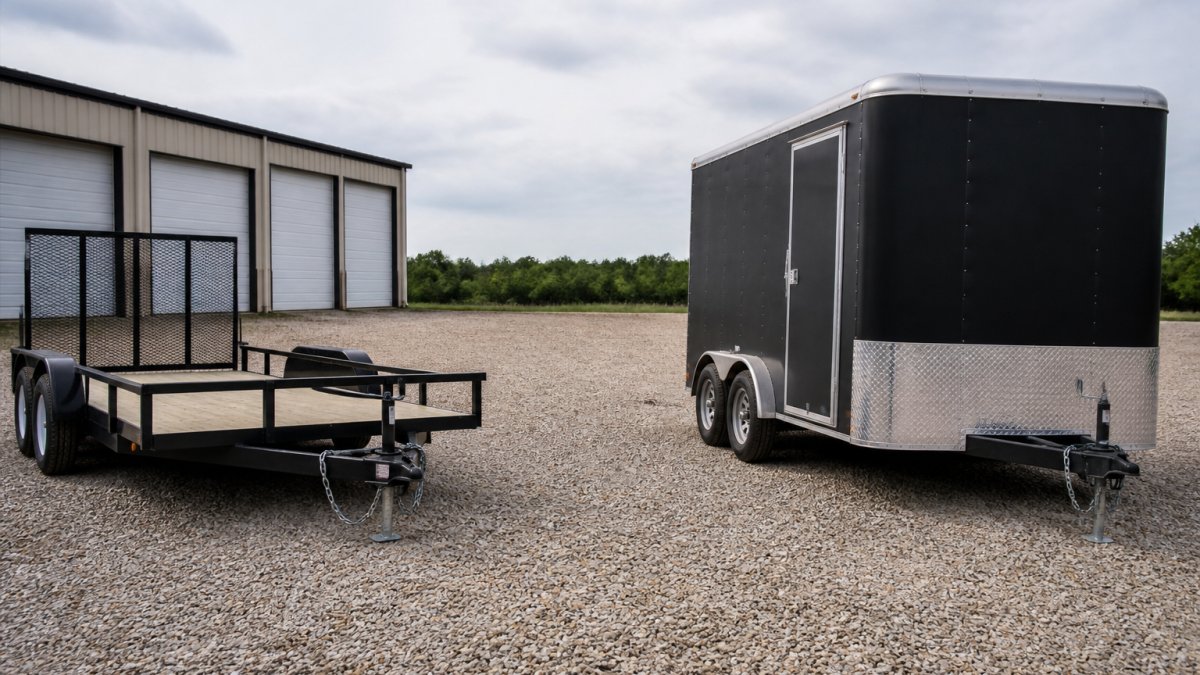
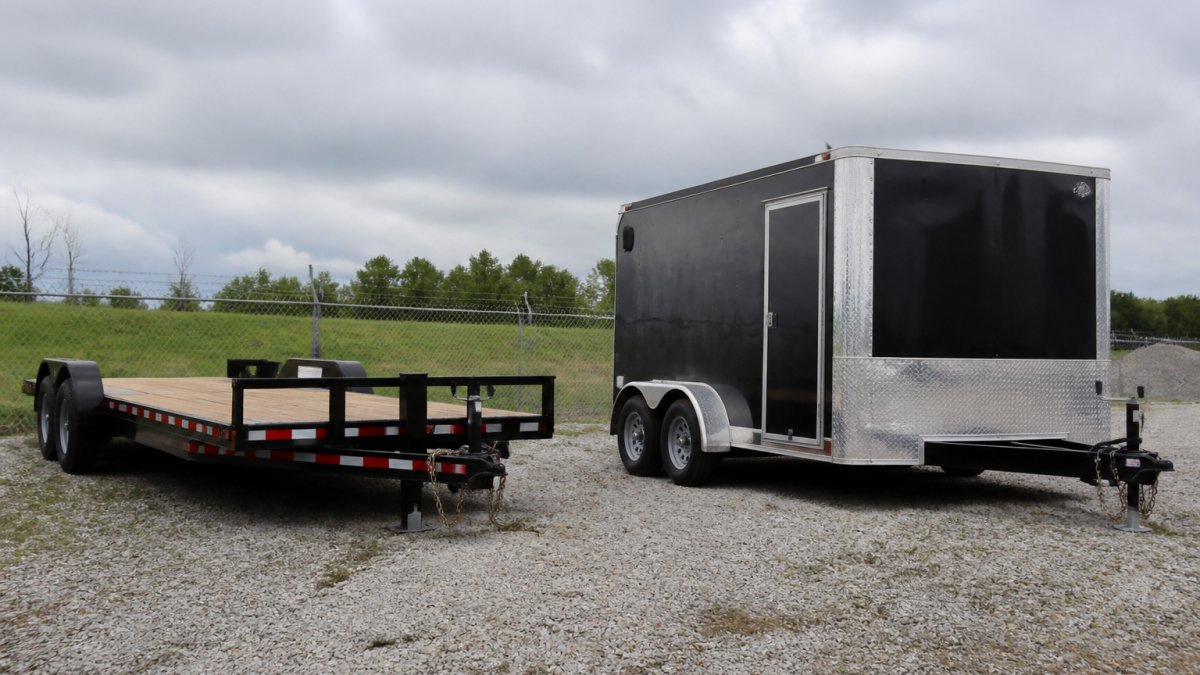
 comparison
Car Hauler Rental Without a CDL: What You Need to Know
Table of Contents
- Car Hauler Rental Without a CDL: What the Law Actually Says
- Non-CDL Towing Weight Limits: The 26,000 lb GCWR Rule
- How to Rent a Car Trailer for Personal Use
- Insurance and Liability When You Rent Without a CDL
- 402 Car Hauler Rentals Availability and Booking
- Vehicle Compatibility Checklist Before You Tow
- Conclusion
- Frequently Asked Questions
Last Updated: October 4, 2026
Car Hauler Rental Without a CDL: What the Law Actually Says
You can rent and tow a car hauler without a CDL as long as your combined truck-and-trailer weight stays under 26,000 pounds and you are not hauling for business.
Here is the part most guides skip: the 26,000-pound threshold is about your Gross Combined Weight Rating, not what the trailer actually weighs when loaded.
The Federal Motor Carrier Safety Administration's commercial vehicle definitions set the federal floor here. State rules can add requirements on top.
Non-CDL Towing Weight Limits: The 26,000 lb GCWR Rule
Gross Combined Weight Rating (GCWR) is the maximum allowable weight of your tow vehicle plus the loaded trailer, as set by the manufacturer. Stay under 26,000 pounds and you generally avoid CDL requirements for personal towing.
Three numbers decide whether you are legal:
- GVWR (Gross Vehicle Weight Rating): your truck's maximum loaded weight
- Trailer GVWR: the trailer's maximum loaded weight
- GCWR: the ceiling for both combined
Add your truck's GVWR to the trailer's GVWR. If the total is 26,000 pounds or less, you are in non-CDL territory for personal use.
How to Find Your Truck's GCWR
Check the driver's side door jamb sticker first. It lists GVWR and, on most modern trucks, the GCWR and tow rating. If the sticker is worn or missing, the owner's manual has a towing chart by cab, bed, axle ratio, and drivetrain.
Then verify the trailer's GVWR on its own data plate, usually on the tongue or the front frame rail. Write both numbers down before you book anything.
How to Rent a Car Trailer for Personal Use
Renting a car trailer for personal use comes down to four steps: confirm your weights, reserve the trailer, inspect it at pickup, and secure the load correctly.
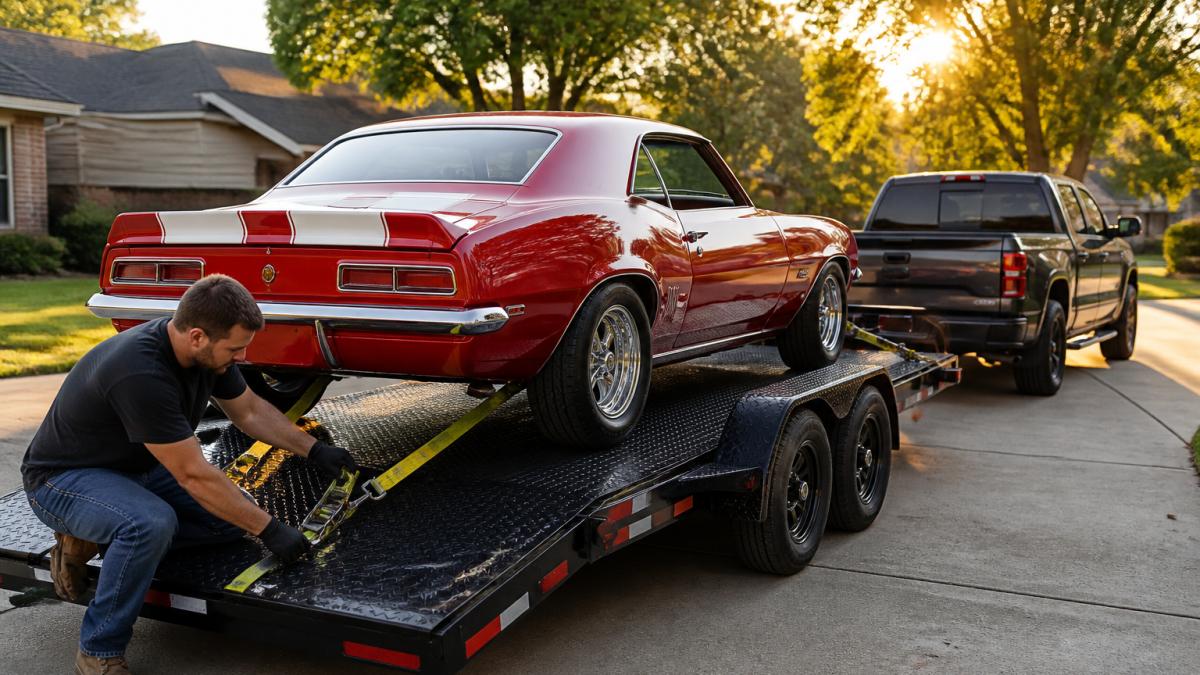
- Confirm your GCWR. Add truck GVWR and trailer GVWR. Under 26,000 pounds keeps you non-CDL.
- Match the hitch class. Most car haulers need a Class III or Class IV receiver and a brake controller for electric or surge brakes.
- Book with a real reservation. Ask whether your dates are held with a deposit or a signed agreement.
- Inspect before you tow. Check tire tread and pressure, strap condition, ramp hardware, and lights.
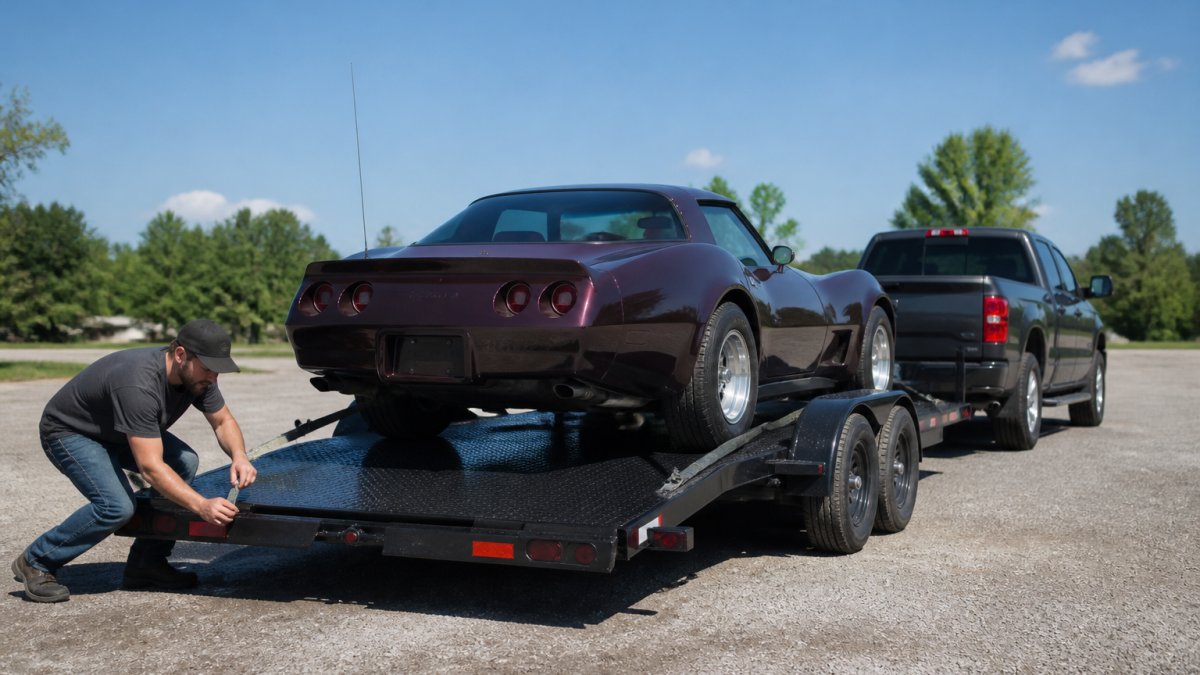
- Secure the vehicle by the tires. Straps go over the wheels, not through suspension or frame points.
We walk every customer through the weight math and the tie-down points before the trailer leaves the lot.
Insurance and Liability When You Rent Without a CDL
Insurance is where a non-CDL car hauler rental gets genuinely complicated, and it is the part most guides wave at instead of explaining. The reason is structural: your personal auto policy, the rental company's policy, and the trailer's own registration each cover different things, and none of them covers everything.
Start with the three buckets of risk you are actually carrying:
- Liability for damage you cause to others while towing (another vehicle, a guardrail, property).
- Physical damage to the rented trailer itself (jackknife, blown tire tearing a fender, ramp damage).
- Damage to the vehicle you are hauling, which is usually covered by that vehicle's own policy, not the trailer rental.
How a personal auto policy usually treats a rented trailer
Most personal auto policies extend liability coverage to a trailer you are towing with a covered vehicle, because the trailer is treated as part of the towed unit rather than a separate vehicle. That is the good news.
Physical damage to the trailer is a separate question. Your auto policy's collision and comprehensive sections may or may not extend to a non-owned trailer, and many policies cap that coverage or exclude trailers entirely.
The commercial-versus-personal line, in practice
There is no single federal test for whether a given trip is commercial, but the pattern regulators and insurers look at includes:
- Whether you are being paid to move the vehicle (a flat fee, a per-mile rate, or a customer invoice).
- Whether the vehicle belongs to a business you operate.
- Whether the trip is part of a for-profit activity (dealer inventory, auction flipping, business fleet moves).
- Whether you advertise hauling services.
If any of those is true, treat the trip as commercial for insurance purposes even if it stays under 26,000 lb GCWR. The CDL exemption and the insurance coverage question are separate tests, and passing one does not pass the other.
Questions to put to your insurer in writing
Before you book, get written answers, email is fine, a phone call is not, to these:
- Does my policy extend liability coverage to a rented car hauler trailer towed by my covered vehicle?
- Does my policy extend collision and comprehensive coverage to a non-owned trailer, and if so, what is the deductible?
- Does my policy exclude coverage when the towed vehicle belongs to someone else or is being moved for compensation?
- If I decline the rental company's damage waiver, what is my out-of-pocket exposure if the trailer is damaged?
What the rental agreement actually controls
The rental contract governs the trailer itself: damage, loss, late return, tire damage, and cleaning. Read three clauses before you sign, the damage responsibility clause, the prohibited-use clause (which often bans commercial hauling outright), and the insurance/wavier election. If the prohibited-use clause bans commercial hauling and your trip is commercial, you may have voided your coverage before you left the lot.
402 Car Hauler Rentals Availability and Booking
Availability is the question we hear most, and the honest answer is that weekends fill first. Race weekends and car show season tighten the calendar further.
We hold reservations with a confirmed booking rather than a verbal promise, so your trailer is set aside for your dates. If your restoration timeline shifts, call us and we will work with the schedule.
We also maintain our trailers between every rental: straps inspected, tires checked, ramps and lights tested.
Vehicle Compatibility Checklist Before You Tow
A car hauler rental only works if your truck can actually pull it. This section is the step-by-step version of that check, where to find each number, how to compute it, and what disqualifies the combination.
Step 1: Pull the four ratings off your truck
Open the driver's side door and photograph the Safety Compliance Certification Label on the door jamb. It lists:
- GVWR, the maximum your truck can weigh, fully loaded, including passengers and cargo.
- GAWR front and rear, the maximum on each axle.
- GCWR, the maximum combined weight of truck plus loaded trailer. This is the number the 26,000 lb rule is measured against.
If the sticker is missing or unreadable, the owner's manual has a towing chart broken out by cab, bed length, axle ratio, and drivetrain. Two trucks that look identical can have different GCWRs based on the rear axle ratio alone, so match all four variables before you trust a number.
Step 2: Pull the trailer's GVWR
The trailer has its own data plate, usually on the tongue or the front frame rail. It lists the trailer's GVWR, the maximum the trailer itself can weigh loaded. Write it down. Do not use the trailer's empty weight; the regulation and the safe-towing math both run on the rated maximum.
Step 3: Run the GCWR math
Add your truck's GVWR to the trailer's GVWR. If the total is 26,000 lb or less, you are in non-CDL territory for personal use. If it is over, you are operating a commercial motor vehicle under federal definitions regardless of what you are hauling.
A second, tighter check: your truck's GCWR must be greater than or equal to the combined actual weight of truck plus loaded trailer.
Step 4: Match the hitch and brake hardware
| Check | What to Verify | Why It Matters |
|---|---|---|
| GCWR | Truck GVWR + trailer GVWR under 26,000 lb | Keeps you non-CDL legal |
| Truck GCWR | Truck GCWR ≥ actual truck + loaded trailer weight | Prevents overloading the tow vehicle |
| Hitch class | Class III (up to 8,000 lb) or Class IV (up to 10,000 lb) receiver, correct ball size | Undersized hitches fail under load |
| Weight-distributing hitch | Required by most manufacturers above 5,000 lb trailer weight | Transfers tongue weight to the front axle |
| Brake controller | Installed and tested if the trailer has electric brakes | Stopping distance on grades |
| Tongue weight | 10-15% of loaded trailer weight | Prevents sway at highway speed |
| Tire condition | Tread depth and cold pressure on truck and trailer | Blowouts are the top roadside failure |
| Load securement | Four-point tire straps, no frame or suspension tie-downs | Keeps the vehicle planted |
| Lights | Running, brake, and turn signals on the trailer | Required in every state |
Step 5: Compute tongue weight
Tongue weight is the downward force the loaded trailer puts on the hitch ball. The working target is 10-15% of the loaded trailer weight for a bumper-pull car hauler.
You do not need a commercial scale to get close. A bathroom scale and a lever arm works for a rough check, or a tongue-weight scale if the rental yard has one.
Step 6: Confirm the route
Towing rules are not identical everywhere. Your home-state license and registration generally travel with you under reciprocity, but weight thresholds, brake requirements, and equipment rules can differ once you cross a state line. If your route crosses multiple states, confirm the strictest rule on the path and build your setup around that, not around your home state's rule.
Conclusion
The 26,000-pound GCWR line, a matched hitch, and honest insurance answers are the whole game when you tow without a CDL. Get those three right and the rest is logistics.
If you are moving a project car, a race vehicle, or a customer's vehicle in the Omaha area, 402 car hauler rentals offers dependable trailers, flexible booking terms, and competitive rates.
Get started with 402 car hauler rentals and haul your vehicle with confidence.
Frequently Asked Questions
Do you need a CDL to haul a car trailer for personal use?
No. A commercial driver license is only required when the combined weight of your truck and loaded trailer reaches 26,001 lbs or more, or when the vehicle is used in interstate commerce. Personal car hauler rental stays under that threshold with a standard pickup and single-car trailer, so a regular driver's license is enough.
What is the maximum GVWR I can tow without a CDL?
The federal limit is a Gross Combined Weight Rating of 26,000 lbs. That figure combines your tow vehicle's weight, the trailer, and the cargo. A half-ton pickup plus a single-car hauler loaded with a 4,000 lb vehicle typically lands around 12,000 to 14,000 lbs, well inside non-CDL towing weight limits.
Are there specific weight limits for non-CDL car hauler rentals?
Yes. You must stay under 26,000 lbs GCWR and avoid crossing into commercial motor vehicle territory, which starts at 10,001 lbs GVWR when used in interstate commerce. 402 Car Hauler Rentals offers single-car trailers suitable for consumer trucks. Check your door jamb sticker for your truck's rating before booking.
What are the licensing requirements for towing a car trailer across state lines?
If your combined weight stays under 26,000 lbs and you are not hauling for hire, most states honor your home driver's license through reciprocity. If you cross into commercial use, like hotshot trucking or freight hauling, DOT compliance and a medical certificate may apply. Verify registration and insurance before you leave.
Can I rent a commercial-grade car hauler without a CDL?
You can rent multi-car trailers engineered for non-CDL operation, but only if the loaded GCWR stays under 26,000 lbs. Manufacturers build wedge and single-car designs specifically for this limit. For occasional personal moves, a single-car rental from 402 Car Hauler Rentals is an option.