 how-to
How to Safely Tow a Car: A 2026 Guide
Table of Contents
- Towing Capacity Requirements: Know Your Numbers Before You Hitch
- Towing a Car with a Tow Dolly vs Car Hauler: Which Method Is Right
- Essential Towing Safety Equipment Every Driver Needs
- Best Practices for Securing a Vehicle on a Trailer
- How to Safely Tow a Car: Driving Techniques That Prevent Accidents
- State Towing Laws and Troubleshooting Common Failures
- How to Safely Tow a Car: Choosing and Renting the Right Trailer
- Frequently Asked Questions
Last Updated: August 30, 2026
Knowing how to safely tow a car is the difference between a smooth transport job and a roadside disaster. Get the weight numbers wrong, skip the pre-trip inspection, or choose the wrong towing method, and you're looking at damaged transmissions, blown tires, or worse. Below, we'll walk through exactly how to do this right, from calculating towing capacity to driving technique to state law compliance.
Towing Capacity Requirements: Know Your Numbers Before You Hitch
Towing capacity is the maximum weight your tow vehicle can legally and safely pull, as specified by the vehicle manufacturer. Exceeding it doesn't just void warranties; it overloads your brakes, stresses the frame, and creates a genuinely dangerous situation on the highway.
Gross Vehicle Weight Rating vs. Curb Weight vs. Payload Capacity
Three numbers govern every tow job, and confusing them is one of the most common mistakes drivers make:
- Gross Vehicle Weight Rating (GVWR): The maximum allowable total weight of a vehicle, including passengers, cargo, and fuel. This applies to both your tow vehicle and the trailer.
- Curb weight: The weight of the vehicle as it sits with a full tank of fuel but no passengers or cargo.
- Payload capacity: The difference between GVWR and curb weight. This is how much additional weight your tow vehicle can carry, including the tongue weight pressing down from the hitch.
Check your door jamb sticker or owner's manual for these figures. Never rely on memory or a salesperson's estimate.
The 80/20 Rule and Tongue Weight
Most experienced haulers follow the 80/20 rule: keep your total trailer weight at or below 80% of your tow vehicle's rated towing capacity. This buffer accounts for real-world variables like wind resistance, road grade, and emergency braking loads.
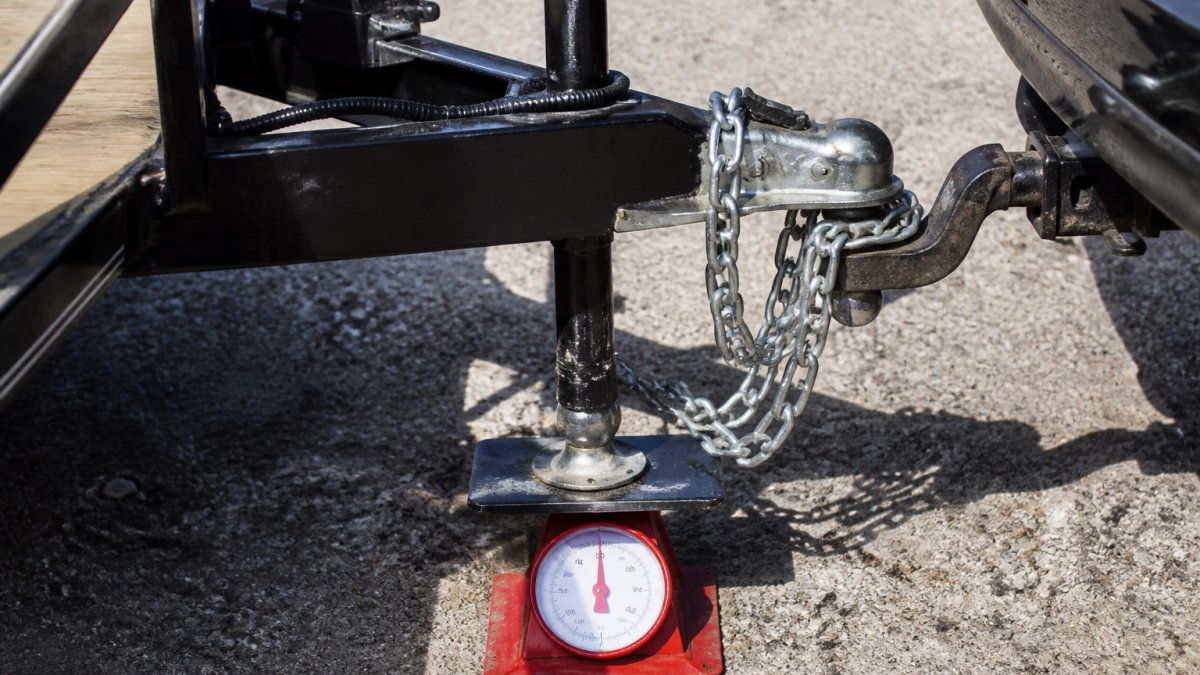
Tongue weight is the downward force the trailer exerts on the hitch receiver. According to guidance from the U.S. Department of Transportation on trailer safety, tongue weight should be between 10% and 15% of the total loaded trailer weight. Too little tongue weight causes trailer sway; too much overloads the rear axle and lifts the front wheels, destroying steering control.
Towing a Car with a Tow Dolly vs Car Hauler: Which Method Is Right
Choosing between a tow dolly and a car hauler isn't just about cost. It's about protecting the vehicle you're transporting and matching the equipment to the mechanical reality of what you're towing.
Flat Towing (Four-Down): When It Works and When It Destroys Transmissions
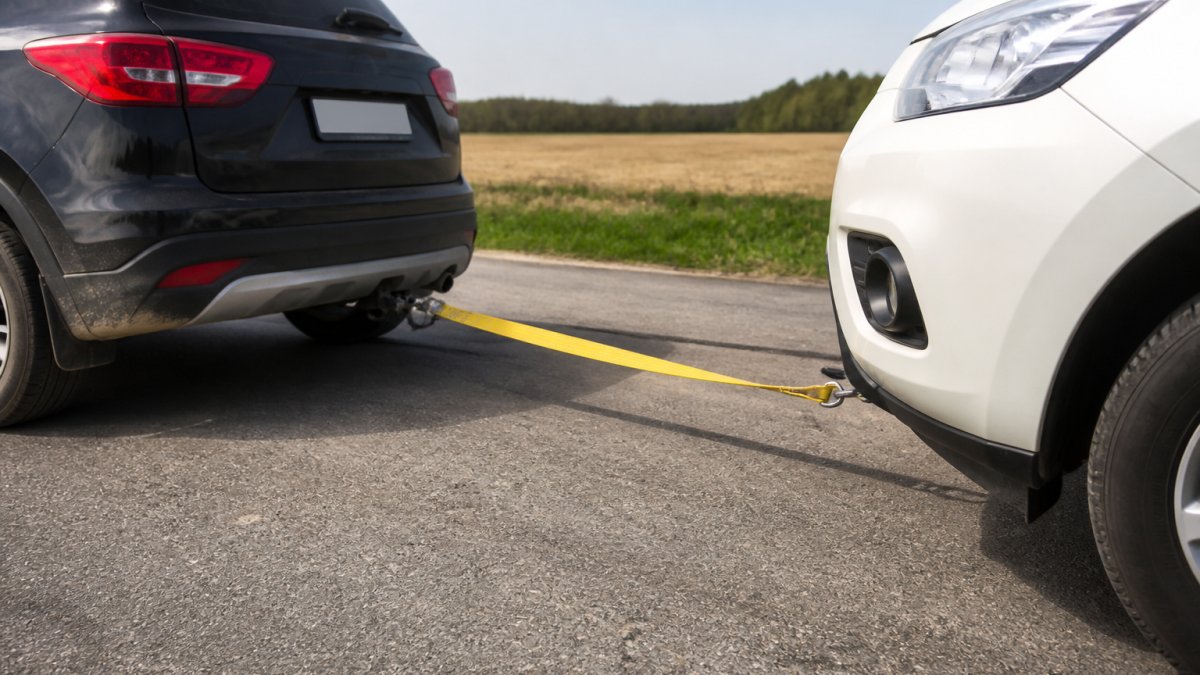
Flat towing, also called four-down towing or dinghy towing, means all four wheels stay on the ground while the vehicle is pulled by a tow bar attached to the front. This method works only for vehicles explicitly approved for flat towing by their manufacturer.
Most automatic transmissions require the engine to run to circulate lubrication through the gearbox. When you flat-tow a vehicle with an incompatible automatic transmission at highway speeds, the output shaft spins without lubrication, causing catastrophic transmission failure often within 100 miles. Always check your owner's manual before flat towing. Many Jeep Wranglers, certain Honda CR-Vs, and some manual-transmission vehicles are approved for flat towing. Most modern front-wheel-drive cars with automatic transmissions are not.
Tow Dolly: Front Wheels Up, Rear Wheels Rolling
A tow dolly lifts the front two wheels of the towed vehicle off the ground while the rear wheels roll freely. This eliminates transmission damage risk for front-wheel-drive vehicles because the driven wheels are off the pavement.
Tow dollies don't work well for rear-wheel-drive vehicles, where the driven wheels still roll and can cause drivetrain wear. All-wheel-drive vehicles should generally not be towed on a dolly. Tow dollies are lighter and easier to maneuver than full trailers, making them practical for shorter moves, though they require that the towed vehicle's steering be unlocked and the front wheels track straight.
Car Hauler (Enclosed or Open Trailer): Full Off-Ground Transport
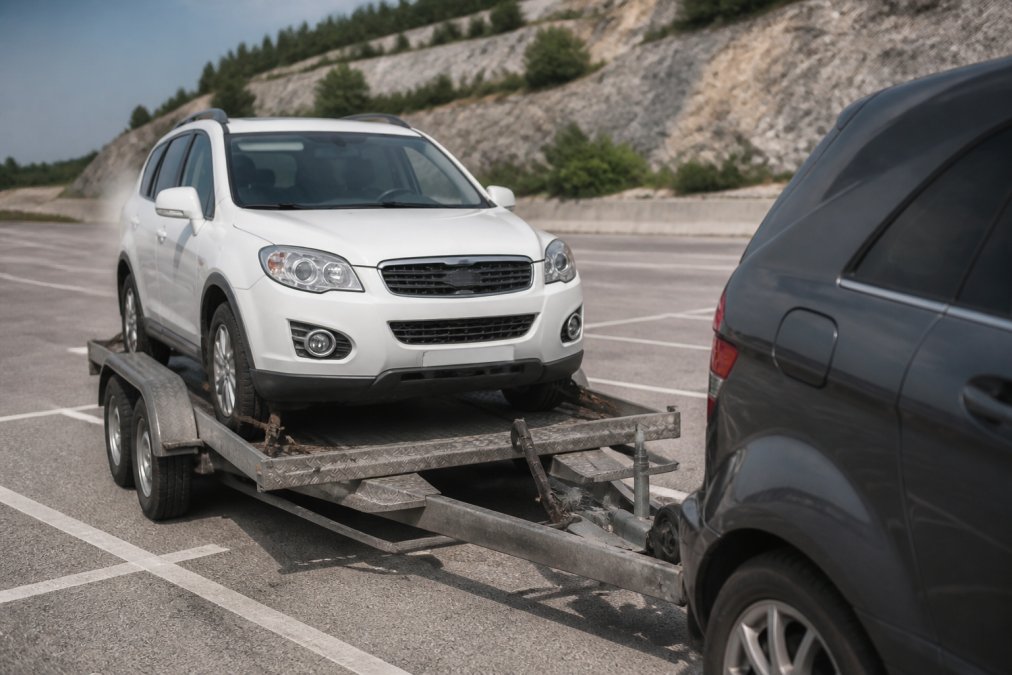
A car hauler, whether open or enclosed, lifts all four wheels completely off the ground. This is the safest method for virtually any vehicle. There is no drivetrain wear, no transmission risk, and no rear-wheel tracking concern.
Open car haulers are the standard choice for most transport jobs. They're lighter, less expensive to rent, and handle everything from project cars to race vehicles. Enclosed trailers add weather and road debris protection for high-value show cars or long-distance hauls.
Essential Towing Safety Equipment Every Driver Needs
Essential towing safety equipment includes a properly rated hitch receiver, safety chains, trailer wiring harness, and functioning trailer brakes for loads above a certain weight threshold. Missing any of these isn't just unsafe; it's illegal in most states.
Here's what every driver needs before pulling out of the driveway:
- Hitch receiver: Must be rated at or above the tongue weight and gross trailer weight you're pulling. Ball size matters; a 2-inch ball for a 1-7/8-inch coupler is a catastrophic mismatch.
- Safety chains: Required in all 50 states. Cross them under the coupler in an X pattern so the trailer tongue doesn't contact the road if the hitch fails.
- Trailer wiring harness: Connects your tow vehicle's brake lights, turn signals, and running lights to the trailer.
- Tow straps and ratchet straps: For securing the towed vehicle to the trailer deck. Ratchet straps with a working load limit appropriate for the vehicle's weight are non-negotiable.
- Wheel chocks: Prevent the vehicle from rolling during loading and unloading.
- Extended towing mirrors: Required in many states when the trailer is wider than the tow vehicle.
Best Practices for Securing a Vehicle on a Trailer
Securing a vehicle on a trailer correctly means using the right attachment points, achieving proper strap tension, and verifying the setup before you move an inch.
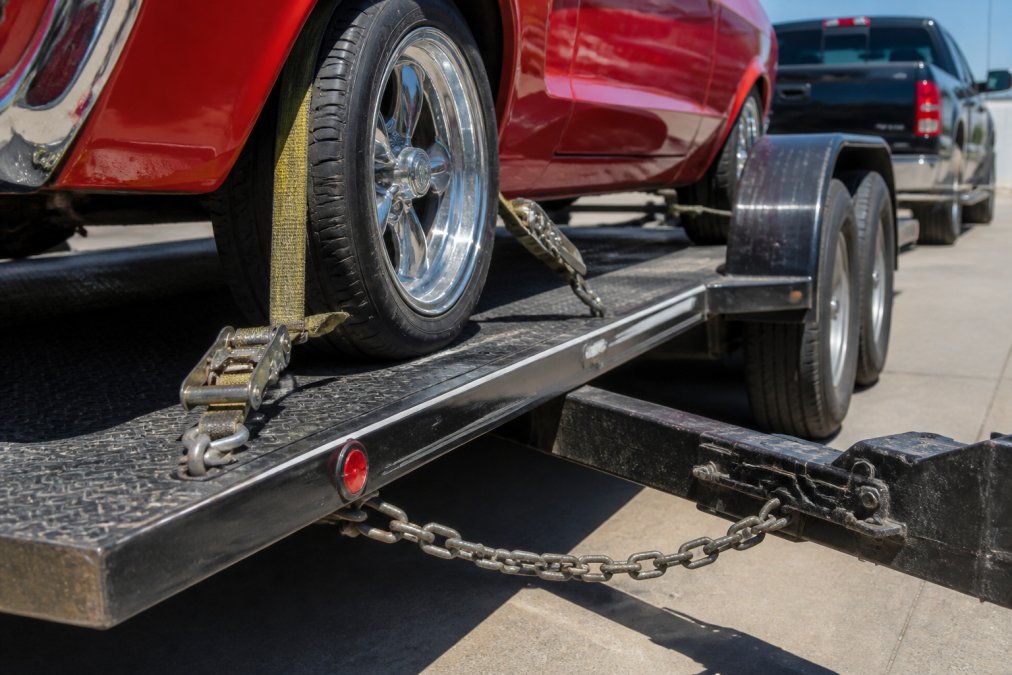
The most common mistake is strapping over the tire instead of using the vehicle's designated tie-down points. Strapping over the tire is a secondary method; the primary method is attaching straps directly to the vehicle's frame or manufacturer-designated tie-down hooks.
Pre-Trip Inspection Checklist
Run through this checklist before every single tow job, no exceptions:
- Coupler is fully seated on the ball and latch is locked
- Safety chains are crossed and attached to the tow vehicle frame
- Trailer wiring is connected and all lights are functioning (brake, turn, running)
- Ratchet straps are attached to proper tie-down points on the vehicle, not just the tires
- Strap tension is firm with no slack; recheck after the first mile
- Wheel chocks removed from behind trailer tires
- Trailer tires inflated to the rated PSI on the trailer's placard
- Trailer brake controller calibrated and tested (if equipped)
- Load distribution checked: 60% of vehicle weight forward of trailer axle
- Towing mirrors adjusted for full rear visibility
Recheck strap tension after the first 10 miles of travel. Straps settle under load and can lose tension faster than most drivers expect.
How to Safely Tow a Car: Driving Techniques That Prevent Accidents
Safe driving technique when towing a car requires adjusting every assumption you have about how your vehicle handles. The combined weight of the tow vehicle, trailer, and loaded car changes braking distances, turning radius, and acceleration in ways that catch inexperienced drivers off guard.
Speed, Braking, and Incline Management
Braking distance increases dramatically when towing. A combination that takes 150 feet to stop at 60 mph without a trailer may need 300 feet or more with a loaded trailer. Increase following distance to at least 6-8 seconds at highway speeds.
On downgrades, use engine braking by shifting to a lower gear rather than riding the service brakes. Sustained brake application on a long descent overheats the brake pads and can cause brake fade. If your brakes feel soft or spongy on a downgrade, pull over and let them cool.
Acceleration should be gradual. Hard acceleration with a heavy trailer behind you can break traction on the rear tires of the tow vehicle, causing the trailer to push sideways. Most states set a towing speed limit of 55 mph, though this varies.
Mirrors, Blind Spots, and Lane Changes
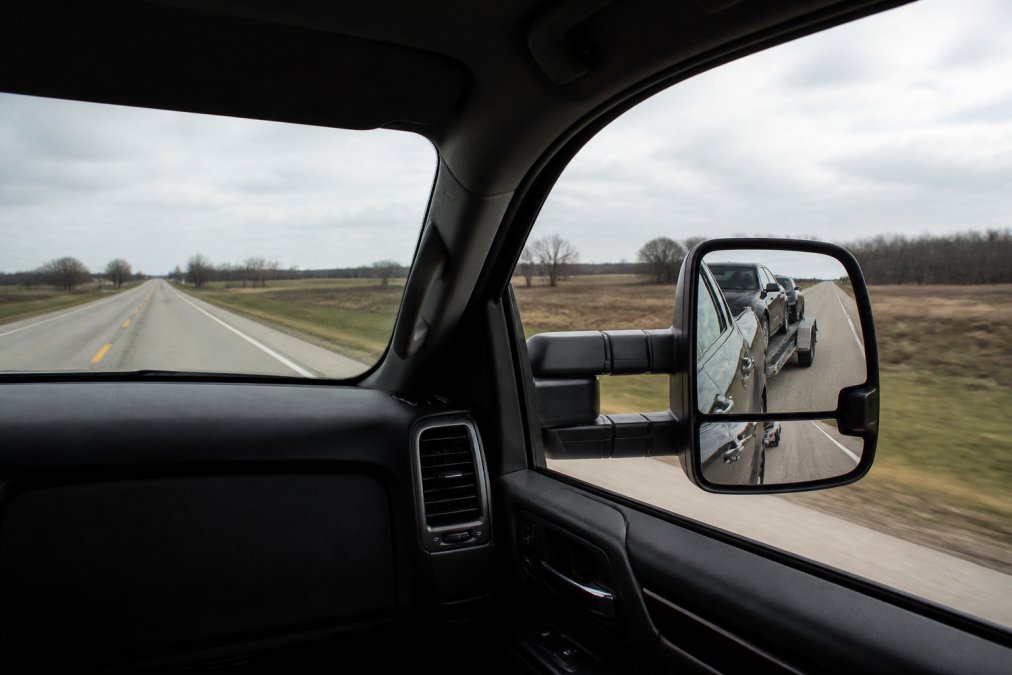
Extended towing mirrors are not optional equipment on a wide trailer; they're a functional necessity. Your standard mirrors will show you the side of the trailer and nothing else. Extended mirrors give you visibility of traffic alongside and behind the trailer, which is the only way to make safe lane changes.
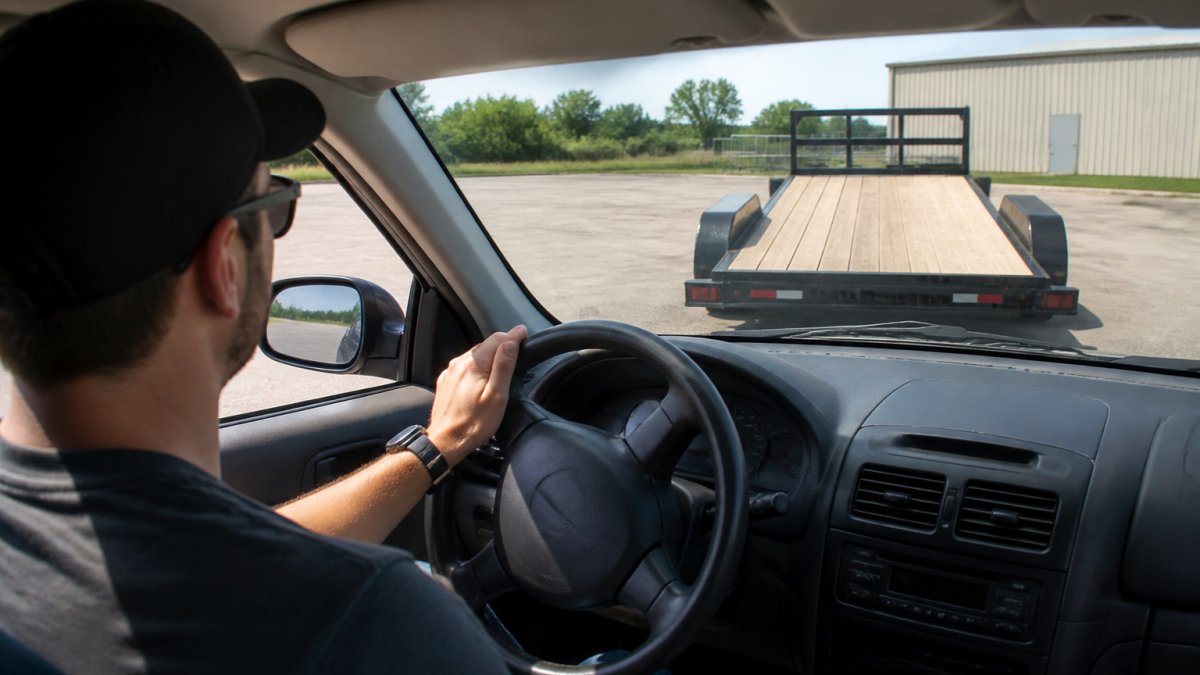
Blind spots when towing are substantially larger than when driving unloaded. Signal early, check mirrors twice, and never rely on a single glance before changing lanes. When backing, use a spotter whenever possible. The trailer turns opposite to the direction you steer the tow vehicle, which is counterintuitive until you've practiced it repeatedly.
State Towing Laws and Troubleshooting Common Failures
Towing laws vary by state, and ignorance of local regulations is not a defense when a trooper pulls you over for a safety chain violation or an oversized load without a permit.
Towing Speed Limits and Safety Chain Laws by State
Most states require safety chains on all towed vehicles, but the specific configuration and weight thresholds differ. As documented in the Federal Motor Carrier Safety Administration's towing regulations overview, safety chains must be crossed under the coupler and attached to the tow vehicle's frame or hitch, not to the ball mount alone.
Speed limits for vehicles towing trailers are commonly set at 55 mph in states like California and Washington, while some states allow towing at the standard highway speed limit. A few states also require trailer brakes on any trailer with a loaded weight above 3,000 pounds. The National Highway Traffic Safety Administration's vehicle lighting standards provide the federal baseline for lighting requirements, but state requirements can exceed these minimums.
Troubleshooting Trailer Sway, Brake Failure, and Equipment Problems
Trailer sway is the most alarming failure mode most drivers encounter. It starts as a gentle side-to-side oscillation and can escalate to a full jackknife within seconds if handled incorrectly. The wrong response is to hit the brakes hard. The right response is to hold the steering wheel firmly, ease off the accelerator gradually, and allow the combination to slow naturally. If your trailer has an integrated brake controller, manually activating the trailer brakes can help arrest the sway.
Sway is almost always caused by insufficient tongue weight, excessive speed, or crosswind. Fix the root cause before the next trip. If a ratchet strap breaks mid-trip, pull over safely and assess before continuing. A vehicle that has shifted on the trailer needs to be repositioned and re-strapped before you move.
How to Safely Tow a Car: Choosing and Renting the Right Trailer
Choosing the right trailer to tow a car comes down to matching the trailer's rated capacity to the vehicle's curb weight, selecting the right trailer type for the tow method, and confirming your tow vehicle can handle the combined load.
For most passenger car transport jobs, an open car hauler with a GVWR that exceeds the towed vehicle's weight by a comfortable margin is the right choice. Verify that the trailer's deck length accommodates your vehicle's wheelbase, and confirm the loading ramps are rated for the vehicle's weight.
402 car hauler rentals offers reliable trailer rentals with flexible booking terms, which matters when your project car restoration timeline isn't fixed or when a car show date gets moved. Our trailers are maintained to a standard that shop owners and mechanics depend on for business use. If you have a modified tow vehicle or specific hauling requirements, we work with you rather than applying the same restrictions as large national chains.
Contact 402 car hauler rentals directly for current rates and availability rather than relying on generic estimates, and confirm your booking well in advance of any event with a fixed date.
=== FAQ ANSWERS (audit these too, same rules) ===
[1] Q: What is the 80/20 rule in towing? A: The 80/20 rule means you should never load your tow vehicle to more than 80% of its rated towing capacity. So if your truck has a gross vehicle weight rating that supports 10,000 lbs of towing, keep the loaded trailer under 8,000 lbs. This buffer accounts for variables like wind, road grade, and emergency braking, situations where running at 100% capacity can cause trailer sway or brake failure.
[2] Q: Is it safer to use a tow dolly or a car hauler? A: A car hauler is generally safer for most vehicles because all four wheels are off the ground, eliminating rear-wheel wear and transmission damage risks. A tow dolly works well for front-wheel-drive vehicles on shorter trips but leaves the rear wheels rolling, which can cause uneven tire wear and creates more exposure to road debris. For classic cars, race vehicles, or rear-wheel-drive vehicles, a car hauler is the better choice.
[3] Q: What safety equipment is required for towing a vehicle? A: At minimum, you need a rated tow hitch and hitch receiver matched to your trailer's tongue weight, safety chains crossed in an X-pattern beneath the hitch, functioning trailer brake lights and turn signals, and load-rated ratchet straps or wheel chocks to secure the vehicle. Many states also require breakaway brake systems on trailers above a certain weight. Check your state's DMV regulations before your trip, as requirements vary.
[4] Q: How can I tow my car without a trailer? A: Flat towing, also called four-down towing, connects the vehicle directly to a tow bar behind the motorhome or tow vehicle with all four wheels on the ground. This only works for vehicles whose manufacturer explicitly approves it, because most automatic transmissions require the engine running to circulate fluid. Towing a non-approved vehicle this way causes transmission damage quickly. Always verify your vehicle's owner manual before attempting flat towing.
Frequently Asked Questions
What is the 80/20 rule in towing?
The 80/20 rule means you should never load your tow vehicle to more than 80% of its rated towing capacity. So if your truck has a gross vehicle weight rating that supports 10,000 lbs of towing, keep the loaded trailer under 8,000 lbs. This buffer accounts for variables like wind, road grade, and emergency braking, situations where running at 100% capacity can cause trailer sway or brake failure.
Is it safer to use a tow dolly or a car hauler?
A car hauler is generally safer for most vehicles because all four wheels are off the ground, eliminating rear-wheel wear and transmission damage risks. A tow dolly works well for front-wheel-drive vehicles on shorter trips but leaves the rear wheels rolling, which can cause uneven tire wear and creates more exposure to road debris. For classic cars, race vehicles, or rear-wheel-drive vehicles, a car hauler is the better choice.
What safety equipment is required for towing a vehicle?
At minimum, you need a rated tow hitch and hitch receiver matched to your trailer's tongue weight, safety chains crossed in an X-pattern beneath the hitch, functioning trailer brake lights and turn signals, and load-rated ratchet straps or wheel chocks to secure the vehicle. Many states also require breakaway brake systems on trailers above a certain weight. Check your state's DMV regulations before your trip, as requirements vary.
How can I tow my car without a trailer?
Flat towing, also called four-down towing, connects the vehicle directly to a tow bar behind the motorhome or tow vehicle with all four wheels on the ground. This only works for vehicles whose manufacturer explicitly approves it, because most automatic transmissions require the engine running to circulate fluid. Towing a non-approved vehicle this way causes transmission damage quickly. Always verify your vehicle's owner manual before attempting flat towing.
Towing a car safely requires getting three things right simultaneously: the mechanical setup, the driving technique, and the legal compliance. Miss any one of them and you're either looking at equipment failure, a traffic citation, or an accident. 402 car hauler rentals provides well-maintained open car haulers with the flexible terms that make it practical to plan around your actual schedule. Get in touch to confirm trailer availability and get your next transport job done right.