 how-to
How to Safely Secure a Car on a Trailer
Table of Contents
- Understanding Tie-Down Equipment and Anchor Points
- Identifying Vehicle-Specific Tie-Down Points
- Best Car Tie-Down Straps and Load Capacity
- Trailer Weight Distribution Tips for Balanced Loading
- Step-by-Step Process to Secure a Car on a Trailer
- DOT Requirements for Vehicle Tie-Downs and Compliance
- Safety Best Practices and Common Mistakes to Avoid
- Frequently Asked Questions
Last Updated: September 3, 2026
Understanding Tie-Down Equipment and Anchor Points
Securing a car on a trailer requires the right equipment and knowledge of proper attachment points. D-rings and snap hooks are the primary anchor points on most trailers. D-rings are welded steel rings mounted to the trailer deck, designed to withstand significant load capacity. Snap hooks, the metal fasteners at the end of straps, connect directly to these D-rings. A properly seated snap hook sits flush against the D-ring with no gaps, ensuring the load doesn't slip during acceleration, braking, or turns.
Wheel nets and axle straps serve different purposes. Wheel nets wrap around tires and work for lighter vehicles or shorter distances. Axle straps attach directly to the vehicle's suspension and provide superior control for heavier vehicles and longer hauls, preventing both vertical and horizontal movement. For most car hauling, axle straps are the professional standard.
The working load limit (WLL) of your straps and anchor points must exceed the vehicle's weight. Most quality ratchet straps have a WLL between 1,000 and 5,000 pounds per strap (fmcsa.dot.gov). Your trailer's D-rings should have markings indicating their rated capacity. Never assume capacity; verify it before loading.
Identifying Vehicle-Specific Tie-Down Points
Not all vehicles have the same securement points, and using the wrong attachment location can damage the vehicle or fail to secure it properly.
For most cars, the frame rails are the safest tie-down points. These are the main structural beams running lengthwise under the vehicle. Attaching straps to frame rails distributes the load across the vehicle's strongest structural elements. Never attach straps to bumpers, which are cosmetic and designed to absorb impact, not lateral forces.
Control arms and suspension components can sometimes be used, but only the lower control arm can handle moderate tension, and never attach more than one strap per side to this location. For vehicles with independent rear suspension, rear lower control arms can work, but frame attachment is always preferable.
Luxury and sports cars often have reinforced frame points or factory-installed tow hooks. Check the owner's manual for designated tie-down locations. Classic and restored vehicles present unique challenges due to thinner frame material. Before transporting a classic car, trace the frame to identify the thickest sections and avoid areas weakened by previous rust repair.
Best Car Tie-Down Straps and Load Capacity
The quality of your straps directly impacts safety and vehicle condition. Ratchet straps use a mechanical ratcheting mechanism to tighten the strap, providing maximum tension control and holding power. They're ideal for heavy vehicles and long-distance hauls and maintain tension as the strap stretches slightly during transport. Cam buckle straps use a simple over-center buckle mechanism and rely on user strength to achieve proper tension. They're lighter and more affordable but more prone to loosening during transport.
For car hauling, ratchet straps are the professional choice. The break strength should be at least 2-3 times the vehicle's weight (fmcsa.dot.gov). A 4,000-pound car should use straps with a break strength of at least 8,000-12,000 pounds.
Polyester webbing is more durable than nylon and resists UV damage better. Wider straps (2 inches or more) distribute pressure more evenly and are less likely to cause damage. Inspect straps before each use for fraying, tears, rust on hardware, or cracks in the ratchet mechanism. Replace worn straps rather than risk failure during transport.
Trailer Weight Distribution Tips for Balanced Loading
How you position the car on the trailer affects stability, braking performance, and wear on your tow vehicle. The 60/40 rule is the foundation of proper trailer loading: 60% of the load weight should be forward of the trailer's axle, and 40% should be behind it. For a single-car trailer, position the car so its weight is slightly forward of center.
Understanding unsprung weight, wheels, tires, and brake components, is critical for balanced loading. Position the vehicle so its center of gravity aligns with the trailer's load-bearing capacity. For most standard car trailers, this means loading the vehicle slightly forward of the geometric center of the trailer deck.
Suspension travel becomes relevant when the loaded trailer is in motion. Improper weight distribution amplifies suspension movement, causing the trailer to bounce and sway. Correct distribution minimizes this movement and keeps the trailer stable. If transporting multiple vehicles on a larger trailer, place heavier vehicles forward and lighter vehicles toward the rear while respecting the 60/40 principle.
Step-by-Step Process to Secure a Car on a Trailer
Properly securing a car on a trailer is a systematic process requiring attention to detail at every stage.
Pre-loading inspection and positioning is where safety begins. Walk the entire trailer deck and check all D-rings for damage, rust, or loose welds. Test each D-ring by pulling on it; it should not move or flex. Inspect all straps for tears, fraying, or hardware damage. Position the trailer on level ground if possible, orienting it so any slope runs side-to-side rather than front-to-back.
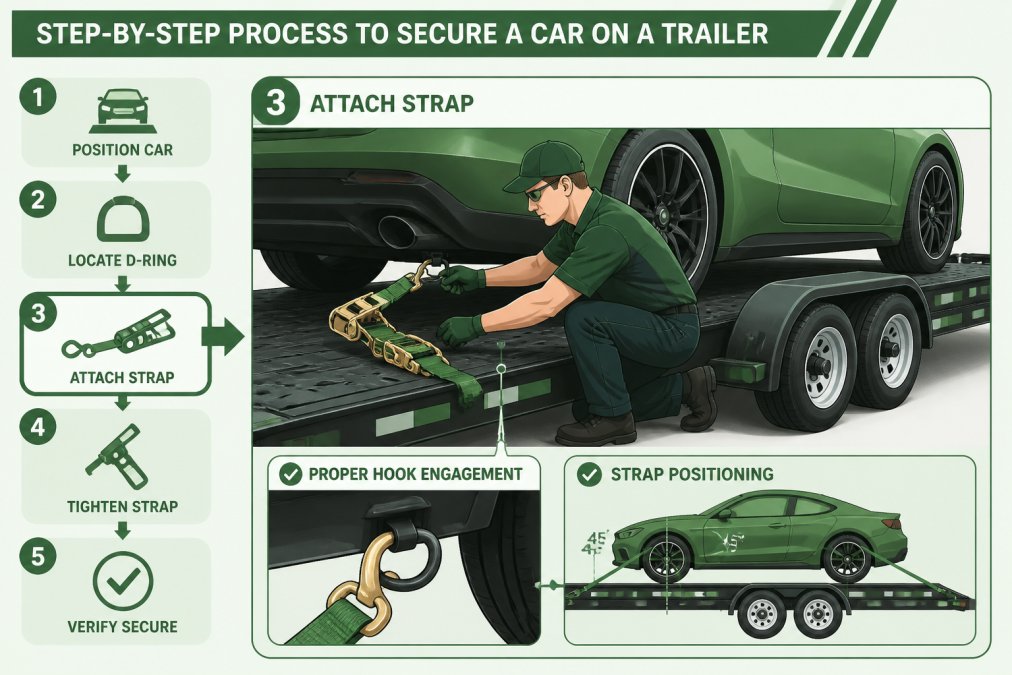
Carefully drive or winch the car onto the trailer, moving slowly and aligning the vehicle's centerline with the trailer's centerline. Once positioned, engage the parking brake and turn off the engine.
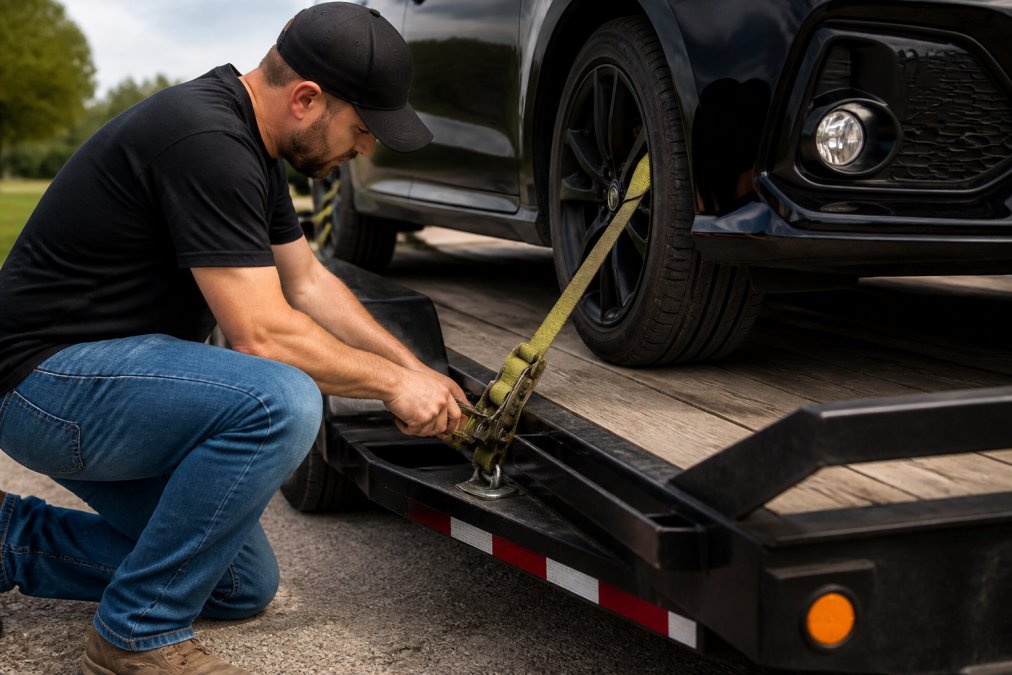
Attaching and tensioning straps requires a four-point tie-down minimum: two straps at the front and two at the rear. Position the front straps to attach to the vehicle's frame rails near the front wheels, angling slightly outward toward the front corners of the trailer at roughly 45 degrees from vertical. The rear straps should attach to the frame rails near the rear wheels, again angling outward toward the rear corners.
When attaching a strap, ensure the snap hook is fully seated in the D-ring with no gaps. Tighten each strap gradually and evenly using a cross-tensioning approach: tighten all four straps partially, then go around again tightening them more, then again until you reach full tension. This prevents the vehicle from shifting as you tighten.
The vehicle should not move at all when you push on it after tensioning. Tighten the straps snugly against the vehicle without deforming the frame. You should not be able to slide your finger under the strap webbing at the point where it contacts the vehicle.
Final safety checks happen before you leave the lot. Physically push on the vehicle at each corner; it should not move. Grab each strap and pull; it should not flex or give. Check that no strap is rubbing against the vehicle's finish. If a strap contacts painted surfaces, place a strap protector between the strap and the paint. Verify that all snap hooks are fully engaged and locked in place. Walk the perimeter one final time, confirming that no straps are loose, twisted, or misaligned.
DOT Requirements for Vehicle Tie-Downs and Compliance
The Department of Transportation has specific regulations governing how vehicles must be secured during transport. According to FMCSA regulations on cargo securement, all vehicles being transported on trailers must be secured with a minimum of four tie-down straps or chains rated for the vehicle's weight and attached to the trailer's anchor points in a manner that prevents any movement. Tie-down straps must be attached to the vehicle's frame or structural components, not to bumpers or other non-structural parts.
Tie-down straps must be spaced along the length of the vehicle to prevent tipping or rolling. Straps should not exceed 45 degrees from vertical to ensure they provide both downward and lateral control.
Drivers must stop and visually inspect tie-downs within the first 50 miles of travel, then again every 150 miles or every three hours, whichever comes first. This inspection includes checking that straps are still tight, that no strap has shifted or twisted, and that the vehicle has not moved on the trailer. Documentation of these inspections should be kept in case of an accident or DOT inspection.
When transporting across state lines, additional regulations may apply. It's the driver's responsibility to know and follow the regulations of all states the trailer will pass through.
Safety Best Practices and Common Mistakes to Avoid
Experience reveals patterns in what works and what fails. The most common mistakes are preventable with proper attention to detail.
Inspection during transport and re-tensioning is often overlooked but critical. Straps can loosen slightly during the first few miles as the vehicle settles and the strap webbing accommodates the load. Stop after 30-50 miles and re-inspect all straps. If any strap has loosened, tighten it immediately. During longer hauls, stop every 150-200 miles to re-inspect. If you notice any strap damage, replace it before continuing.
Protecting vehicle finish and preventing sway requires proactive measures. Use strap protectors at every point where a strap contacts the vehicle's painted surface. If you notice the trailer swaying during transport, reduce speed first. Once you've slowed down, find a safe place to stop and re-inspect the load. Check that all straps are equally tight and that the vehicle is positioned correctly on the trailer.
Common mistakes include using straps that are too short, which forces extreme angles that reduce holding power, and mixing strap types. Use straps that are long enough to attach at the proper 45-degree angle and stick with one type, ensuring all straps are the same length and rated capacity.
The most dangerous mistake is assuming a vehicle is secure without physically testing it. Always push on the vehicle at each corner after tensioning. The vehicle should be immobile, not "mostly secure" or "probably fine."
Safely securing a car on a trailer combines equipment knowledge, attention to detail, and respect for load securement physics. Whether transporting a classic car to a show or moving a vehicle across the country, the process is the same: use the right equipment, attach to proper anchor points, tension evenly, and inspect regularly. At 402 car hauler rentals, we maintain trailers equipped with quality D-rings, anchor points, and tie-down systems designed for reliable vehicle transport. Our team can walk you through the securing process and answer questions about your specific vehicle's tie-down points. Get started with 402 car hauler rentals and transport your vehicle with confidence.
Frequently Asked Questions
How many tie-down straps are required to secure a car?
A standard four-point tie-down configuration uses four straps minimum, one at each corner of the vehicle. This setup distributes load evenly and prevents cargo sway. Heavy vehicles or high-value cars may require six straps with cross-strapping for additional stability. Always verify your trailer's anchor point capacity and follow DOT requirements for vehicle tie-downs to ensure safe securement.
What is the 60/40 rule for trailer weight distribution?
The 60/40 rule means 60% of your total load weight should be positioned forward of the trailer's axle, with 40% behind it. This distribution prevents trailer sway and maintains towing stability. When securing a car on a trailer, position heavier components (engine, transmission) toward the front of the deck. Proper weight distribution reduces strain on your tow vehicle and improves control during transport.
Should you use wheel straps or chassis tie-downs?
Chassis tie-downs (axle straps) are generally preferred because they secure the vehicle's frame directly, providing more stable load control. Wheel nets offer additional support but work best as a secondary restraint. For classic or race cars with sensitive suspension, chassis tie-downs minimize stress on control arms and suspension travel. Always use best car tie-down straps rated for your vehicle's weight and check working load limits before securing.
Can you leave a car in gear while on a trailer?
No, leave the vehicle in neutral with the parking brake off during transport. Keeping the car in gear can cause engine strain and potential damage during loading, unloading, or if the trailer experiences sudden movement. Ensure the steering wheel is straight, remove the key, and lock the doors after positioning. This prevents accidental engagement and protects the vehicle's drivetrain throughout the journey.