 how-to
Car Hauler Rental Booking Guide: Safe Towing in 2026
Table of Contents
- Match Your Tow Vehicle to the Trailer Before You Book
- How to Secure a Trailer Rental in Five Steps
- What Drives Car Trailer Rental Cost (and the Hidden Fees)
- Choosing the Right Car Hauler Rental Equipment
- Loading and Securing a Vehicle on the Trailer
- Insurance, Liability, and Emergency Roadside Protocol
- Frequently Asked Questions
Last Updated: September 17, 2026
Match Your Tow Vehicle to the Trailer Before You Book
A car hauler rental booking guide is only as good as the math you do before you reserve anything. The single biggest reason rentals go wrong is a tow vehicle that can't legally or safely pull the loaded trailer.
The Four Ratings That Have to Clear
Every trailer has a gross vehicle weight rating (GVWR), the maximum the trailer and its cargo can weigh together. Your tow vehicle has its own ratings, and all four of these have to clear before the setup is legal and stable:
- Trailer GVWR, the ceiling for the trailer plus the car on it.
- Tow vehicle towing capacity, the maximum loaded trailer weight your truck is rated to pull.
- Tow vehicle payload, everything the truck carries, including passengers, cargo, the hitch, and the tongue weight pressing down on the ball.
- Tongue weight limit, the maximum downward force the hitch and receiver are rated to accept.
A Simplified Compatibility Checklist
Work through these in order. If any step fails, stop and resize the trailer or the tow vehicle.
- Step 1, Weigh the car. Use a public scale or the manufacturer's curb weight. Add fuel, tools, and anything left in the vehicle.
- Step 2, Add the trailer's empty weight. This is on the trailer's data plate, not in the sales brochure.
- Step 3, Compare the total to the trailer's GVWR. If the loaded total exceeds GVWR, the trailer is overloaded regardless of what your truck can pull.
- Step 4, Compare the loaded total to your tow vehicle's towing capacity. Stay under it, not at it.
- Step 5, Calculate tongue weight at 10-15% of the loaded total. Subtract that figure, plus passengers and cargo, from your payload rating.
- Step 6, Confirm the result is positive. If payload goes negative, the truck is overloaded even though the trailer is within its own limits.
Hitch Classes, Ball Mounts, and Brake Controllers
Hitch class determines how much weight you can pull. Class III and IV hitches handle most car hauler setups; lighter classes won't. The ball mount must match your trailer coupler size, and the ball itself needs the correct diameter and torque spec.
When the Numbers Are Close, Size Down
If any figure lands within a few hundred pounds of a limit, treat it as a fail. Grades, headwinds, and summer heat all reduce real-world margin. Sizing down to a lighter trailer or up to a more capable tow vehicle is cheaper than a roadside failure with a car on the deck.
How to Secure a Trailer Rental in Five Steps
Reserving a car hauler rental takes about fifteen minutes if you have your paperwork ready. Here's the sequence that avoids surprises.
- Confirm your tow vehicle's ratings. Check GVWR, payload, and hitch class against the trailer you need.
- Call or book online with your dates. Flexible dates widen your options; peak weekends fill fast.
- Submit your documents. Driver's license, proof of insurance, and a payment method for the deposit.
- Review the rental agreement. Read the damage waiver terms and liability clauses carefully.
- Get your reservation confirmation in writing. Confirm pickup time, return time, and the exact trailer.
Documents, Deposit, and Reservation Confirmation
Most rental agreements require a valid driver's license, proof of auto insurance, and a security deposit. The deposit covers potential damage and is typically refunded after inspection. Get your reservation confirmation in writing so there's no dispute about which trailer you booked and when.
What Drives Car Trailer Rental Cost (and the Hidden Fees)
Car trailer rental cost depends on trailer type, rental duration, and whether you need a one-way or local rental. Daily rates are the baseline, but the final bill often includes charges renters didn't plan for.
Watch for these line items:
- Security deposit, refundable, but ties up funds during your rental
- Damage waiver, optional coverage that adds to the daily rate
- Late return fees, charged by the hour or day past your return time
- Cleaning fees, if the trailer comes back with excessive dirt or debris
- Mileage or one-way surcharges, common on one-way rentals
Choosing the Right Car Hauler Rental Equipment
Equipment choice comes down to what you're hauling and how far. The main options are open flatbed trailers, enclosed car carriers, and tow dollies.
| Equipment | Best For | Towing Demand | Weather Protection |
|---|---|---|---|
| Open flatbed | Most cars, local and long hauls | Moderate | None |
| Enclosed carrier | Classic and show cars | High | Full |
| Tow dolly | Short local moves, FWD cars | Low | None |
Loading and Securing a Vehicle on the Trailer
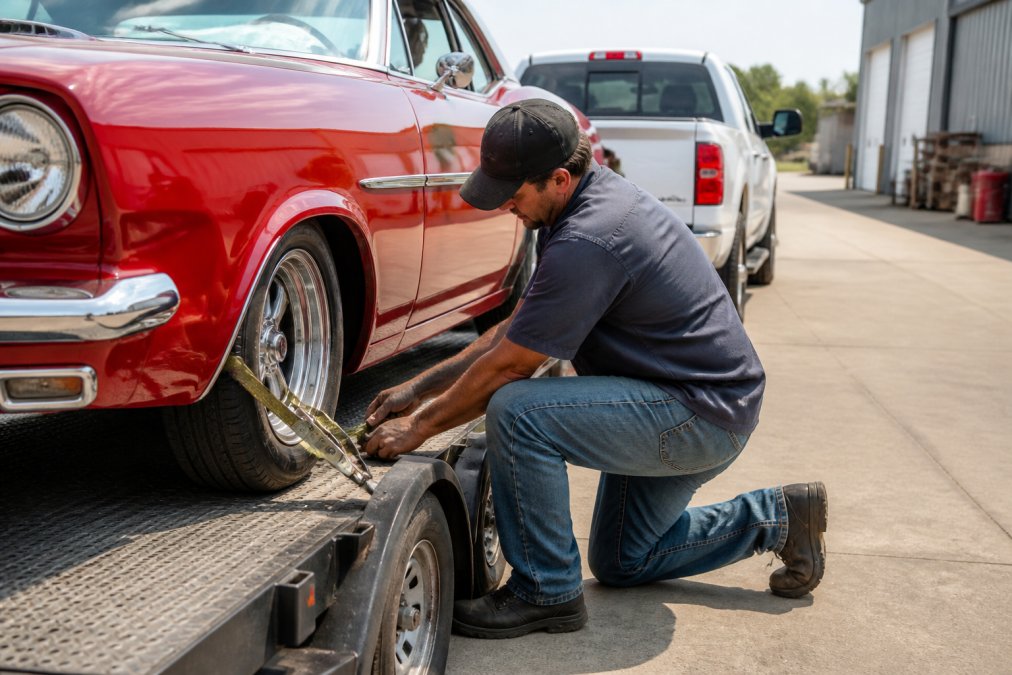
Loading and securing techniques decide whether your car arrives intact. Get this wrong and no amount of careful driving saves you. This is the part most booking guides skip entirely, so here is the full procedure.
Positioning the Vehicle on the Deck
Drive or winch the car onto the trailer centered over the axles. Aim for roughly 60% of the vehicle's weight forward of the trailer's axles, that bias is what produces correct tongue weight. Too far back and the trailer will sway; too far forward and you overload the hitch.
The Four-Point Tie-Down Method
Four properly rated straps are the minimum for a car hauler. Two is not a method, it's a gamble.
- Use ratchet straps rated for the load. Check the working load limit printed on the strap webbing, not the breaking strength.
- Attach to the frame or dedicated tie-down points. Never hook to brake lines, fuel lines, suspension arms, or sheet metal.
- Cross the straps front to back. The front-left strap runs to the rear-right anchor and vice versa. Crossing resists lateral movement.
- Compress the suspension slightly. A small amount of preload keeps the car from bouncing against the straps on rough pavement.
- Keep strap angles shallow. Aim for no more than about a 45-degree angle from the deck. Steep angles pull the car sideways instead of down.
Re-Checking at Every Stop
Straps stretch and settle as you drive. Check tension after the first few miles, then again at every stop. A strap that felt tight in the driveway can be slack after 50 miles of vibration.
At each check, look for:
- Slack in any strap
- Hooks that have shifted or opened
- The car creeping forward or back on the deck
- Tire straps that have loosened their grip
What to Do If the Load Shifts Mid-Transit
If you feel the trailer start to sway or see the car move in the mirror, do not brake hard. Ease off the throttle, keep the steering steady, and pull over as soon as it's safe. Re-secure the load completely before continuing. Driving on a shifted load to reach the next exit is how trailers end up on their sides.
Insurance, Liability, and Emergency Roadside Protocol
Insurance and liability coverage is where renters get caught off guard. Your personal auto policy may not cover a rented trailer, and the towing vehicle's coverage often applies differently than you'd expect.
For emergencies, know the protocol before you leave:
- Blown tire or brake failure: pull over safely, set up warning triangles, and call the rental company's emergency line.
- Broken strap or shifted load: stop immediately, re-secure, and don't continue until the load is stable.
- Breakdown of the tow vehicle: keep the trailer attached if possible and call for roadside assistance equipped to handle a loaded trailer.
Frequently Asked Questions
What documents do I need to book a car hauler rental?
Bring a valid driver's license, proof of auto insurance that covers the tow vehicle, and a credit or debit card for the security deposit. Most rental agreements also require you to list any additional drivers. If a business is paying, a company card and authorization letter speed up pickup. Ask the rental office whether they need proof of towing capacity for your truck, since some locations verify hitch class and brake controller installation before releasing the trailer.
How far in advance should I book a car hauler to guarantee availability?
Reserve at least one to two weeks ahead for a standard weekend, and three to four weeks for peak car show or race season. Popular flatbed and enclosed trailers move fast in spring and summer. If your dates are firm, ask about a reservation confirmation with a deposit so the unit is held in your name. Flexible renters who can shift by a day or two have an easier time finding an open trailer.
How do I determine if my vehicle can safely tow a car hauler?
Check the gross vehicle weight rating (GVWR) and payload on your truck's door jamb sticker, then subtract the trailer's loaded weight, including the car. Keep tongue weight within the hitch receiver and ball mount rating, usually 10 to 15 percent of the loaded trailer weight. Compare your tow rating to the combined vehicle combination weight. If the numbers are close, add a weight-distributing hitch and confirm the trailer brakes and brake controller are working before you leave the lot.
What is typically included in car trailer rental cost?
Base daily rate, trailer rental insurance or damage waiver, taxes, and any one-way drop fee if you are not returning the trailer to the same location. Some shops charge for tie-down straps, safety chains, or spare tire use, and late returns often trigger an extra day. Ask for an itemized quote before you sign the rental agreement so the final bill matches the estimate. Rates vary by trailer type, rental length, and season.
Hauling a car safely comes down to preparation: matching your tow vehicle to the trailer, securing the load correctly, and understanding your coverage before you drive off. 402 car hauler rentals keeps well-maintained trailers ready for project cars, race vehicles, and everything between, with flexible booking terms and competitive rates for hobbyists and shops alike. Get started with 402 car hauler rentals and book a trailer that fits your tow vehicle and your timeline.