 listicle
Heavy Duty Trailer Rental Omaha: 2026 Comparison Guide
Table of Contents
- Quick Comparison: Heavy Duty Trailer Rental Omaha Options
- Best Car Hauler Rental Picks for Omaha Projects
- Towing Capacity Requirements: Matching Your Truck to the Trailer
- Trailer Rental Insurance: What's Covered and What Isn't
- Step-by-Step Towing Safety Checklist Before You Leave the Lot
- Trailer Types Compared by Project: Flatbed, Dump, Cargo, and Car Hauler
- CDL Requirements for Heavy-Duty Hauling in Nebraska
- Conclusion: Choosing the Right Heavy Duty Trailer Rental Omaha Provider
- Frequently Asked Questions
Last Updated: September 10, 2026
Quick Comparison: Heavy Duty Trailer Rental Omaha Options
Finding a heavy duty trailer rental in Omaha starts with knowing which provider fits your hauling job. This guide from 402 car hauler rentals covers the options, the towing math, and the safety steps that keep you legal on I-80.
Here's the short version before the details:
| Provider | Best For | Booking Style | Pricing Visibility |
|---|---|---|---|
| 402 car hauler rentals | Project cars, race vehicles, flexible terms | Direct booking, flexible dates | Contact for a quote |
| Honeyman Rent-All | Contractors needing heavy equipment trailers | Local yard pickup | Contact for pricing |
| Neighbors Trailer | Renters wanting specific trailer types fast | Peer-to-peer marketplace | Listed per owner |
| U-Haul | Standard moves and light-to-medium hauling | Online reservation | Listed online |
| Herc Rentals | Large commercial jobsites | Commercial account | Contact for pricing |
The distinction that matters most: a car hauler and a dump trailer solve different problems, and the provider that stocks one may not stock the other.
Best Car Hauler Rental Picks for Omaha Projects
The best car hauler rental for most Omaha hobbyists and shops has flexible terms, a maintained fleet, and a clear answer if your timeline slips.
402 Car Hauler Rentals: Flexible Terms for Project Cars
Restoration work rarely follows a calendar, a project car due Saturday is often ready the following Thursday, and rigid daily rates punish that.
402 car hauler rentals offers flexible terms, competitive rates, and a fleet built for project cars and race vehicles.
Honeyman Rent-All: Established Local Heavy-Duty Fleet
Honeyman Rent-All runs a local equipment catalog including heavy-duty 6.5x17 trailer models aimed at construction and hauling rather than vehicle transport. Rates aren't listed online, so you'll need to call.
Neighbors Trailer: Peer-to-Peer Marketplace with Transparent Rates
Neighbors Trailer connects renters with individual owners, so availability can exceed a single yard's inventory and rates are listed per owner. The catch: maintenance standards vary by owner.
Towing Capacity Requirements: Matching Your Truck to the Trailer
Towing capacity requirements come down to three numbers: your vehicle's gross vehicle weight rating, the trailer's loaded weight, and your payload capacity after passengers and cargo. Get one wrong and you're overloading a truck that felt fine in the driveway.
Gross Vehicle Weight Rating and Payload Capacity Explained
Gross vehicle weight rating (GVWR) is the maximum total weight a vehicle is rated to carry, including itself, passengers, fuel, and cargo. Payload capacity is GVWR minus curb weight. Towing capacity is the maximum weight the vehicle can pull, almost always lower than people assume.
The practical rule: subtract the trailer's loaded weight from your tow rating, then passengers and gear from your payload. Whichever limit you hit first is your real ceiling, a half-ton pickup can be overloaded by tongue weight alone once the bed is full.
Hitch Class, Brake Controllers, and Wiring Harness Checks
Hitch class determines how much weight you can safely distribute: Class III handles most car hauler and utility work, while Class IV and V are needed for heavier flatbed and gooseneck setups. A brake controller is not optional on loaded trailers above a certain weight, and many states require trailer brakes past a threshold (nhtsa.gov).
Before you leave the lot, confirm three connections: the ball mount is rated for your load, the wiring harness matches the trailer's plug type, and the brake controller is calibrated to the trailer.
| Check | What to Verify | Why It Matters |
|---|---|---|
| Hitch class | Rating meets loaded trailer weight | Under-rated hitches fail under load |
| Ball mount | Correct drop and ball size | Wrong drop causes sway and poor tracking |
| Brake controller | Calibrated to this trailer | Mis-set gain causes lockup or no braking |
| Wiring harness | Plug type matches trailer | No lights means no legal towing |
Trailer Rental Insurance: What's Covered and What Isn't
Trailer rental insurance is the gap most renters discover after an incident. A trailer is separate property from your tow vehicle, and most personal auto policies treat it that way. Understanding the three coverage layers before you sign is the difference between a $200 repair and a $20,000 claim.
The Three Coverage Layers on a Rented Trailer
1. Liability for damage you cause to others. If your trailer separates, swings into another vehicle, or drops cargo, the claim generally routes through your auto liability coverage. Most personal policies extend liability to a trailer you're pulling, but only for personal use, commercial use, like hauling a customer's vehicle or hauling for hire, is commonly excluded.
2. Physical damage to the trailer itself. Some providers sell a damage waiver, a daily fee and they absorb damage to their equipment, excluding negligence, tire damage, and overhead strikes. Others hold you liable for full replacement value and bill your insurance. Read the damage section, not the marketing page.
3. Cargo and the vehicle you're hauling. Your auto policy almost never covers the car on the trailer. A customer's project car needs its own coverage, the owner's policy, or a commercial inland marine / garagekeepers policy if you're a shop. This is the most common gap in vehicle-transport rentals.
What Your Personal Auto Policy Typically Does and Doesn't Do
| Scenario | Typical Personal Auto Treatment |
|---|---|
| Personal move, rented utility trailer, damage to a third party | Liability usually extends to the trailer |
| Personal use, trailer damaged in an at-fault accident | Physical damage may extend if you carry comprehensive/collision |
| Hauling a customer's vehicle for shop business | Commercial-use exclusion often applies |
| Vehicle being towed is damaged | Generally not covered by the tow vehicle's policy |
| Trailer stolen from your driveway | Usually not covered unless specifically endorsed |
Renters often assume "full coverage" on their truck covers whatever is behind it. It doesn't, the trailer is a distinct insured object, and the cargo is a third.
Questions to Get Answered in Writing Before You Tow
- What is my maximum out-of-pocket if the trailer is totaled?
- Does the damage waiver exclude tire damage, overhead strikes, or single-vehicle rollovers?
- Does my personal auto policy extend liability to a rented trailer used for personal transport?
- If I'm hauling a customer's vehicle, does my policy or theirs respond first?
- Is the deposit refundable, and what triggers a deduction?
Commercial Use Is the Line That Moves
If you're a shop hauling a customer vehicle, a dealer moving inventory, or anyone towing for compensation, you've likely stepped outside a personal auto policy. The gap is typically filled by a commercial auto policy with a hired/non-owned trailer endorsement, or a garagekeepers policy for vehicles in your care. Confirm which one you carry before accepting a customer's keys.
Step-by-Step Towing Safety Checklist Before You Leave the Lot
A towing safety checklist takes about ten minutes and prevents the failures that end trips early. Run it every time, even on a trailer you rented last week.
- Confirm the coupler is fully seated on the ball and the latch is locked
- Cross the safety chains under the tongue in an X pattern
- Plug in the wiring harness and test running lights, brake lights, and turn signals
- Verify tire pressure on all trailer tires, including the spare
- Check lug nut torque on every wheel
- Test the brake controller with a manual override at low speed
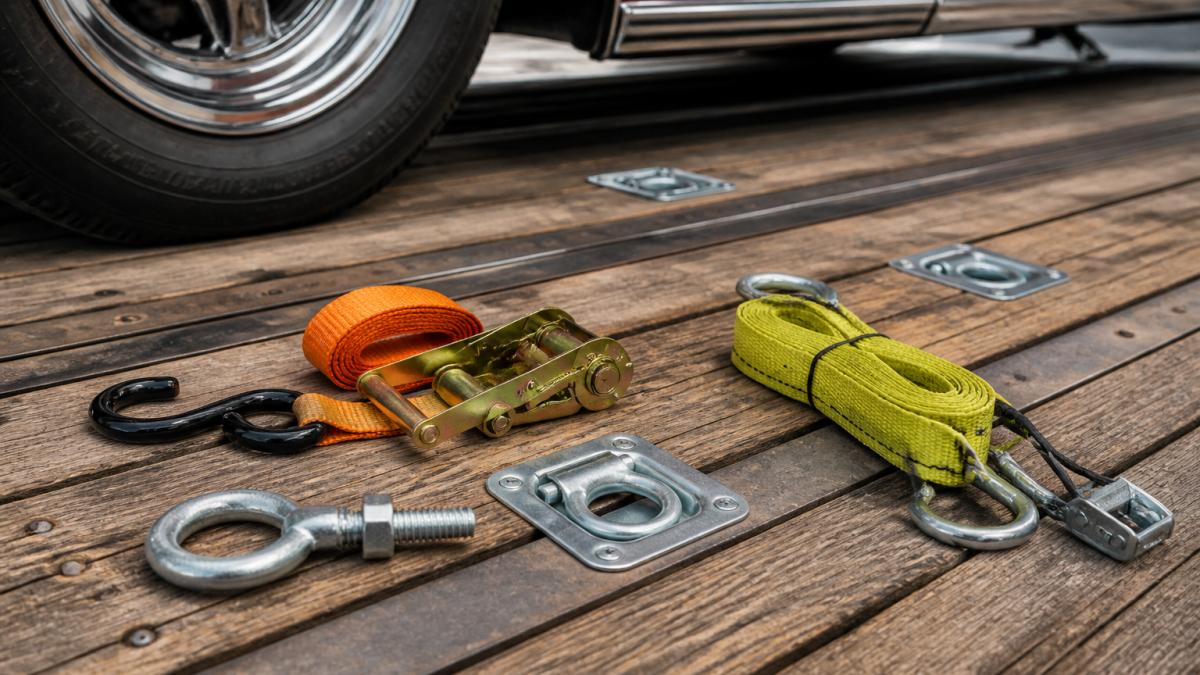
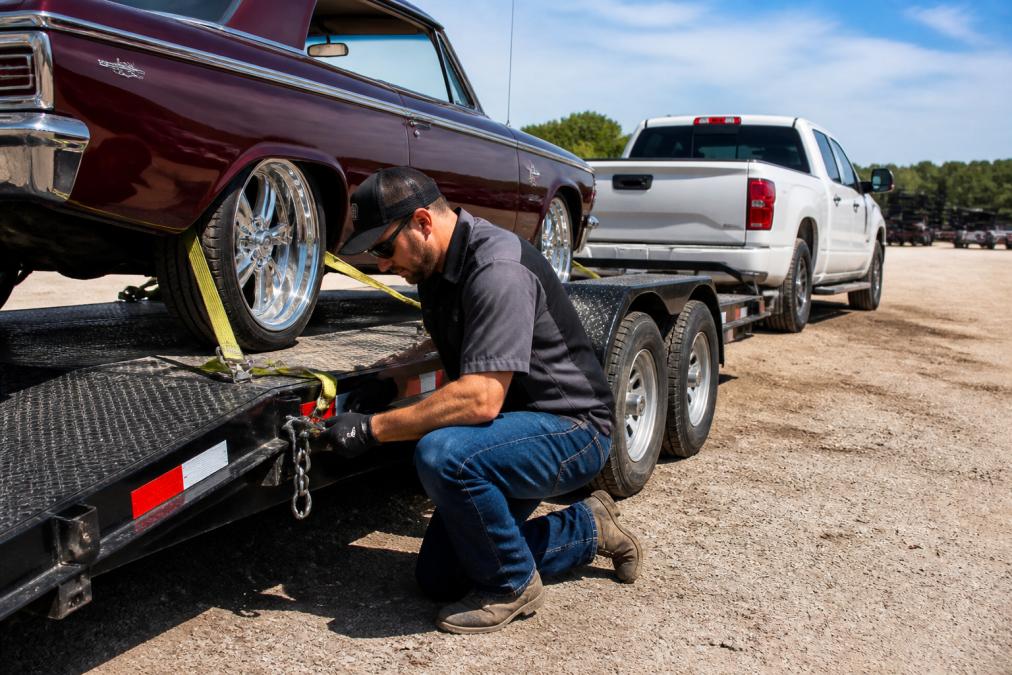
- Confirm load securement: at least two tie-down points per vehicle, four for heavier loads
- Re-check straps after the first few miles, then again at every stop
Trailer Types Compared by Project: Flatbed, Dump, Cargo, and Car Hauler
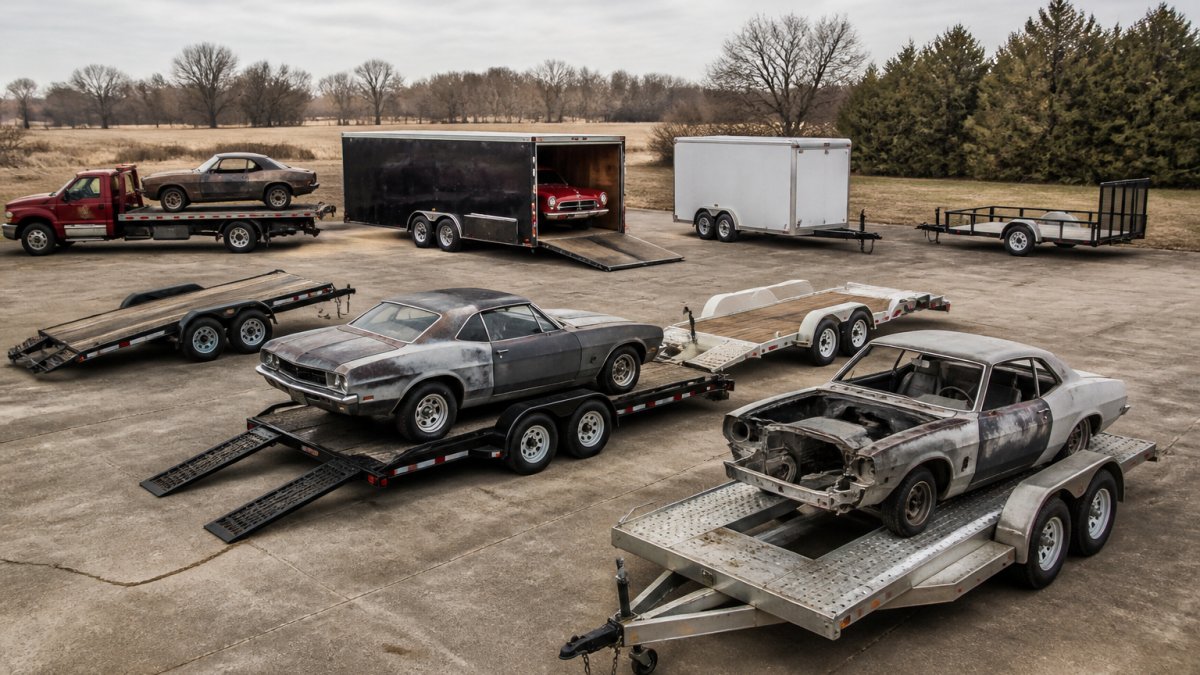
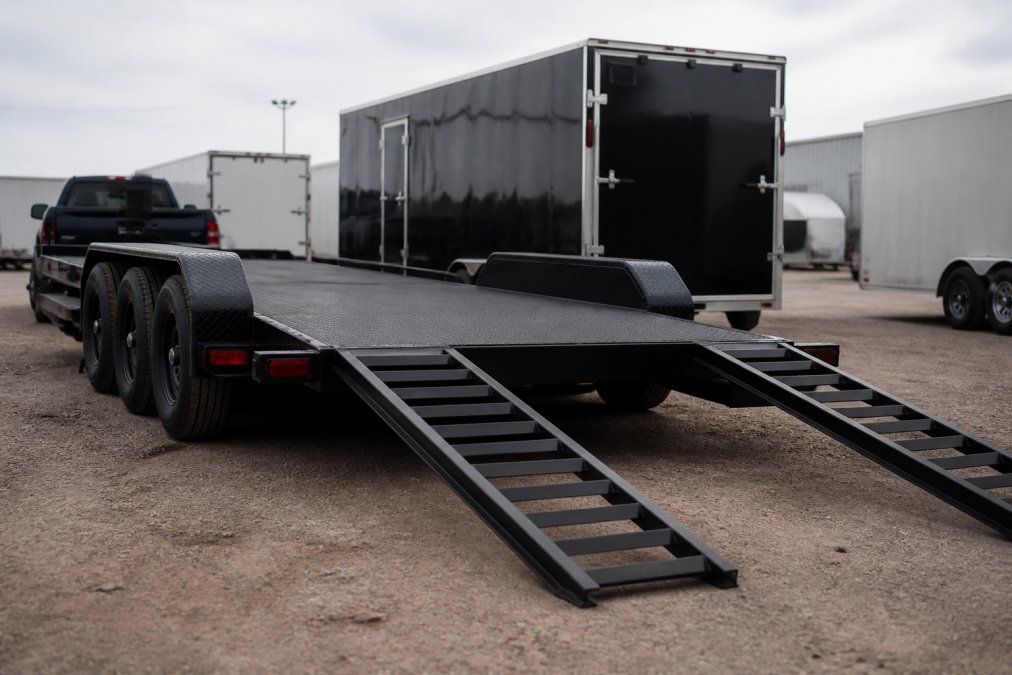
Matching trailer type to project prevents overpaying and under-equipping. Flatbeds handle oversized or awkward loads; dump trailers move loose material and debris; cargo trailers protect contents from weather and theft; car haulers, including tilt-deck and deckover, are purpose-built for vehicle transport with low loading angles.
| Project | Recommended Trailer | Key Spec to Check |
|---|---|---|
| Classic or race car transport | Car hauler, tilt deck | Deck length and ramp angle |
| Equipment hauling | Flatbed or deckover | Payload capacity, tie-down points |
| Debris and material removal | Dump trailer | Dump angle, GVWR |
| Moving with weather protection | Enclosed cargo | Interior dimensions, ramp rating |
| Multiple vehicles | Tandem axle deckover | Axle rating, total GVWR |
Tandem axle setups distribute weight better and track straighter at highway speed, which matters on longer hauls. Single-axle trailers are lighter and easier to maneuver but less stable near capacity.
CDL Requirements for Heavy-Duty Hauling in Nebraska
Most renters hauling a project car or equipment on a bumper-pull trailer never need a CDL. But the line is defined by federal weight thresholds and the nature of the operation, not by how big the trailer looks in the lot.
The Federal Thresholds That Trigger a CDL
Federal rules set the baseline Nebraska adopts. A CDL is generally required when you operate:
- A combination of vehicles with a gross combination weight rating (GCWR) of 26,001 lbs or more, provided the towed unit has a GVWR over 10,000 lbs; or (fmcsa.dot.gov)
- A single vehicle with a GVWR of 26,001 lbs or more; or
- A vehicle designed to transport 16 or more passengers; or
- A vehicle carrying hazardous materials in quantities requiring placards.
The 10,000-lb trailer rule catches heavy-duty renters. A three-quarter-ton pickup (GVWR around 10,000 lbs) pulling a 14,000-lb GVWR deckover puts the combination past 26,001 lbs GCWR, and the trailer alone exceeds 10,000 lbs, crossing the CDL line on paper even when empty.
The Personal-Use Exemption, and Where It Stops
Federal rules exempt recreational vehicles and personal-use operations that don't involve commerce (fmcsa.dot.gov). A hobbyist towing a race car to a track day on a 14,000-lb trailer is generally fine with a standard license; the same rig pulling a customer's car for a shop is a different question.
The distinction is whether the haul is in furtherance of a commercial enterprise. Signs you're commercial:
- You're being paid to move the vehicle or equipment.
- The vehicle belongs to a customer of your business.
- The trailer or tow vehicle is titled to a business.
- You're operating under a DOT number or app-based dispatch.
If any apply, treat the CDL question as live and verify before you hook up.
Class A vs. Class B vs. Class C for Trailer Renters
| License Class | Typical Use for Trailer Renters |
|---|---|
| Class A | Combination over 26,001 lbs GCWR with a towed unit over 10,000 lbs GVWR, the class most heavy gooseneck and large deckover combos fall under |
| Class B | Single vehicle over 26,001 lbs GVWR, or towing a unit under 10,000 lbs GVWR |
| Class C | Vehicles under 26,001 lbs GVWR that don't meet A or B, includes most standard-license personal towing |
| Non-CDL Class C / standard | Personal-use towing under the thresholds above |
Endorsements and Additional Requirements
Beyond the base class, heavy-duty haulers may need:
- Air brake endorsement if the trailer is equipped with air brakes.
- Hazmat endorsement for placarded loads.
- Medical examiner's certificate for most commercial operation.
- ELDT (Entry-Level Driver Training) completion before taking the skills test for a new Class A or B.
How to Verify Your Specific Setup
- Find the GVWR on the tow vehicle's door jamb sticker.
- Find the GVWR on the trailer's tongue plate.
- Add them for a rough GCWR (actual loaded weight is what matters, but GVWR is the conservative planning number).
- Compare against the 26,001-lb and 10,000-lb thresholds.
- Ask whether the trip is personal or in furtherance of a business.
Conclusion: Choosing the Right Heavy Duty Trailer Rental Omaha Provider
The hard part of heavy duty trailer rental Omaha isn't finding a trailer. It's finding one whose terms survive a slipped timeline, whose fleet you trust at highway speed, and whose pricing you understand before you sign.
402 car hauler rentals offers flexible terms for project timelines that move, competitive rates, and a fleet for transporting project cars and race vehicles. Whether you're a hobbyist hauling a restoration or a shop moving customer vehicles, the trailer is ready.
Get started with 402 car hauler rentals and haul your next vehicle with terms that fit your project, not a calendar.
Frequently Asked Questions
What are the weight capacity requirements for heavy duty trailer rentals in Omaha?
Heavy duty trailer rental capacity depends on the trailer class. Tandem axle flatbed and car hauler trailers commonly handle payloads between 7,000 and 10,000 pounds, while deckover and gooseneck models can exceed that. You must check the trailer's gross vehicle weight rating (GVWR) against your truck's towing capacity. Never exceed the lower of the two ratings. Ask the rental provider for the specific GVWR and payload capacity before booking.
Do I need a special license to tow a heavy duty trailer?
In most cases, a standard driver's license is enough for trailers under 10,000 pounds GVWR. A Commercial Driver's License (CDL) is required when the combined vehicle and trailer weight exceeds 26,001 pounds, or when the trailer itself exceeds 10,000 pounds and the combination crosses that threshold. Nebraska follows federal CDL standards. Confirm your specific setup with the rental provider before you book.
Is trailer rental insurance included, or do I need my own policy?
Most rental providers offer basic liability coverage as an add-on, but it often excludes damage to the trailer itself or to the vehicle being hauled. Your personal auto policy may extend to rental trailers, but coverage varies by insurer. Before you sign the rental agreement, ask exactly what trailer rental insurance covers, what the deductible is, and whether your own policy needs to be primary. Get it in writing.
What is the difference between a standard utility trailer and a heavy duty car hauler?
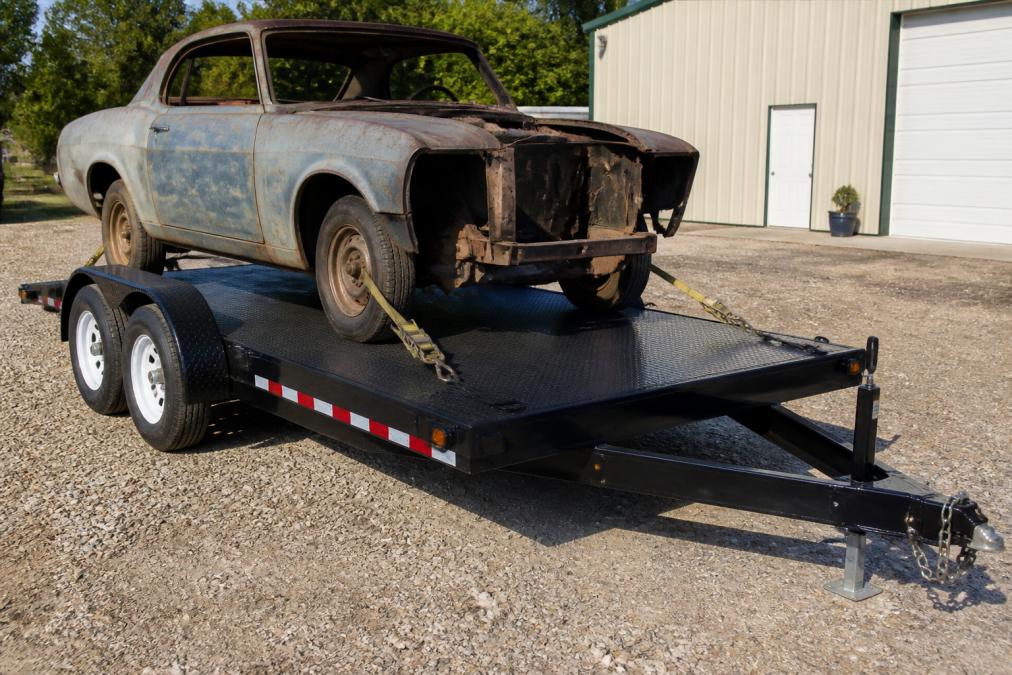
A standard utility trailer is built for light loads like lawn equipment or furniture, with lower payload capacity and smaller dimensions. A heavy duty car hauler uses a reinforced frame, tandem axles, and a longer deck designed specifically for vehicles. Car haulers also include tie-down points, ramps or a tilt deck, and brake controllers. For transporting a classic car, race car, or heavy equipment, a car hauler is the correct choice.
How do I reserve a heavy duty trailer rental in Omaha?
Most Omaha rental providers let you reserve online or by phone. You will need a valid driver's license, proof of insurance, and a credit card for the deposit. Confirm the pickup location, rental dates, and whether the trailer has a brake controller and correct hitch class for your truck. Ask about the cancellation policy and any fees for late returns. Book early for weekends and event dates when demand is highest.