 listicle
Best Tie Down Points for Classic Cars: 2026 Guide
Table of Contents
- Types of Tie-Down Straps for Classic Cars
- How to Secure a Classic Car on a Trailer
- Wheel Net vs Frame Strap for Classic Cars
- Choosing Trailer Attachment Points: E-Track vs D-Rings
- Towing Safety Tips for Vintage Vehicles
- Avoiding Paint and Wheel Damage During Transport
- Legal and Insurance Requirements for Classic Car Transport
- Frequently Asked Questions
Last Updated: September 30, 2026
Types of Tie-Down Straps for Classic Cars
The best tie down points for classic cars depend on one decision: whether you secure the vehicle by its axles or by its wheels. Get that right and everything else, from strap width to anchor placement, falls into line. This guide breaks down the hardware, attachment methods, and protection steps that keep a vintage car's frame and finish intact.
Axle Straps: Direct Frame Connection
Axle straps are heavy-duty webbing loops that wrap around a vehicle's axle housing and connect to ratchet straps, creating a direct, low-angle pull that holds the chassis against the trailer deck. They use reinforced D-rings and protective sleeves to guard against frame damage, and work best on exposed, sturdy axles like older solid-axle classics; enclosed suspension and independent rear setups are hard to route safely.
Wheel Nets and Soft Loops: Protecting Expensive Wheels
Wheel nets cradle the tire and secure it to the trailer deck, isolating the suspension from the tie-down force. Soft loops do similar work at a smaller scale, protecting delicate wheel finishes.
How to Secure a Classic Car on a Trailer
Securing a classic car means anchoring it so the chassis and suspension can't shift, bounce, or creep during the drive. It takes about 20 to 30 minutes once you've done it a few times.
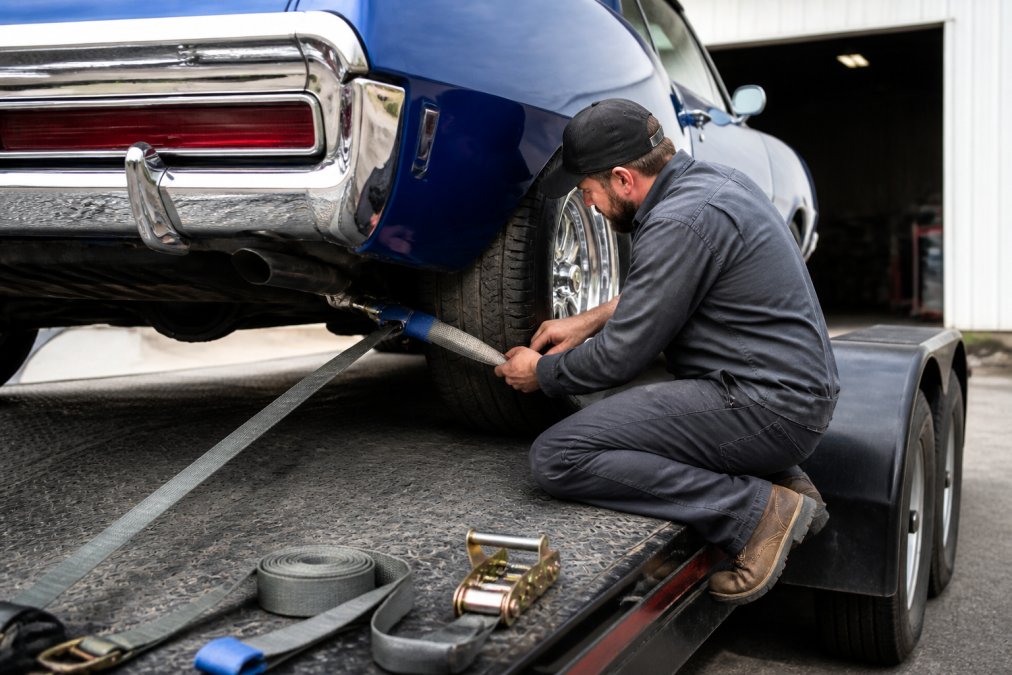
Step-by-Step Securement Process
- Park the tow vehicle and trailer on level ground and set the parking brake.
- Load the car slowly, centering it over the axles for even load distribution.
- Set chock blocks against the front and rear of at least one tire.
- Route axle straps or wheel nets around your chosen tie-down points.
- Attach ratchet straps and tension them in a cross pattern, front-left to rear-right and so on.
- Tighten each strap evenly, checking that the suspension sits at its normal ride height.
- Add redundant safety chains as a backup to the primary straps.
- Re-check tension after the first few miles and at every stop.
A common mistake is over-tightening. Cranking a ratchet down too far compresses the suspension and can bend a control arm or stress a mounting point. Snug, not crushing, is the goal.
Wheel Net vs Frame Strap for Classic Cars
Wheel nets win for classic cars with delicate suspension or expensive wheels; frame and axle straps win for sturdy exposed axles.
| Method | What It Secures | Best For | Main Drawback |
|---|---|---|---|
| Axle straps | Axle housing | Exposed solid axles | Hard on enclosed suspension |
| Wheel nets | Tire and wheel | Low-clearance and rare wheels | Needs specific anchor points |
| Frame straps | Chassis rails | Sturdy full-frame cars | Can stress weak mounting points |
| Soft loops | Wheel finish contact points | Protecting expensive wheels | Extra step in the process |
Choosing Trailer Attachment Points: E-Track vs D-Rings
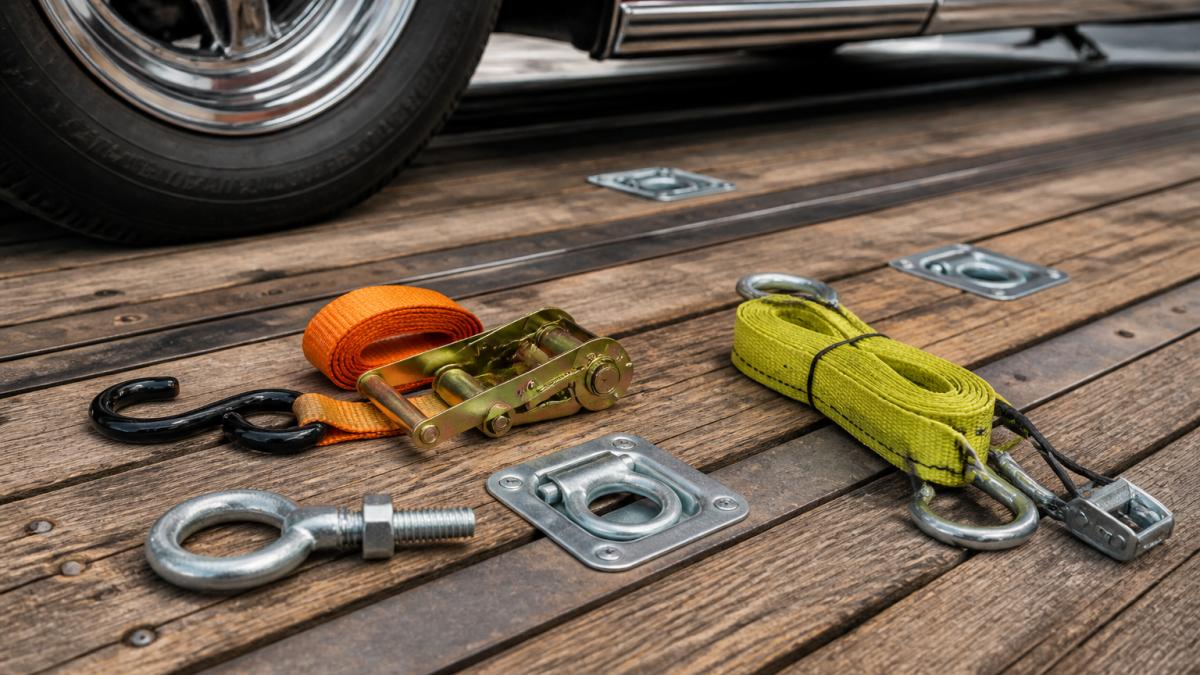
E-track and D-rings are the two anchor systems on most car hauler trailers. E-track is a slotted horizontal rail that lets you slide anchor fittings anywhere along its length; D-rings are fixed steel loops, surface-mounted or recessed. What most guides skip is that the deck material underneath the anchor decides which hardware actually holds.
Matching Hardware to Deck Material
A tie-down anchor is only as strong as what it's bolted to. The same D-ring that's rock-solid on a steel deck can pull through a wood plank under a hard stop.
| Deck Type | Best Anchor Hardware | Mounting Notes | Watch Out For |
|---|---|---|---|
| Wood plank (2x6 or 2x8) | Surface-mount D-rings with backing plates, or bolt-through E-track | Use a steel backing plate or fender washer under the deck; bolts must pass through the plank, not just the top face | Plank splitting, rot, and loose fasteners after freeze-thaw cycles |
| Steel deck | Weld-on D-rings, recessed D-rings, or bolt-on E-track | Welded anchors need a qualified welder; bolt-on needs grade-8 hardware | Paint cracking around welds, rust creep |
| Aluminum deck | Bolt-on E-track or D-rings with aluminum-specific fasteners | Use anti-galling compound on stainless fasteners; avoid welding to heat-treated aluminum | Galvanic corrosion between dissimilar metals |
| Composite or coated deck | Bolt-through anchors with wide backing plates | Confirm the deck's load rating with the manufacturer before drilling | Hidden voids that crush under load |
E-Track: Flexibility With a Rating to Respect
Standard 2-inch E-track is typically rated around 2,000 lb per fitting when the rail is fastened to a sound deck, and the rail carries a higher working load than any single fitting, so the fitting is usually your weak link. Hauling a 3,500 lb classic, four fittings at 2,000 lb each gives headroom, but only if the deck under the rail is solid.
D-Rings: Permanence and a Known Rating
Recessed and surface-mounted D-rings are fixed steel loops, and their rating is set by the anchor and its mounting hardware together. A recessed D-ring rated at 5,000 lb is worthless held by two lag bolts into a soft plank. Surface-mounted rings need high-strength hardware and, on wood decks, a backing plate underneath.
Anchor Angle Changes Everything
The best tie down points for classic cars on a trailer are rated for the load and positioned to pull at a shallow angle. A strap pulling straight down at 90 degrees stresses an anchor far more than one at 25 to 45 degrees; as the angle steepens, the effective load climbs well past the strap's tension, so an anchor fine for a shallow pull can be overloaded by a vertical one.
Towing Safety Tips for Vintage Vehicles
Towing safety for vintage vehicles starts with matching strap ratings to the car's actual weight. Every strap carries a working load limit (WLL), the maximum load it's designed to hold in normal use, always lower than its break strength.
Other habits that matter:
- Inspect webbing for cuts, fraying, or UV damage before every trip.
- Replace any strap with a damaged ratchet mechanism rather than forcing it.
- Check tire pressure on the trailer, not just the tow vehicle.
- Keep the load's center of gravity low and centered over the axles.
Avoiding Paint and Wheel Damage During Transport
Paint and wheel damage during transport usually comes from strap contact, not the road. A strap vibrating against a fender for hundreds of miles wears through clear coat; a metal hook touching a polished rim leaves a mark. On original single-stage paint or a fresh respray, that damage can't be buffed out of a thin or aged finish like it can on modern clear coat.
Contact-Point Materials, Ranked
| Material | What It Protects | Best Use | Limits |
|---|---|---|---|
| Cordura or heavy nylon sleeve | Strap-to-paint contact | Sliding over any webbing that crosses a panel | Adds bulk; can trap grit if not cleaned |
| Neoprene or felt-lined sleeve | Delicate or aged paint | Show cars, single-stage finishes | Felt holds moisture; dry before storage |
| Soft loop (nylon or polyester) | Wheel and rim contact | Wrapping through a wheel or around an axle | Must be rated for the load, not just soft |
| Rubber-coated hook | Hook-to-anchor contact | Trailer-side attachment | Coating wears; inspect before each trip |
| Microfiber pad under a strap | High-pressure contact points | Where a strap crosses a sharp body edge | Can shift; secure it |
Collectors hauling show cars treat every strap-to-car contact as a two-layer problem: a soft loop or sleeve against the car, a clean strap against the sleeve. Grit trapped between sleeve and paint does the same damage as a bare strap, so wipe both before every load.
Routing Rules That Prevent Damage
- Route every strap so it clears body panels by at least a finger's width. Contact under tension is contact that rubs.
- Use the shortest hook that reaches your anchor point. A long hook has more metal to swing into a panel.
- Cross straps in a shallow X pattern rather than pulling straight down, which keeps them off fenders and rocker panels.
- Never route a strap over a brake line, fuel line, or wiring harness. A strap that chafes through a line is a mechanical failure, not a cosmetic one.
- Pad sharp body edges where a strap has to cross them, even with a sleeve in place.
Protecting Wheels and Rims
Wheel nets and soft loops isolate the tire and rim from metal contact, but the loop itself must be rated for the load. A soft loop designed only to protect finish, not carry tension, can fail under a hard stop, check the working load limit, not just the material.
Legal and Insurance Requirements for Classic Car Transport
Transporting a classic car comes with legal and insurance requirements that vary by state and policy. Most states require a properly rated hitch, working trailer lights, and safety chains. Cargo securement rules apply to commercial haulers, and many states extend similar standards to private towing.
Frequently Asked Questions
What is the easiest tie-down system to use for classic cars?
Wheel nets with soft loops are often the easiest for classic cars because they secure the tire directly without reaching under the vehicle. You place the net over the tire, hook it to E-track or D-rings, and ratchet it down. Axle straps work well too but require access to the axle, which can be difficult on low-clearance classics. Both systems need proper tensioning and regular checks during transport.
How many tie-down points do I need to safely secure a vehicle?
You need at least four tie-down points, one at each corner of the vehicle. For classic cars, many owners use six or eight points for extra stability, especially on long hauls. Each strap should have a working load limit that together exceeds the vehicle weight by at least 50%. Check that your trailer has enough D-rings or E-track sections to accommodate the pattern you plan to use.
Should I use frame-mounted or wheel-net tie-down points?
It depends on your priorities. Frame-mounted axle straps connect directly to the chassis for a very secure hold, but they compress the suspension and can stress older frame components. Wheel nets secure the tire to the trailer deck, isolating the suspension and protecting the frame from stress. For classic cars with original suspension or delicate undercarriages, wheel nets are usually the safer choice.
What are the best tie-down straps for protecting classic car paint?
Look for straps with soft loops or protective webbing sleeves. Soft loops wrap around axles or through wheels without metal-to-paint contact. Webbing sleeves slide over the strap where it touches the vehicle body. Flat-eye wheel straps also minimize abrasion. Avoid any strap with exposed hooks or hardware that could rub against fenders or bumpers during tensioning. Inspect straps before each use for fraying or wear.
Is it better to cross tie-down straps or run them parallel?
Crossing straps front-to-rear helps prevent side-to-side movement during turns and braking. Parallel straps work for straight-line towing but allow more lateral shifting. Many haulers use a combination: parallel straps on the front and crossed straps on the rear. Whatever pattern you choose, ensure each strap has a clear path to its anchor point without rubbing against brake lines, fuel lines, or exhaust components.