 listicle
Best Car Hauler for Restoration: 2026 Buyer's Guide
Table of Contents
- Open vs. Enclosed Car Hauler for Restoration: Which Type You Need
- Essential Trailer Features for Non-Running Cars
- Trailer Rental vs. Buying for Restoration Projects
- Top Car Hauler Options for Restoration Work
- 402 Car Hauler Rentals: Flexible Rental Solution for Restoration Hauling
- Futura Trailers: Lowering Deck for Low-Clearance Vehicles
- JIMGLO Enclosed Car Trailer: Maximum Protection for High-Value Projects
- Iron Bull Car Haulers: Heavy-Duty Steel Construction
- Featherlite Trailers: Industry Standard for Professionals
- ATC Trailers: Modular Design with Workshop Capability
- PJ Trailers: Nationwide Support and Durability
- Cons:
- Critical Specs: Weight Capacity, Axle Configuration, and Payload
- Choosing the Right Best Car Hauler for Your Project
- Frequently Asked Questions
Last Updated: September 20, 2026
Open vs. Enclosed Car Hauler for Restoration: Which Type You Need
Choosing the best car hauler for restoration is the first decision you'll make when transporting a restoration project, and the choice depends on your vehicle's condition and value.
An open car hauler exposes your vehicle to road debris, weather, and UV damage during transport. It's lighter to tow, easier to load and unload, and typically costs less upfront. An enclosed car hauler protects your project from all environmental hazards, making it the choice for finished restorations or high-value builds.
The key factors are your vehicle's condition, distance traveled, and whether you're protecting a finished investment or moving functional transportation.
If your paint is done or you're hauling a finished car to a show, enclosed is the only sensible choice. If you're moving a stripped frame or donor vehicle, open saves money without real risk.
Essential Trailer Features for Non-Running Cars
Non-running vehicles present unique loading challenges because they can't drive onto the deck, the trailer must do the work.
The most critical feature is a tilt bed or lowering deck. This mechanism drops the trailer bed toward the ground, reducing the angle of ramps and making it possible to load a vehicle with minimal power from a tow vehicle. Without it, you're fighting gravity and the laws of physics every time you load a non-runner.
Ramps matter enormously. Steel ramps are durable but heavy; aluminum ramps weigh less but flex under load. Look for ramps at least 12 inches wider than your vehicle's track width to prevent wheels from slipping off edges.
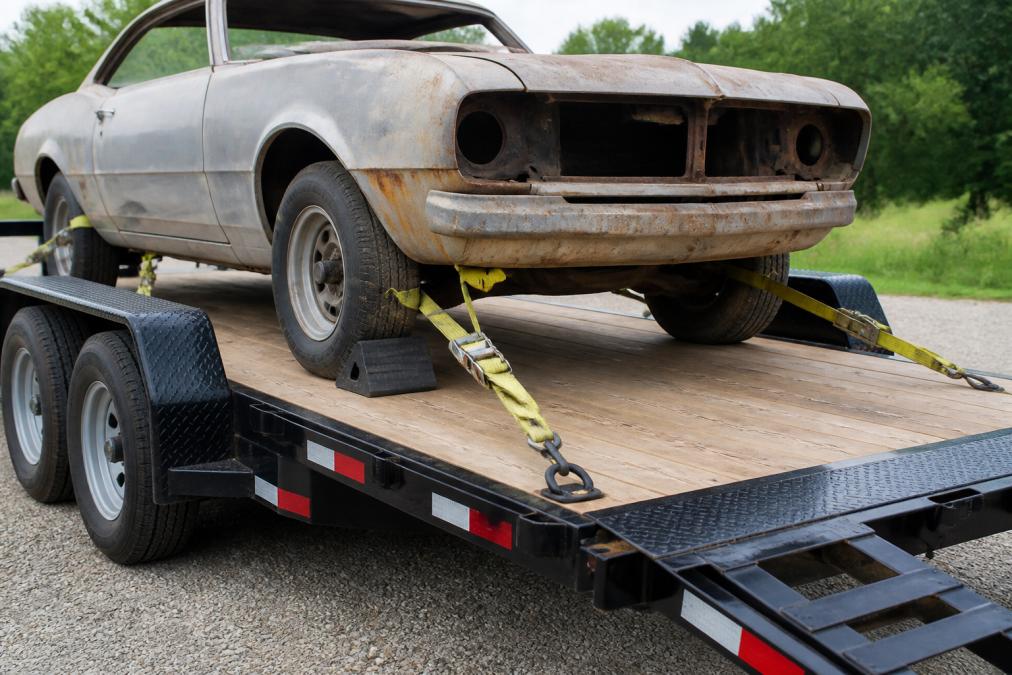
Tie-down points must be abundant since non-runners rely entirely on straps and chains. You need at least four solid anchor points; better trailers have integrated tie-down tracks or D-rings spaced every foot or two along the deck.
Wheel chocks prevent forward and backward movement. They should be adjustable to fit different wheel sizes and constructed so they won't slip when the vehicle is loaded. Many trailers include basic chocks; better ones have heavy-duty designs that lock in place.
A winch or come-along mounted at the front makes pulling a non-runner up the ramps manageable. Electric winches are faster than hand-crank models.
Trailer Rental vs. Buying for Restoration Projects
Renting makes sense if:
- You're moving a single vehicle to a new location
- Your restoration timeline is uncertain
- You don't have secure storage for a trailer
- You want to avoid maintenance and registration costs
- You need a specific trailer type for one job
Rental offers flexibility without commitment, but costs add up if you need the trailer multiple times per year.
Buying makes sense if:
- You'll haul multiple vehicles over the next 2-3 years
- You have storage space at home or a shop
- You want the trailer available whenever you need it
- You're willing to handle maintenance and repairs
Owning a trailer gives you control over scheduling and the ability to customize it. Over time, if you use it regularly, ownership becomes cheaper than renting.
Top Car Hauler Options for Restoration Work
402 Car Hauler Rentals: Flexible Rental Solution for Restoration Hauling
402 Car Hauler Rentals in Omaha offers flexible booking and competitive rates designed for restoration projects.
Their flexible rental terms accommodate unpredictable restoration schedules, and you get reliable trailers.
Local service in the Omaha area means you can discuss your specific hauling needs and get a rental solution that fits your project.
Pros:
- Flexible booking terms adapted to restoration timelines
- Reliable, well-maintained trailers
- Competitive rates
- Local service understanding restoration projects
Cons:
- Availability limited to Omaha service area
- Best for regional hauling, not long-distance moves
Futura Trailers: Lowering Deck for Low-Clearance Vehicles
Futura's lowering deck design solves the problem of loading low-slung restorations without damaging the front bumper or hood.
All-aluminum construction keeps the trailer light, and the integrated tie-down system makes loading non-runners easier.
Pros:
- Exceptional lowering deck reduces loading strain
- Lightweight aluminum construction
- Integrated tie-down system
- Corrosion-resistant build
Cons:
- Significantly higher purchase price
- Overkill for basic hauling needs
JIMGLO Enclosed Car Trailer: Maximum Protection for High-Value Projects
JIMGLO specializes in enclosed trailers with aerodynamic design and customizable interiors to protect finished restorations from road hazards and weather damage.
This is the trailer for show cars and high-value restorations where appearance matters.
Pros:
- Superior environmental protection
- Professional aesthetic
- Customizable interior
- Aerodynamic design
Cons:
- Significant investment cost
- Heavier to tow than open trailers
- Overkill for donor vehicles or frames
Iron Bull Car Haulers: Heavy-Duty Steel Construction
Iron Bull builds heavy-duty steel trailers for high-volume haulers, prioritizing durability over weight with proven powder-coat finishes.
This is practical equipment for frequent hauling. Steel construction is heavier than aluminum but offers durability that justifies the weight for regular use.
Pros:
- Solid value for the price
- Rugged build quality
- Multiple ramp storage options
- Proven powder-coat durability
Cons:
- Heavier than aluminum models
- Less refined finish than premium brands
Featherlite Trailers: Industry Standard for Professionals
Featherlite is the choice of professional restoration shops and race teams, with all-aluminum construction and versatile tie-down systems built to last decades.
Featherlite trailers offer nationwide parts and service availability.
Pros:
- Excellent resale value
- Lightweight and durable
- Versatile tie-down systems
- Nationwide parts and service availability
Cons:
- Premium pricing
- Overkill for occasional haulers
ATC Trailers: Modular Design with Workshop Capability
ATC builds enclosed trailers with bolt-together modular construction that allows customization for interior storage, cabinets, and workspace, ideal for mobile workshops.
This is ideal if you want your trailer to serve as a mobile restoration shop or race support vehicle.
Pros:
- Highly customizable
- Durable modular construction
- Interior workspace options
- Easier repairs than welded designs
Cons:
- Longer lead times for custom builds
- Premium pricing for customization
- More complex than standard trailers
PJ Trailers: Nationwide Support and Durability
PJ Trailers offer extensive nationwide dealer networks for parts and service, with heavy-duty steel frames and multiple deck configurations.
This is the practical choice if you want reliable service availability and durable steel construction.
Pros:
- Easy to find parts and service
- Very durable steel frame
- Multiple deck configurations
- Extensive dealer network
Cons:
- Heavier than aluminum alternatives
Kaufman Trailers: Budget-Friendly Steel Option
Kaufman offers no-frills steel trailers at budget prices with standard construction and simple functional design.
Pros:
- Highly affordable
- Simple maintenance
- Reliable basic functionality
Cons:
- Basic features compared to premium brands
- Less refined construction quality
Critical Specs: Weight Capacity, Axle Configuration, and Payload
Gross Vehicle Weight Rating (GVWR) is the maximum combined weight of trailer and contents. Check your vehicle's title for its GVWR before buying a trailer.
Tandem axle trailers (two axles) handle heavier loads and distribute weight more evenly than single-axle designs, providing better stability and brake distribution.
Payload capacity is what the trailer can carry after subtracting its own curb weight. A trailer with a 10,000-pound GVWR and a 2,000-pound curb weight has 8,000 pounds of payload. Your restoration vehicle must weigh less than that. If you're unsure of your vehicle's weight, weigh it at a truck scale before committing to a trailer.
Tongue weight, the downward force the trailer exerts on your tow vehicle's hitch, typically runs 10-15% of the total trailer weight. A 5,000-pound trailer might have 500-750 pounds of tongue weight. Your tow vehicle must be rated for that.
Choosing the Right Best Car Hauler for Your Project
Start with your vehicle's condition and weight. A running vehicle under 3,500 pounds can go on a basic open trailer. A non-running vehicle or anything over 4,000 pounds needs a tandem-axle trailer with a tilt bed or lowering deck.
Frequently Asked Questions
What is the best car hauler for restoration projects?
The best car hauler depends on your vehicle type and budget. For low-clearance restoration cars, a lowering deck trailer like Futura eliminates loading challenges. For high-value finished projects, enclosed options like JIMGLO provide weather and debris protection. For frequent haulers, steel-frame trailers from Iron Bull or PJ offer durability and value. Rental options like 402 Car Hauler Rentals work well for one-time transport without ownership costs. Consider your vehicle's weight, dimensions, and condition before deciding.
Should I choose an open or enclosed trailer for a restoration vehicle?
Open trailers suit budget-conscious restoration projects and work well for short distances. They offer easier loading, lower cost, and simpler maintenance. Enclosed trailers protect high-value or finished restoration vehicles from road debris, weather, and UV damage. They also provide security during transport. Choose open if your restoration is still in progress; choose enclosed if it's nearing completion or has significant value. Your vehicle's condition and the distance traveled should guide this decision.
What features are essential when hauling a non-running restoration car?
Non-running restoration cars require trailers with multiple tie-down points, integrated ramp systems, and adequate deck length for safe positioning. Lowering deck technology reduces loading angles and prevents undercarriage damage. Wheel chocks secure the vehicle during transport. Electric brakes improve safety on longer hauls.
What is the 60/40 rule on trailers, and why does it matter for restoration cars?
The 60/40 rule states that 60% of the load should be forward of the trailer's axle and 40% behind it. This distribution prevents trailer sway, reduces strain on your tow vehicle, and maintains stable handling during transport. For restoration cars, proper weight distribution protects the vehicle from shifting during braking or turning. Uneven loading can damage suspension components or cause the vehicle to slide. Always position the restoration car's center of gravity forward of the axle for safe hauling.