 how-to
How to Winch a Car Onto a Trailer: Step-by-Step
Table of Contents
- What You'll Need Before You Winch a Car Onto a Trailer
- Car Winch Capacity for Trailer Loading: How Much Pull Do You Need?
- Mounting the Winch and Setting Up the Trailer
- Where to Attach a Winch to a Car (and Where Not To)
- Step-by-Step: Winching the Car Onto the Trailer
- Loading a Non-Running Car Onto a Trailer
- How to Secure a Car on a Trailer After Loading
- Common Mistakes to Avoid When Winching a Car
- Frequently Asked Questions
Last Updated: October 15, 2026
What You'll Need Before You Winch a Car Onto a Trailer
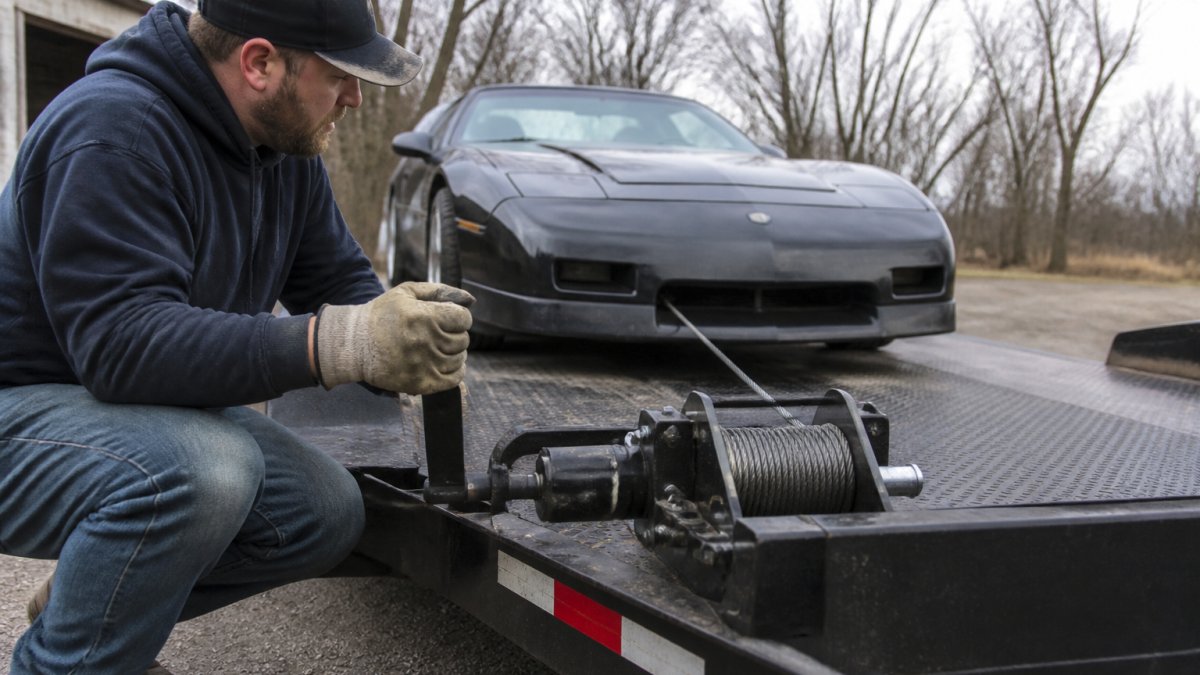
Winching a car onto a trailer is the safest way to load a vehicle that can't drive up the ramps under its own power. The pull goes right when the setup is right.
Before you winch a car onto a trailer, gather this gear and check it twice:
- Winch rated above your vehicle's weight, not equal to it
- Charged battery or jumper pack to power the winch
- Heavy gloves and eye protection for everyone near the line
The Occupational Safety and Health Administration guidance on machine guarding and stored energy treats a loaded winch line as stored energy. That's the right mindset. A stretched cable or rope holds force that releases the instant something fails.
Winch, Power Source, and Rigging Gear Checklist
Run this list before every load:
- Winch capacity at least 1.5 times the vehicle weight
- Battery charged, cables long enough to reach the winch
- Hook, shackle, and strap inspected for cracks or fraying
Car Winch Capacity for Trailer Loading: How Much Pull Do You Need?
Car winch capacity for trailer loading comes down to one number: your vehicle's weight, plus a safety cushion. A winch that only matches the car's weight will strain and stall on a dead pull, especially up ramps.
Why the 1.5x Rule Exists
A winch's rated capacity is the maximum line pull at the drum's first layer of rope or cable.
The 1.5x multiplier is a working cushion, not a physics formula. It covers drum-layer derating, rolling resistance (roughly 2 to 5 percent of vehicle weight on pavement, higher on gravel or grass), ramp angle, and stiction, the extra force to break a parked car free.
Worked Examples at Real Vehicle Weights
| Vehicle | Curb Weight | Minimum Winch Rating (1.5x) | Comfortable Rating (2x) |
|---|---|---|---|
| Compact car | 2,800 lb | 4,200 lb | 5,600 lb |
| Mid-size sedan | 3,400 lb | 5,100 lb | 6,800 lb |
| Half-ton pickup | 5,000 lb | 7,500 lb | 10,000 lb |
| Full-size SUV | 5,800 lb | 8,700 lb | 11,600 lb |
| Classic muscle car | 3,600 lb | 5,400 lb | 7,200 lb |
Find your curb weight on the driver's door jamb sticker or in the owner's manual. Use that number, not the gross vehicle weight rating, which includes passengers and cargo you won't have on the trailer.
Adjusting for Slope, Drag, and Condition
The multiplier changes with the situation:
- Flat ground, rolling car: weight x 1.5
- Up ramps, rolling car: weight x 1.5 to 2
- Non-running, dragging car: weight x 2 or more
Size the winch for the worst case you expect, a dead, locked vehicle on a steep ramp, not the best case. A larger winch running at half capacity runs cooler, pulls smoother, and lasts far longer than a small winch at its limit.
Synthetic Rope vs. Steel Cable
Synthetic rope and steel cable each have a place. Synthetic rope is lighter, safer if it breaks, and easier to handle. Steel cable resists abrasion better and costs less, but stores more energy and can cut if it snaps.
- Synthetic rope: best for most trailer loading, safer snap-back, floats, easy to inspect for fraying
- Steel cable: tough surfaces, tight budgets, but heavier, sharper if it fails, and prone to kinks that weaken it
- Both: inspect before every use, replace at the first sign of damage, and match the line's working load limit to the winch rating, not just the winch's motor
Mounting the Winch and Setting Up the Trailer
A winch is only as good as the mount holding it and the power feeding it. A weak mount flexes under load and can tear free, sending the winch flying. Undersized wiring overheats, drops voltage, and turns a strong winch sluggish.
Winch Mount Location and Trailer Frame Prep
Mount the winch to a plate bolted or welded to the trailer frame, centered on the deck. The line should pull straight down the middle of the trailer, not at an angle.
- Center the mount so the car loads straight
- Bolt through the frame, not sheet metal, grade 8 hardware at minimum
- Check the height so the line clears the deck and ramps without rubbing
A winch plate spreads the load across the frame. Bolting directly to a thin crossmember concentrates force at four points and can crack the metal. If you weld, use a qualified welder, a cold weld on a winch plate is a failure waiting to happen.
Powering the Winch: Battery, Cables, and Fuses
A winch draws serious current, often 200 to 400 amps under heavy load, and the power source has to deliver it without melting.
Three common power arrangements:
- Vehicle battery: Simplest if the tow vehicle is close enough. Keep the cable run short, long runs drop voltage and heat the cable.
- Trailer-mounted battery: A dedicated deep-cycle battery keeps the winch self-contained. Charge it between uses; it tolerates the slow, heavy draw better than a starting battery.
- Jumper pack or portable power station: Fine for occasional light pulls, but check the amp rating. Many consumer jumper packs cannot sustain a winch's draw and will shut down mid-pull.
Cable and fuse considerations:
- Cable gauge: Match the winch maker's recommendation for your run length. Undersized cable is the most common cause of weak, slow winching.
- Fuse or breaker: Install one rated for the winch's peak draw, close to the battery. It protects the wiring if the winch stalls or shorts.
- Connections: Clean, tight, and protected from corrosion. A loose terminal arcs, heats, and can start a fire.
Setting Up the Trailer and Ramps
Set the trailer on level ground, chock the wheels front and back, and lower the ramps so they sit flat with no gap.
- Match ramp width to tire width, narrow ramps let tires slip off the edge
- Secure ramps to the trailer with pins or straps so they can't kick out under load
- Check the approach angle, a steep ramp scrapes low front lips and splitter
If the trailer sits on a slope, block the low side so the deck is level. A tilted deck walks the car sideways as it loads.
Where to Attach a Winch to a Car (and Where Not To)
Where to attach a winch to a car decides whether the pull is safe. Use a solid, factory-rated recovery point or the vehicle's frame, never anything that can bend, snap, or tear loose.
Safe points include:
- Factory tow hooks
- Frame rails
- A rated recovery point bolted to the frame
If the car has no good point, use axle straps around the frame joined to the winch hook with a rated shackle. The connection must be as strong as the winch line.
Step-by-Step: Winching the Car Onto the Trailer
Here's the full sequence, start to finish:
- Park the trailer on level ground and chock the wheels.
- Lower and secure the ramps so they can't shift.
- Line the car up straight with the ramps, centered.
- Set the car in neutral and release the parking brake.
- Attach the winch line to a rated point with a shackle.
- Power the winch and take up the slack slowly.
- Winch in steadily, watching the car stay centered.
- Stop when the car's wheels sit over the trailer's tie-down points.
- Set the parking brake and shift to park.
- Disconnect the winch line and stow it.
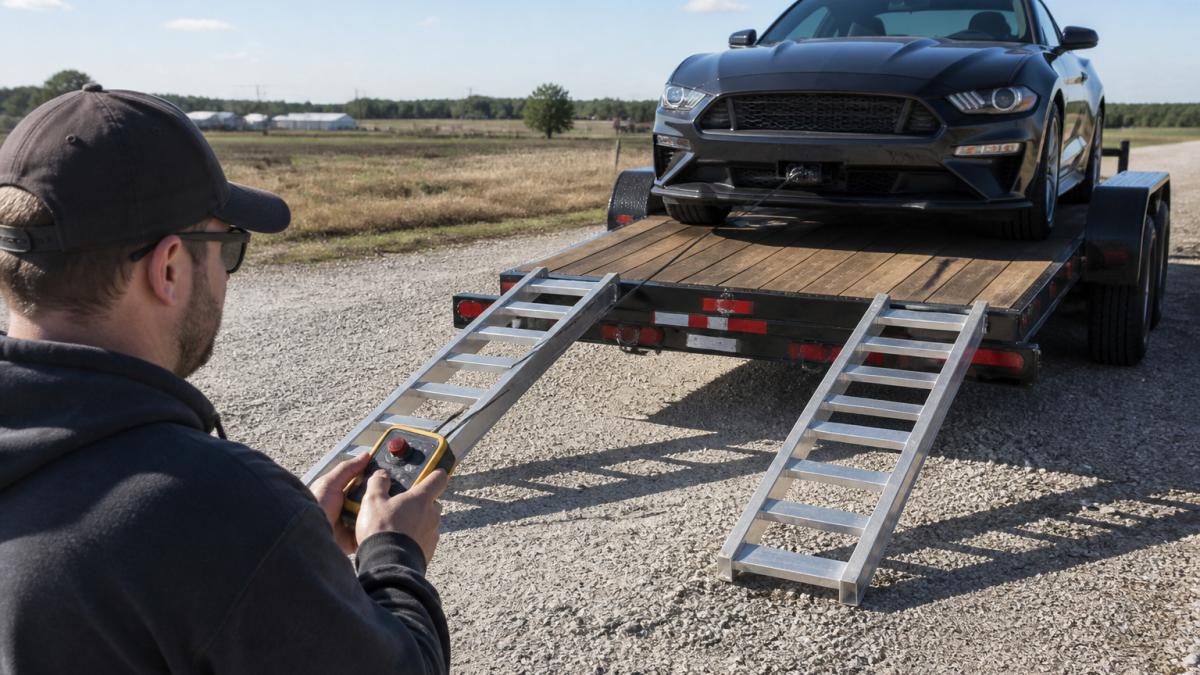
Keep the pull slow and steady. Fast pulls jerk the car and can walk it off-center. If the car drifts, stop, reset, and start again.
Loading a Non-Running Car Onto a Trailer
Loading a non-running car onto a trailer needs more pull and more care. A car with locked brakes or a seized drivetrain drags instead of rolls, so the winch works harder.
- Free the wheels if you can, release the brake, or pull the axles
- Use a bigger winch than a rolling car would need
- Add soap or a slip plate under dragging tires to cut friction
If the steering locks, straighten the front wheels before the pull. A car that can't steer will fight the ramps.
How to Secure a Car on a Trailer After Loading
How to secure a car on a trailer matters as much as the load itself. A car that shifts at highway speed is a disaster. Four straps, crossed front and rear, hold it in place.
- Use four ratcheting straps, one per corner
- Cross the straps in an X pattern for side-to-side control
- Compress the suspension slightly, don't crush it
The Federal Motor Carrier Safety Administration cargo securement rules require working load limits that match the load. Match your straps to the car's weight, not to what's in the toolbox.
Common Mistakes to Avoid When Winching a Car
Most winching problems trace back to a handful of errors. Avoid these and the load goes smoothly.
| Mistake | Why It's Dangerous | The Fix |
|---|---|---|
| Undersized winch | Stalls or snaps under load | Rate it 1.5x the car weight |
| Hooking the bumper | Bends or tears loose | Use a frame or rated point |
| Standing in line with the line | Snap-back injury | Keep everyone to the side |
| Skipping the chocks | Trailer rolls mid-pull | Chock both sides first |
| Fast, jerky pulls | Car walks off-center | Winch in slow and steady |
| No post-load recheck | Straps loosen on the road | Stop and retighten early |
The National Highway Traffic Safety Administration guidance on vehicle safety stresses that a loose or shifting load is a leading cause of crashes. Secure it like your life depends on it, because on the highway it might.
Frequently Asked Questions
How do you winch a car onto a trailer if it won't start?
Put the transmission in neutral and release the parking brake. If the steering locks, use the ignition key to unlock the column or use wheel skates under the front tires. Attach the winch line to a solid recovery point on the frame or axle, then pull slowly and steadily. Have a spotter guide the front wheels up the ramps so the car stays centered. Once loaded, set the parking brake, chock the wheels, and secure the car with four tie-down straps.
What winch capacity do I need to load a car onto a trailer?
Match the winch rating to the vehicle weight with a safety margin. A 3,000 lb car on a flat surface needs roughly 3,000 to 4,500 lbs of pulling capacity, but a 5,000 to 6,000 lb winch gives you room for ramps, rolling resistance, and steep loading angles. If the vehicle is disabled or sitting on grass, add more margin. Never size a winch at the exact vehicle weight.
Where should you attach a winch to a car?
Use a factory tow hook, a frame-mounted recovery point, or a rated D-ring shackle attached to the frame. If the car has no tow hook, loop a heavy-duty axle strap around a solid axle or lower control arm. Never hook to the bumper, sheet metal, suspension springs, or steering components. Those parts can bend or break under load and send the hook flying back toward the trailer.
How do you keep a car straight while winching it onto a trailer?
Line the car up with the ramps before you start pulling, and keep the winch line centered on the trailer. Have a spotter watch the front wheels and signal corrections. If the car drifts, stop the winch, reset the wheel position, and resume. Winching slowly and steadily prevents the car from jerking sideways. For non-running vehicles, wheel skates or a steering wheel lock bar help hold the front wheels in line.
Loading a car onto a trailer is a two-person job done right, and the right trailer makes it easier. If your project car or race vehicle needs a ride and you'd rather not fight a worn-out rental, 402 car hauler rentals has you covered. Our dependable car haulers come with flexible booking terms and competitive rates, so hobbyists and shop owners alike get a trailer that's ready to work. Get started with 402 car hauler rentals and load your next vehicle with confidence.