 how-to
How to Secure Vehicle Straps: Step-by-Step Guide
Table of Contents
- What You'll Need Before You Start
- Car Hauler Tie Down Points: Finding the Right Anchor Spots
- Step-by-Step: How to Secure Vehicle Straps
- Ratchet Strap Tensioning Techniques for a Tight Hold
- DOT Cargo Securement Standards: Staying Legal and Safe
- Protecting Your Vehicle: Rims, Paint, and Abrasion Points
- Common Mistakes to Avoid When Securing Vehicle Straps
- Weather, Roadside Checks, and Legal Liability
- Frequently Asked Questions
Last Updated: September 27, 2026
What You'll Need Before You Start
Securing a vehicle to a trailer starts long before you touch a strap. Getting the right gear together first is the difference between a safe haul and a costly mistake.
Here's what you need on hand:
- Four heavy-duty ratchet straps rated for your vehicle's weight
- Two axle straps or soft loops to protect the frame
- Wheel chocks (at least two)
- Work gloves
- A flashlight or headlamp for low-light checks
Car Hauler Tie Down Points: Finding the Right Anchor Spots
Car hauler tie down points are the fixed spots on your trailer built to hold a strap under load. Finding the right ones is the most important step in the process, and the right choice depends as much on the vehicle's construction as on the trailer's hardware.
- D-rings welded or bolted to the trailer bed
- Stake pockets along the sides
- E-track rails on some models
- Axle straps that wrap around the vehicle's axle or frame
Match the Anchor to the Chassis, Not Just the Trailer
Most guides stop at the trailer hardware. What actually determines whether your load stays put is the vehicle's chassis type, because unibody and body-on-frame vehicles carry load very differently.
Reading the Trailer's Hardware
Not all trailer anchor points are equal. D-rings rated for securement are stamped or tagged with a working load limit; an unrated D-ring is decorative, not a securement point. Stake pockets sit at the trailer's edge and force the strap to pull at an angle. E-track is the most flexible because you can slide the anchor to line up with the vehicle's attachment point, keeping the pull closer to straight.
Step-by-Step: How to Secure Vehicle Straps
Securing vehicle straps correctly takes about 15 minutes for a standard car. Follow these steps in order, and don't skip the parking brake. The steps also flag where the procedure changes based on what you're hauling, because a one-size-fits-all sequence is where most drivers get into trouble.
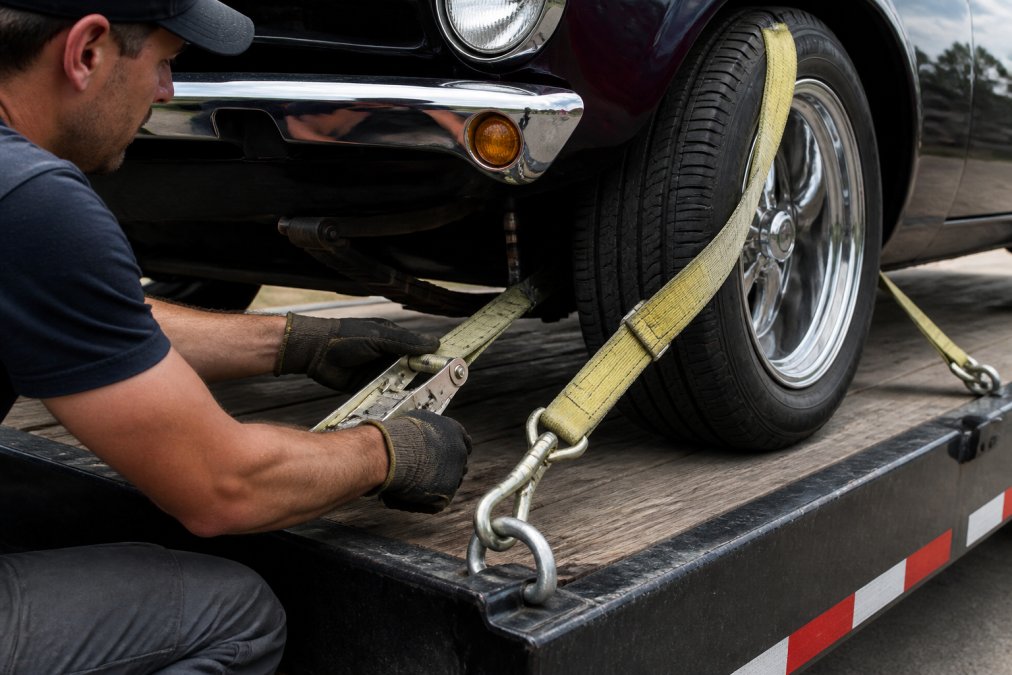
Step 1: Position the Vehicle and Set the Parking Brake
Center the vehicle on the trailer bed so weight sits evenly over the axles. Set the parking brake, shift into park or first gear, and chock the tires.
Step 2: Attach Straps to Anchor Points and Axle
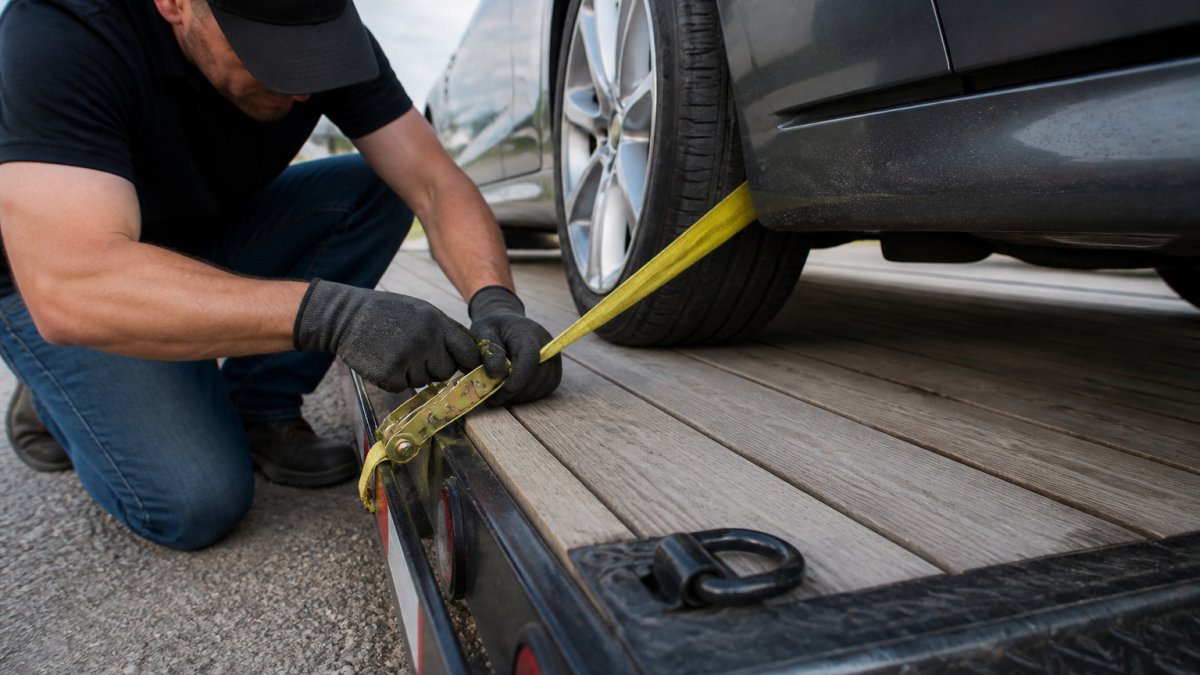
Hook the ratchet end of each strap to a trailer D-ring. Wrap the other end around the vehicle's axle or frame using an axle strap. Route the strap so it pulls straight, not at a sharp angle.
Step 3: Route and Cross-Strap for Load Distribution
Cross-strapping means running straps in an X pattern from opposite corners, stopping the vehicle from sliding side to side or front to back.
For heavier vehicles, use an eight-point securement setup instead of four. Two extra straps on each end reduce movement and take stress off any single anchor point.
Step 4: Re-Tension Mid-Trip Without Compromising Safety
This is the step most guides skip, and it causes the most failures. Straps settle as the suspension compresses and the webbing relaxes, so a strap tight in the driveway can go slack within 50 miles. Stop every 100 to 150 miles, or at the first safe pull-off after you notice trailer movement, and re-check every strap.
When you re-tension:
- Pull fully off the roadway onto a level surface, set the tow vehicle's parking brake, and turn on hazard lights.
- Walk the trailer and press each strap. Re-tension any strap that has visible slack.
- Crank the ratchet only until the strap is taut with slight give, do not over-tighten to compensate for a strap that keeps loosening.
- If the same strap goes slack twice, stop and inspect it. A strap that won't hold tension usually has stretched webbing, a slipping ratchet pawl, or a damaged anchor point, and re-tensioning it again won't fix the underlying problem.
Never re-tension a strap from the traffic side of the trailer or while the vehicle is on an incline. A vehicle that shifts while you're under it is the worst-case scenario, and it's entirely preventable by waiting for a safe, level pull-off.
Step 5: Final Walk-Around Before You Pull Out
Before you move, walk the full rig once more. Confirm every ratchet handle is closed and locked, every hook is seated, and no strap runs over a sharp edge or drags near the ground. Check that the parking brake is still set and the chocks are stowed. This 60-second check catches mistakes between steps and mirrors what commercial drivers do before every departure.
Ratchet Strap Tensioning Techniques for a Tight Hold
Ratchet strap tensioning techniques come down to one rule: tight enough to hold, not so tight you damage the vehicle or strap.
- Feed the webbing through the ratchet's mandrel slot
- Pull the slack through by hand until the strap is snug
- Crank the ratchet handle until the webbing is taut
- Stop when the strap has no slack but still has slight give
- Close the handle and check that the release mechanism locks
DOT Cargo Securement Standards: Staying Legal and Safe
DOT cargo securement standards are the federal rules that govern how cargo, including vehicles, must be tied down during transport. The Federal Motor Carrier Safety Administration cargo securement rules set the baseline for working load limits, strap counts, and inspection.
The core requirements for vehicle transport:
- The total working load limit of your straps must meet or exceed the cargo weight
- Straps must be in good condition with no knots or cuts
- The load must not shift during normal driving
- You must inspect securement before, during, and after the trip
| Vehicle Type | Minimum Straps | Best Anchor Setup |
|---|---|---|
| Compact car | 4 | D-rings + axle straps |
| Full-size truck | 4-6 | D-rings + frame straps |
| Classic or race car | 4-8 | Cross-strapped D-rings |
| Heavy equipment | 8+ | E-track + chain binders |
Protecting Your Vehicle: Rims, Paint, and Abrasion Points
Straps that touch bare metal will scratch paint and chew up rims. Protect the contact points before you tension anything.
Where straps rub against the vehicle, add abrasion protection:
- Soft axle straps instead of bare hooks on the frame
- Strap sleeves or pads where webbing crosses a sharp edge
- Wheel nets over tires to spread the load and skip the rims entirely
- Corner protectors on any spot where webbing meets a painted surface
Common Mistakes to Avoid When Securing Vehicle Straps
Most securement failures trace back to a handful of repeat mistakes:
- Anchoring to the wrong spot (bumpers, trim, suspension parts)
- Skipping the parking brake before loading
- Over-tightening until the suspension bottoms out
- Forgetting to re-check tension after the first few miles
- Using worn straps with frayed webbing or bent hooks
- Routing straps over sharp edges without protection
- Loading off-center so the trailer sways
The single biggest cause of securement failure is a strap that was tight at loading and loose by mile 50. Re-check your tension at every stop.
Weather, Roadside Checks, and Legal Liability
If you'd rather not own and maintain a trailer, renting is a solid option. 402 car hauler rentals offers reliable and affordable trailer rental solutions with flexible booking terms and competitive rates, providing dependable gear without the storage and upkeep.
Frequently Asked Questions
How many straps are needed to secure a car on a trailer?
For most passenger vehicles, the Federal Motor Carrier Safety Administration (FMCSA) requires a minimum of four tie-down straps, each with a working load limit of at least 1,100 pounds. However, many experts recommend using at least four straps in a cross-strap pattern and adding a fifth or sixth strap for extra security. When securing a vehicle, always check that the total working load limit of all straps meets or exceeds 50% of the vehicle's weight. For heavy-duty or classic cars, use six to eight straps for added safety.
What are the DOT requirements for vehicle tie-downs?
DOT cargo securement standards (49 CFR 393) require that all cargo, including vehicles, be secured to prevent shifting or falling. For vehicles, the total working load limit of all tie-downs must be at least 50% of the vehicle's weight. Each strap must have a working load limit of at least 1,100 pounds, and straps must be in good condition with no knots, cuts, or fraying. Additionally, the securement system must be inspected before each trip and re-tensioned as needed during transport.
How do I properly tension a ratchet strap?
To tension a ratchet strap, first thread the webbing through the ratchet's mandrel, then crank the handle back and forth until the strap is tight. Stop when the strap is snug and you can no longer easily pull it by hand. Over-tensioning can damage the strap or vehicle, so aim for a firm, even tension across all straps. After tensioning, close the handle fully and secure the excess webbing with a tie or hook and loop strap to prevent flapping. Re-check tension after the first few miles.
Can I use ratchet straps on a car with custom wheels or low ground clearance?
Yes, but you need to protect the wheels and avoid routing straps through the wheels themselves. Instead, use axle straps or wheel nets designed for custom or low-clearance vehicles. Axle straps wrap around the axle or suspension components, while wheel nets cradle the tire. Always use abrasion protection (like a sleeve or pad) where the strap contacts the vehicle. For low-clearance cars, check that the strap doesn't rub against the body or brake lines. If unsure, consult a professional or use a trailer with wheel chocks and over-the-tire straps.
Securing vehicle straps correctly takes practice, but the payoff is a safe, legal haul every time. If you'd rather skip the equipment upkeep, 402 car hauler rentals offers reliable trailer rentals with flexible terms and competitive rates for project cars, race vehicles, and everything in between. Our trailers come inspected and ready to roll, so you can focus on the drive, not the gear. Get started with 402 car hauler rentals and haul with confidence.