 blog
Towing a Dead Vehicle: 5 Essential Tips for Safe Hauls
Table of Contents
- Assess the Vehicle and Pick the Right Tow Method
- How to Load a Nonrunning Car Onto a Trailer
- How to Secure a Car on a Trailer
- Get the Trailer Safety Chain Length Right
- Run a Car Hauler Trailer Safety Checklist Before You Move
- Set Up Roadside Scene Safety and Know the Towing Rules
- Conclusion
- Frequently Asked Questions
Last Updated: October 17, 2026
Assess the Vehicle and Pick the Right Tow Method
Towing a dead vehicle starts with one honest look at the car. Someone hooks up before checking what they are dealing with. A locked drivetrain, flat tire, or seized brake can turn a simple haul into a broken trailer and a wrecked transmission.
So assess first. Ask three questions:
- Does it roll and steer? If the wheels turn freely, you have options. If not, you need a flatbed.
- Is it front-wheel, rear-wheel, or all-wheel drive? This decides how the car can be pulled.
- What does the owner's manual say? Automakers list approved towing methods and speed limits for each model.
A disabled vehicle is any car that cannot move under its own power, a dead battery, blown engine, wrecked front end, or a car that has sat for years. Each one loads differently.
Tow Dolly vs. Flatbed vs. Tow Bar
Three main tools handle a dead vehicle, and each fits a different job.
| Method | Best For | Wheels on Ground | Main Limit |
|---|---|---|---|
| Tow dolly | Front-wheel-drive cars that roll | Two rear wheels | Rear wheels must spin freely |
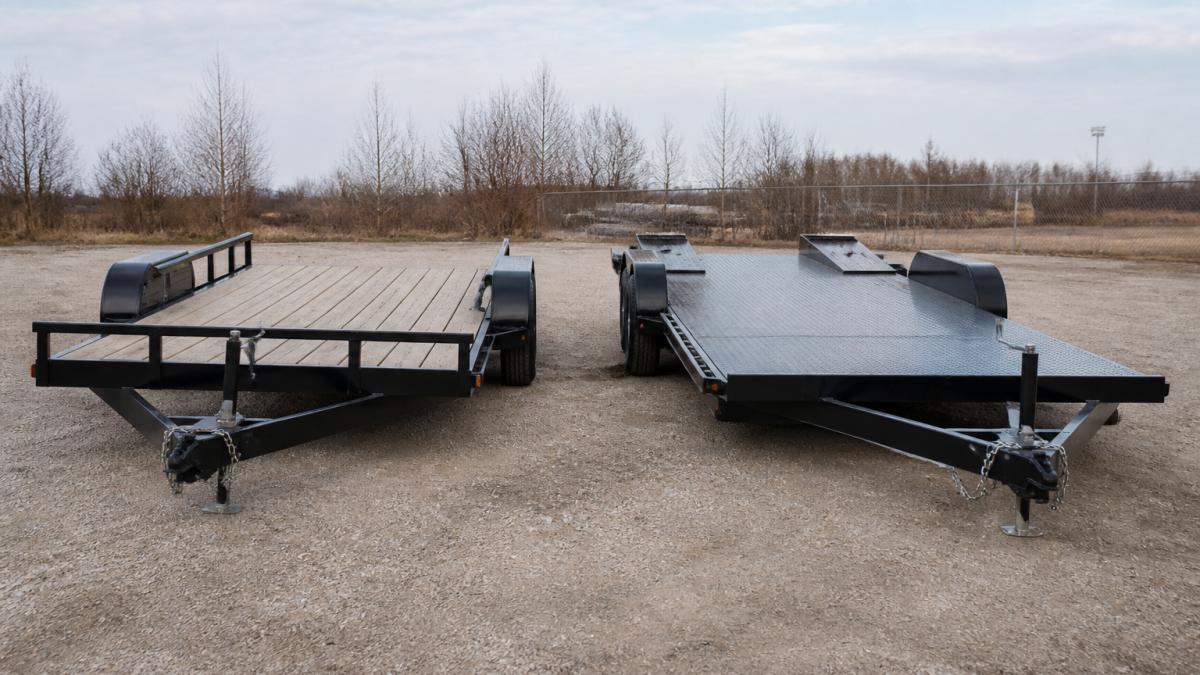
| Flatbed trailer | Any car, including AWD and wrecked | None | Needs ramps and a winch |
| Tow bar | Track cars and off-road rigs | All four | Only with a rated baseplate |
A tow dolly lifts the front wheels and leaves the rear on the road, good for front-wheel-drive cars with a healthy rear end.
Our rule of thumb: if the car cannot roll, cannot steer, or has all-wheel drive, use a flatbed. It is the safest tow method for a nonrunning car.
Transmission and Drivetrain Precautions
An automatic transmission can be destroyed by flat towing. The internals still turn when the wheels spin, but the fluid pump does not run.
Rear-wheel-drive cars must go on a dolly or flatbed. All-wheel-drive and four-wheel-drive vehicles should ride on a flatbed, full stop.
Check the manual before you hook up. If the guide says "flat tow not permitted," believe it.
How to Load a Nonrunning Car Onto a Trailer
Loading a dead car is a winch job, not a push job. With the engine off you have no power steering, so the front wheels will not self-center; no brake boost, so the pedal is a brick; and if the transmission will not shift out of park, the rear wheels may be locked. Plan for all three before the ramps come out.
First, make the car rollable
- Unlock the steering. Turn the key to the ON position (or press the start button without the brake) so the steering column unlocks. If the battery is dead, use a jump box on the terminals just long enough to unlock the column and shift the transmission, then disconnect it.
- Release the parking brake. If it is an electronic parking brake, you may need power to release it. Check the owner's manual for the manual release procedure; many models have a hidden lever or a sequence of pedal and button presses.
- Shift to neutral. If the shifter will not move, look for a shift-lock override, usually a small slot near the shifter that you press with a screwdriver or key.
Match the winch to the load
A winch rated below the loaded weight of the car will stall or snap a cable. Choose one rated at least 1.5 times the car's curb weight, and use a snatch block to double the pull near the limit. Keep the cable low and straight; a side pull can kink it and damage the winch.
The loading sequence
- Park on level ground. A sloped ramp shifts weight and makes the car hard to control. If you must load on a slope, chock the trailer wheels and load uphill, never downhill.
- Set the tow vehicle in park and chock its wheels. Set the trailer's parking brake and lower the jack.
- Lay the ramps at a shallow angle. Long ramps reduce scraping on low bumpers. If the car has a low front lip, add a transition block at the base of the ramp.
- Line the car up straight with the trailer deck. A crooked pull loads the car off-center and puts side load on the winch.
- Hook the winch to a chassis tow point, never to a bumper, tie rod, or control arm. If the car has no rated front tow point, use a axle strap around the frame rail or a wheel basket, not a chain hooked to sheet metal.
- Winch slowly and watch the car. Stop if the cable slackens, the car shifts sideways, or a wheel stops rolling. A dead car with a dragging brake will skid up the ramp; stop and fix the brake before continuing.
- Set the parking brake and put the transmission in park once the car sits over the axles. If the parking brake does not work, leave the transmission in gear (manual) or in park (automatic) and rely on the tie-downs.
A slow, straight pull beats a fast, crooked one every time.
How to Secure a Car on a Trailer
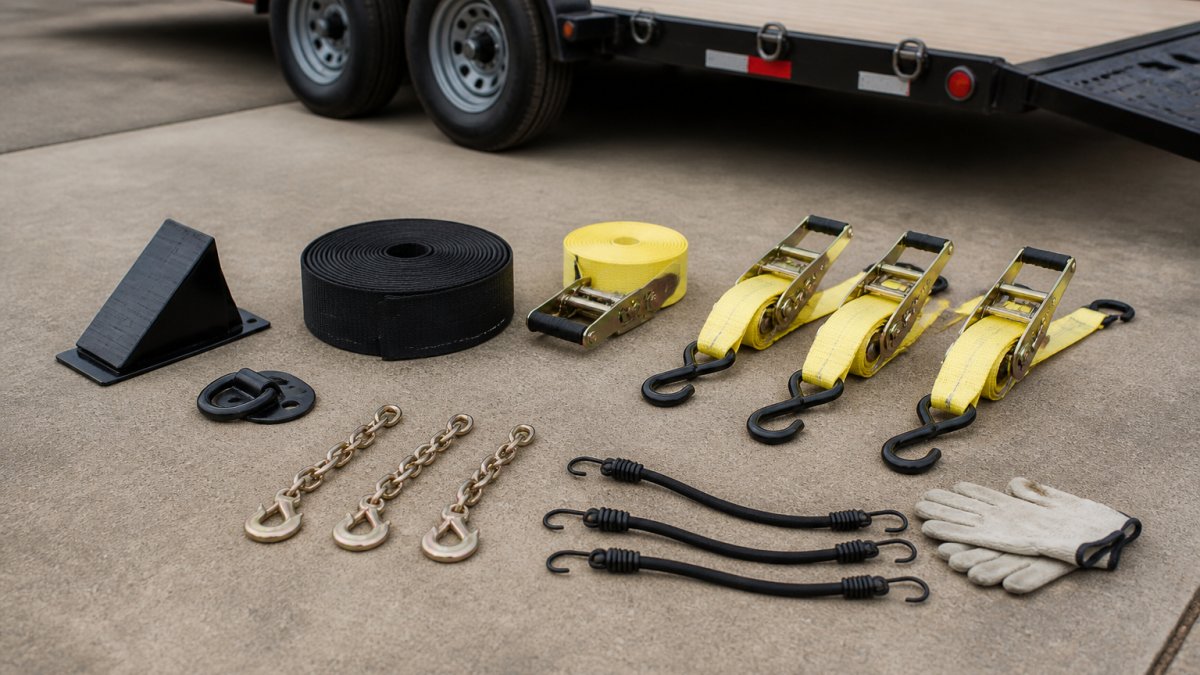
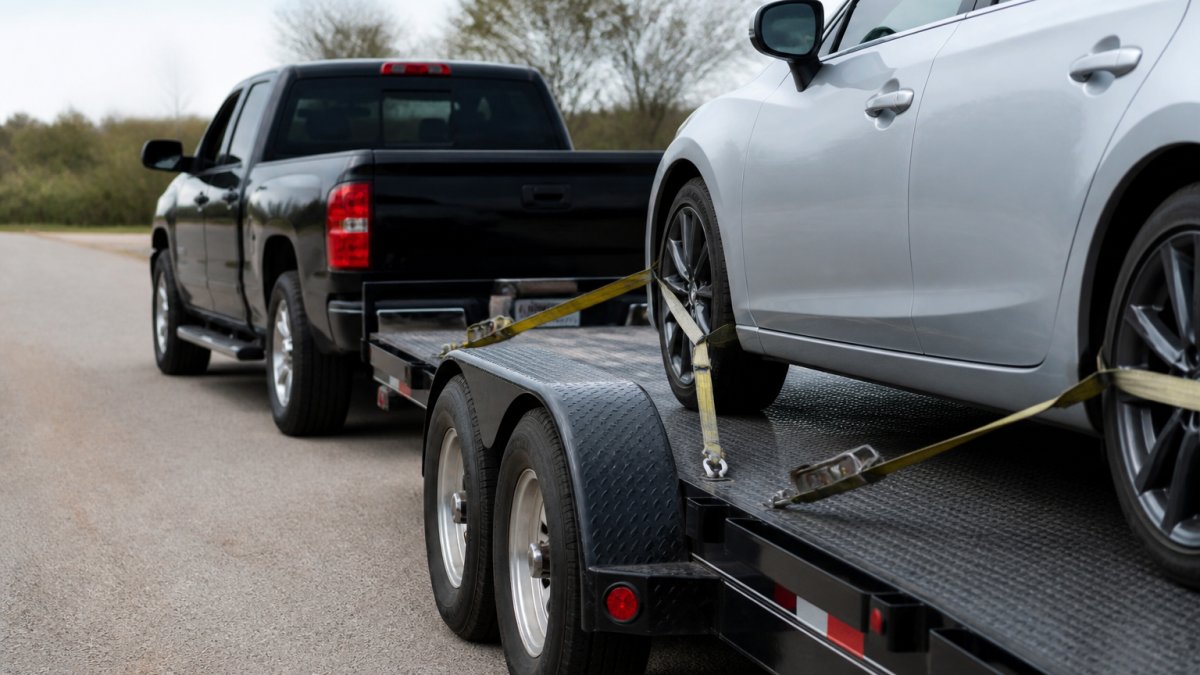
Securing a car means tying it down at four points so it cannot move forward, back, or sideways. Use four straps, one per corner, attached to a wheel or chassis tie-down point, and cross the rear straps if the trailer has room.
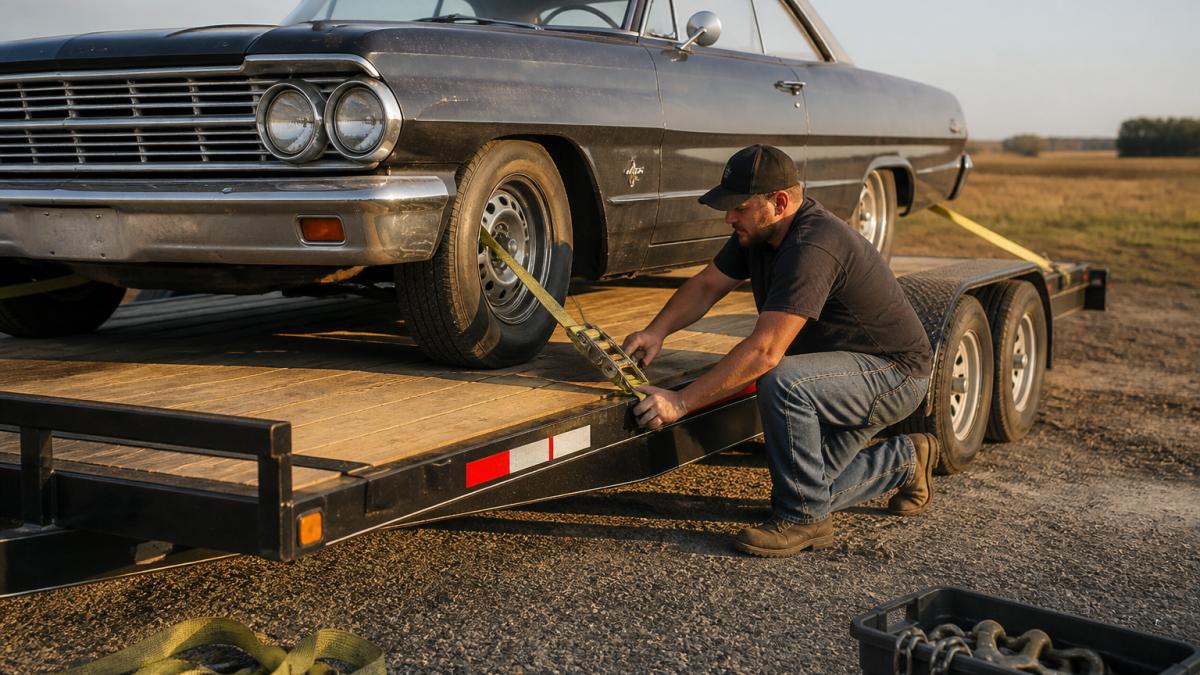
Here is how to secure a car on a trailer the right way:
- Use four straps minimum, one at each corner of the car.
- Attach to wheels or frame points, not to brake lines or fuel lines.
- Ratchet until the strap is tight but not so tight it crushes the suspension.
Get the Trailer Safety Chain Length Right
A good rule: cross the chains under the coupler and let them hang with a small amount of slack.
If the hitch fails, the chains are the only thing keeping the trailer off the pavement. Too long, and the trailer drops before the chain catches.
Check the chain rating against the trailer's loaded weight. A chain rated below the load is a chain that fails when you need it.
Run a Car Hauler Trailer Safety Checklist Before You Move
A car hauler trailer safety checklist catches the small problems before they become roadside failures. Run it every time, even on a short haul.
- Coupler locked and pinned to the hitch ball
- Safety chains crossed and attached
- Breakaway cable hooked to the tow vehicle
This list takes five minutes; a failed coupler or dead brake light can cost you far more.
If you are renting, ask how the trailer was inspected before pickup. A dependable rental outfit will walk the trailer with you and show you the straps, tires, and lights.
Set Up Roadside Scene Safety and Know the Towing Rules
Roadside scene safety comes before the hookup. A dead car on a shoulder is one of the most dangerous places you can work: the person loading it is the most exposed, and the car cannot move itself if traffic drifts.
Set the scene before you touch the car
- Get the car as far off the travel lane as possible. If it rolls, push it onto the shoulder or a nearby lot. If it does not roll, do not stand in the lane to work on it.
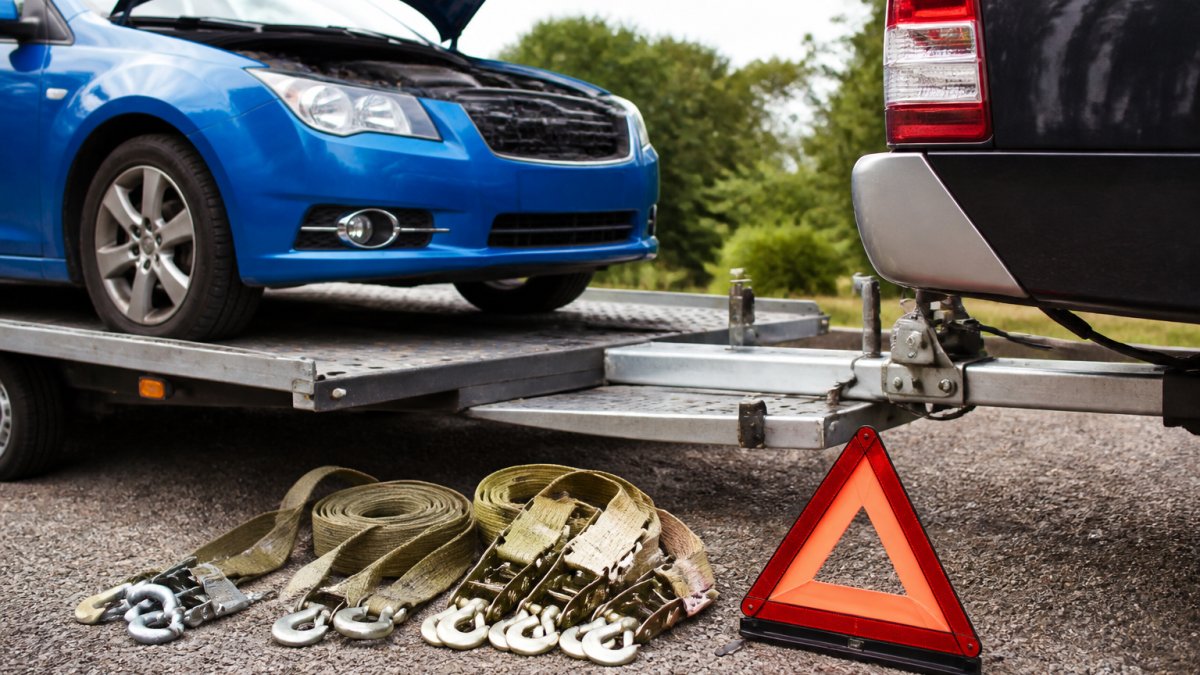
- Turn on the hazard lights on both vehicles. If the dead car's battery is flat, put a portable magnetic hazard light or a reflective triangle on the rear of the car.
- Place warning devices behind the scene. A common pattern is to set three reflective triangles: one at the rear of the car, one about 10 feet behind that, and one about 100 feet back on a highway (closer on a side street). Flares work too, but they burn out and start fires in dry grass.
Check the rules before you haul
Towing laws vary by state, and a dead vehicle can fall under different rules than a running one. Before you hook up:
- Confirm the speed limit for towed loads. Many states cap trailer speed at 55 mph or lower, even where the posted limit is higher. Check your state motor vehicle department's trailer rules.
- Confirm lighting requirements. Most states require working brake lights, turn signals, and running lights on the towed load, visible from a set distance. If the dead car's lights do not work, use a magnetic tow-light kit that plugs into the tow vehicle.
- Check weight and permit thresholds. Some states require a permit above a certain combined weight or trailer weight. Know your loaded weight before you cross a scale or a state line.
- Verify the tow vehicle's ratings. Confirm the towing capacity, gross combined weight rating (GCWR), and maximum trailer weight in the tow vehicle's owner's manual. Do not rely on a bumper sticker or a sales brochure.
A five-minute check of your state's rules and your ratings prevents a roadside stop, a citation, or a failed hitch.
Conclusion
Towing a dead vehicle safely comes down to preparation: assess the car, pick the right method, secure it at four corners, and check every connection before you roll.
If you need a trailer you can trust, 402 car hauler rentals offers dependable car hauler trailers with flexible terms and competitive rates. We inspect every trailer before pickup, walk you through the tie-downs, and help you match the right trailer to your car.
Frequently Asked Questions
What is the safest way to tow a dead vehicle?
For most nonrunning cars, a flatbed car hauler is the safest option because all four wheels sit off the ground, so the drivetrain, steering, and brakes aren't turning. If you use a tow dolly, the front wheels go on the dolly and the rear wheels roll, which means you must confirm the rear axle can spin without damage. Avoid rope-and-bumper setups entirely. Whatever method you choose, match the trailer's load limit to the vehicle's weight and check every strap and chain before you pull away.
Can you tow a nonrunning car with a car hauler trailer?
Yes, and it's usually the best choice. A car hauler trailer carries the full weight of the vehicle on its deck, so a dead engine, locked steering, or a seized wheel bearing doesn't affect the tow. You'll need a winch or come-along to pull a nonrunning car up the ramps, plus wheel chocks and four-point tie-downs. Confirm the trailer's maximum trailer weight exceeds the car's curb weight, and check that your tow vehicle's towing capacity covers both.
How do you secure a dead vehicle on a trailer?
Use four separate tie-down straps, one at each corner, attached to the vehicle's chassis or dedicated tie-down points, never to brake lines or suspension components. Cross the rear straps if the trailer manufacturer allows it to limit side-to-side movement. Tighten until the suspension compresses slightly, then stop. Set the parking brake, leave the transmission in park or gear, and re-check every strap after the first few miles, since straps can settle once the vehicle shifts on its suspension.
How tight should safety chains be when towing?
Safety chains should be tight enough to hold the trailer coupler off the ground if the hitch fails, but loose enough to allow a full turning radius without binding. Cross them under the coupler in an X pattern so the trailer tongue catches in the cradle rather than dropping straight to the pavement. Check that the chain length lets you make a tight turn without the links pulling taut, and inspect the links for cracks or stretched sections before every haul.