 ultimate-guide
Reliable Car Trailer Rental Services: What to Check First
Table of Contents
- Why Most Trailer Rentals Fail When You Need Them Most
- Car Trailer Rental Safety Checklist: 7 Points to Inspect
- Towing Capacity Requirements for Trailers: Match Your Truck First
- Car Trailer Rental Cost Factors That Determine Your Final Bill
- The Pre-Rental Inspection Checklist: What to Walk Around and Check
- How to Hitch and Load a Rental Trailer Without Damaging Your Car
- Step 1: Align the Hitch Ball and Coupler
- Step 2: Attach Safety Chains and Wiring
- Step 3: Raise the Jack and Check the Connection
- Step 4: Position the Vehicle for Correct Weight Distribution
- Step 5: Secure the Vehicle with Four Tie-Down Straps
- Step 6: Tighten Straps Gradually and Alternating
- Step 7: Final Tug and Visual Inspection
- Common Loading Mistakes to Avoid
- Insurance and Liability: What Your Rental Agreement Actually Covers
- Final Checklist Before You Drive Away
- Frequently Asked Questions
Last Updated: September 5, 2026
Why Most Trailer Rentals Fail When You Need Them Most
The gap between a smooth haul and a roadside disaster usually comes down to preparation, not luck. Most people book a car trailer rental based on price and availability, then discover too late that their towing vehicle lacks the capacity or the equipment is poorly maintained.
Below, we break down the safety checklist, towing capacity requirements, cost factors, and the inspection steps that separate a dependable rental from a costly mistake, plus the insurance and liability questions most guides skip.
Car Trailer Rental Safety Checklist: 7 Points to Inspect
A thorough walk-around takes ten minutes and can prevent thousands of dollars in damage. Check the tires for cracks, proper inflation, and adequate tread depth. Inspect the tie-down straps for fraying, cuts, or worn ratchets, and confirm the safety chains are free of rust and properly rated for the load. Test every light on the trailer, including brake lights and turn signals, because a failed light can get you pulled over and cited.
Verify the hitch ball size matches your receiver and that the coupler locks securely without excessive play. Check the wheel bearings by jacking the trailer and spinning each wheel, listening for grinding or roughness. Examine the ramps for bending or cracks, especially if you are loading a low-clearance vehicle. Finally, confirm the spare tire and jack are present and functional.
Towing Capacity Requirements for Trailers: Match Your Truck First
Your truck's towing capacity is the single most important number in this process. Found in your owner's manual or on the driver's door jamb sticker, it represents the maximum weight your vehicle can safely pull and must exceed the combined weight of the trailer and the loaded car. The gross vehicle weight rating also matters, since the tongue weight adds to your payload (nhtsa.gov).
Matching Trailer Type to Vehicle Class
Here is how trailer types map to common vehicle classes:
- Half-ton trucks (Ford F-150, Ram 1500, Chevy Silverado 1500): These trucks typically have a towing capacity between 8,000 and 13,000 pounds depending on engine, cab configuration, and axle ratio. A single-axle car carrier rated for 7,000 pounds gross trailer weight is usually a safe match for hauling a compact car or a small sedan. A tandem-axle carrier rated for 10,000 pounds is better for a full-size sedan or a heavy coupe, but you must verify the specific payload and towing numbers on your door sticker.
- Heavy-duty trucks (Ford F-250/F-350, Ram 2500/3500, Chevy Silverado 2500/3500): These trucks often have towing capacities from 14,000 to 20,000 pounds or more. They can handle a tandem-axle car carrier rated for 10,000 to 15,000 pounds, which is sufficient for a heavy truck, a large SUV, or a classic car with a steel body. The limiting factor is usually the hitch receiver class, not the engine.
- SUVs and crossovers (Tahoe, Expedition, Sequoia): Many full-size SUVs are rated to tow between 6,000 and 9,000 pounds. A tow dolly rated for 5,000 pounds is a safer choice than a full car carrier for these vehicles, because the dolly keeps the towed car's front wheels off the ground and reduces total tongue weight. A car carrier loaded with a mid-size sedan can push an SUV past its payload limit even if the towing number looks adequate.
- Electric vehicles (F-150 Lightning, Rivian R1T, Cybertruck): EVs have unique towing considerations. The battery pack adds significant curb weight, which reduces available payload for tongue weight. Towing also cuts range by roughly 40 to 50 percent, so a 200-mile trip may require a charging stop (energy.gov). Verify the EV's published towing capacity and check whether the trailer's electric brakes are compatible with the vehicle's brake controller interface.
The Hitch Assembly and Brake Controller
If your trailer has electric brakes, which most car carriers do, you need a brake controller installed in your cab. Many modern trucks come with an integrated controller, but older trucks may require an aftermarket unit. The hitch must be rated for the gross trailer weight, and the hitch ball size must match the coupler. Check the actual sticker on the hitch for its rating rather than assuming a Class III receiver handles everything.
How to Read the Door Jamb Sticker
The driver's door jamb sticker lists three critical numbers: GVWR, GAWR, and the payload limit. Subtract the curb weight of your truck from the GVWR to find your payload. Then add the tongue weight of the loaded trailer (typically 10 to 15 percent of the gross trailer weight) to the weight of your passengers and cargo. If that sum exceeds the payload number, you are overloaded even if the towing capacity looks fine.
A Quick Calculation Example
Suppose you plan to haul a 3,500-pound sedan on a 2,200-pound tandem-axle car carrier. The gross trailer weight is 5,700 pounds. At 12 percent tongue weight, the trailer puts about 684 pounds on your hitch. If your truck has a payload limit of 1,500 pounds, you have room for roughly 816 pounds of passengers and cargo. Run this calculation before you book the trailer.
Car Trailer Rental Cost Factors That Determine Your Final Bill
Rental pricing depends on several variables beyond the advertised daily rate. The type of trailer, whether a basic tow dolly or a full car carrier with brakes, drives the base cost. Rental duration matters, as many providers offer weekly rates that lower the per-day price for longer hauls. The distance you travel also affects the bill, particularly for one-way rentals.
Most agreements require a security deposit that is refunded after the trailer is returned undamaged. Additional coverage, like a protection package, adds a daily fee but limits your financial exposure if something goes wrong. Ask about mileage limits and late fees before you sign.
The Pre-Rental Inspection Checklist: What to Walk Around and Check
Treat the inspection as a shared responsibility between you and the rental provider. Review the rental agreement and note any pre-existing damage, such as scratches, dents, or worn tires, and have the staff initial your list. Check the trailer's registration and ensure the VIN matches the paperwork.
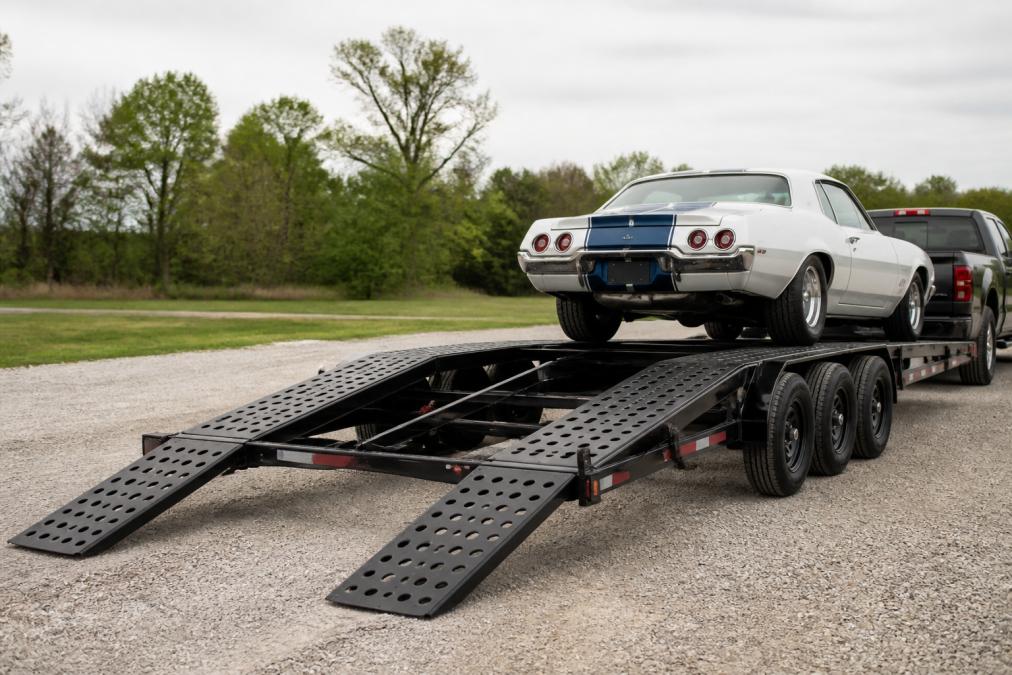
Inspect the ramps for secure attachment and verify the deck surface provides enough traction for your vehicle's tires. Check the placement of the tie-down points and ensure they are rated for the weight of your car. This pre-rental inspection protects you from being charged for damage you did not cause and ensures the equipment is roadworthy.
How to Hitch and Load a Rental Trailer Without Damaging Your Car
Proper hitching and loading is a sequence of mechanical checks, not a single action. Here is the full process.
Step 1: Align the Hitch Ball and Coupler
Back your truck up so the hitch ball sits directly under the coupler. Use a spotter if you are not confident in your alignment. The coupler must sit level with the hitch ball; if the trailer is angled sharply, the coupler may not seat properly. Lower the trailer onto the ball and close the latch. The latch must click into place, and the coupler should have no vertical movement when you lift on the tongue.
Step 2: Attach Safety Chains and Wiring
Attach the safety chains, crossing them under the coupler to create a cradle that catches the trailer if it detaches. The chains should have enough slack to allow for turns but not so much that they drag on the pavement. Connect the wiring harness and verify all lights function, including brake lights, turn signals, and running lights.
Step 3: Raise the Jack and Check the Connection
Raise the trailer's jack fully and secure it in the travel position. Confirm the safety chains are not twisted or caught on any part of the hitch. Verify the ramps are stowed or locked in the travel position.
Step 4: Position the Vehicle for Correct Weight Distribution
Position your car so roughly 60 percent of its weight sits forward of the trailer's axles, which keeps the tongue weight within spec. Loading the car too far back reduces tongue weight and causes dangerous sway at highway speeds. The goal is a tongue weight of 10 to 15 percent of the gross trailer weight.
Step 5: Secure the Vehicle with Four Tie-Down Straps
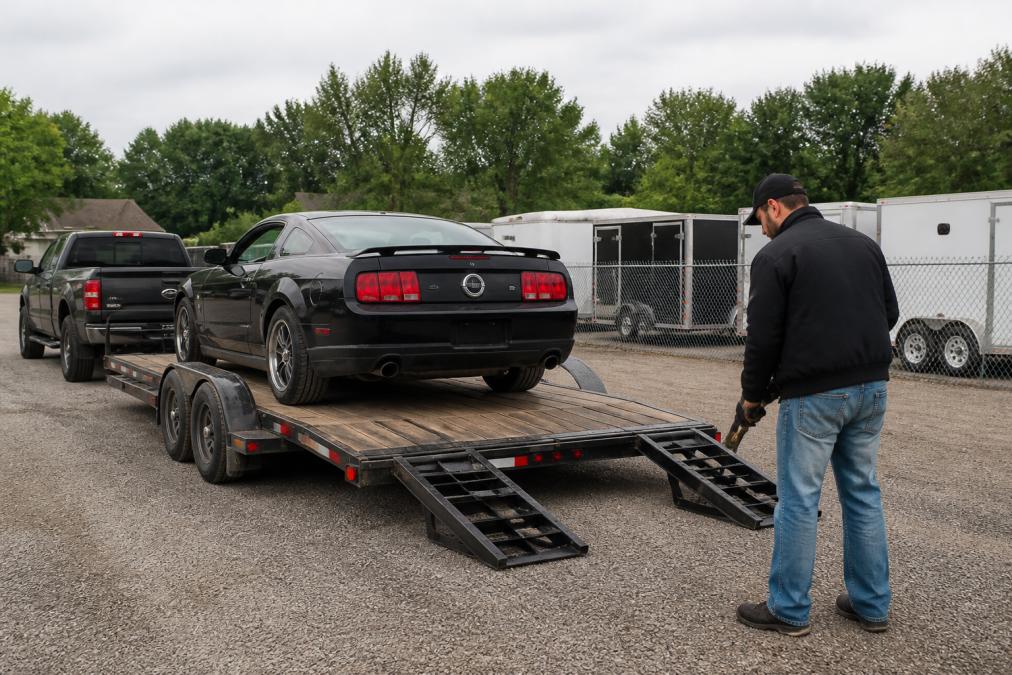
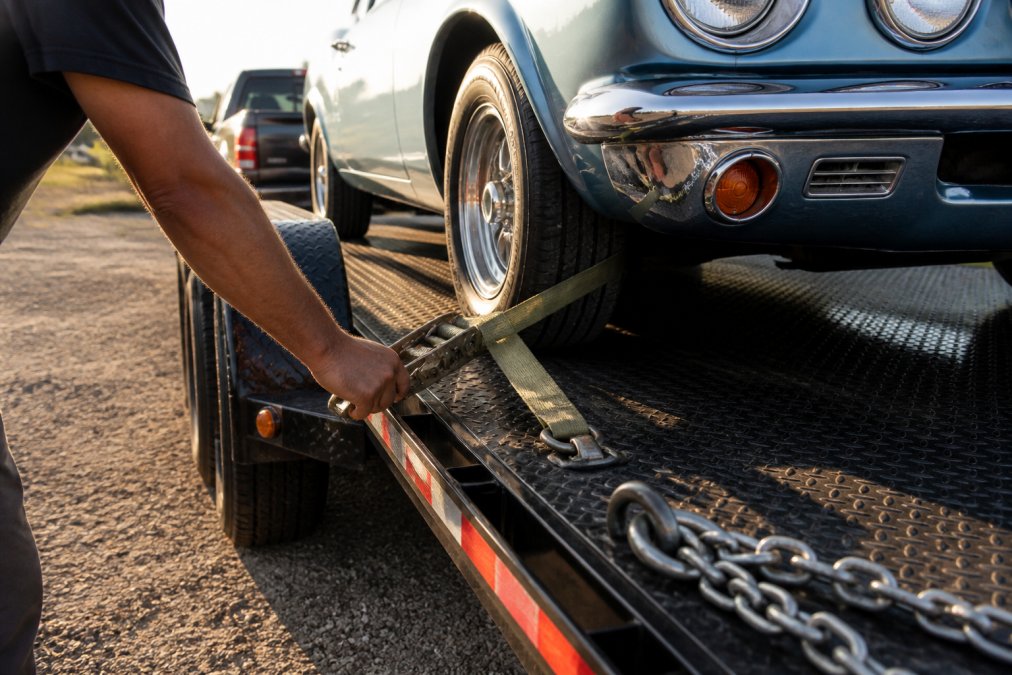
Secure the vehicle by chocking the wheels and using four tie-down straps attached to the frame or designated points, never the bumpers or axles. Most car carriers have D-rings or slots in the deck for this purpose. Use ratchet straps rated for at least 5,000 pounds each (fmcsa.dot.gov).
Step 6: Tighten Straps Gradually and Alternating
Tighten the straps gradually, alternating sides, until the car sits firmly on the suspension. Start with the front left strap, then the front right, then the rear left, then the rear right. Repeat the sequence, tightening each strap a little more each time.
Step 7: Final Tug and Visual Inspection
End with a final tug on every strap before you drive. Pull on each strap to confirm it is tight, and check that the ratchets are fully closed and locked. Walk around the trailer and verify the car has not shifted during tightening. Check that the ramps are stowed, the jack is up, and the safety chains are clear of the ground.
Common Loading Mistakes to Avoid
- Loading the car too far back: This reduces tongue weight and causes trailer sway at highway speeds. The car's center of gravity should be slightly forward of the trailer's axle centerline.
- Using only two straps: A car can shift sideways or forward under hard braking. Four straps, one at each corner, are the minimum for a safe haul.
- Attaching straps to the bumper: Bumpers are not designed to handle the forces of towing. Use frame points or designated tie-down locations.
- Forgetting to chock the wheels: Wheel chocks prevent the car from rolling while you are attaching straps. Remove them only after all straps are tight.
- Ignoring the spare tire: Confirm the trailer has a spare tire and that it is inflated. A flat trailer tire on the highway is a major delay, and many rental providers do not include roadside assistance for the trailer itself.
Insurance and Liability: What Your Rental Agreement Actually Covers
Your personal auto insurance may not cover damage to a rental trailer or the vehicle being towed. Many policies exclude trailers not owned by you, so check with your agent before you pick up the equipment. The rental company's own insurance typically covers the trailer itself, but you are liable for damage to the towed car and any third-party property.
The rental agreement spells out your obligations, including the permitted use of the trailer. Commercial use, such as hauling customer vehicles for a repair shop, may require a commercial rental agreement or additional coverage. Read the fine print on load securement and weight limits, because exceeding the rated capacity voids most liability protection.
Final Checklist Before You Drive Away
A reliable car trailer rental experience ends with a final verification, not a hope. Confirm your truck's towing capacity against the loaded weight, check the hitch connection and safety chains, and test the lights and brakes one last time. Verify that your tie-down straps are tight and the car is properly positioned.
For renters in the Omaha area, 402 car hauler rentals offers dependable equipment and flexible terms for hauling project cars, race vehicles, and customer cars. Our trailers are suited for a range of transport jobs, and we work with you on booking dates that fit your schedule. Whether you need a trailer for a weekend car show or a week-long restoration move, we provide the equipment and support for a safe haul.
Frequently Asked Questions
How do I verify the safety standards of a car trailer rental before booking?
Ask the rental company directly about their maintenance schedule for tires, brakes, and lighting. When you arrive, inspect the tie-down straps for fraying or cracks, check the tire tread and pressure, and verify all lights function properly. A reputable provider will walk you through their inspection points without hesitation. If they resist showing you the equipment or cannot answer basic maintenance questions, consider that a red flag.
What towing capacity requirements for trailers should my vehicle meet?
Your tow vehicle must have a rated towing capacity that exceeds the combined weight of the trailer and your loaded vehicle. Check your owner's manual for the maximum towing capacity, then weigh your vehicle with the load it will carry. Remember to factor in the trailer's own weight. Never exceed the manufacturer's rating, as this creates a serious safety risk.
What documents are required to rent a car hauler?
Most rental companies require a valid driver's license, proof of insurance for your tow vehicle, and a credit card for the security deposit. Some local providers may also ask for a copy of your vehicle registration. Call ahead to ask about specific requirements, especially if you are using a commercial vehicle or a truck with a modified suspension, as policies vary between national chains and independent rental services.
How do I know if a trailer rental service is reliable?
Start by reading recent reviews from customers who describe specific experiences, not just star ratings. Ask about the age of their equipment and their maintenance routine for critical parts like tires, brakes, and tie-down straps. Confirm that their advertised rate includes all fees and that availability is guaranteed once you book. A reliable service will be transparent about their equipment's condition and clear about their policies on cancellations and equipment failure.
Renting a trailer involves more than finding the lowest daily rate. The safest approach is to verify the equipment, match it to your truck, and understand your liability before you tow. 402 car hauler rentals combines reliable equipment with flexible terms and competitive rates for Omaha-area haulers. Contact us to reserve a trailer that fits your vehicle and your timeline.
Frequently Asked Questions
Q: How do I verify the safety standards of a car trailer rental before booking?
A: Ask the rental company directly about their maintenance schedule for tires, brakes, and lighting. When you arrive, inspect the tie-down straps for fraying or cracks, check the tire tread and pressure, and verify all lights function properly. A reputable provider will walk you through their inspection points without hesitation. If they resist showing you the equipment or cannot answer basic maintenance questions, consider that a red flag.
Q: What towing capacity requirements for trailers should my vehicle meet?
A: Your tow vehicle must have a rated towing capacity that exceeds the combined weight of the trailer and your loaded vehicle. Check your owner's manual for the maximum towing capacity, then weigh your vehicle with the load it will carry. Remember to factor in the trailer's own weight. Never exceed the manufacturer's rating, as this creates a serious safety risk.
Q: What documents are required to rent a car hauler?
A: Most rental companies require a valid driver's license, proof of insurance for your tow vehicle, and a credit card for the security deposit. Some local providers may also ask for a copy of your vehicle registration. Call ahead to ask about specific requirements, especially if you are using a commercial vehicle or a truck with a modified suspension, as policies vary between national chains and independent rental services.
Q: How do I know if a trailer rental service is reliable?
A: Start by reading recent reviews from customers who describe specific experiences, not just star ratings. Ask about the age of their equipment and their maintenance routine for critical parts like tires, brakes, and tie-down straps. Confirm that their advertised rate includes all fees and that availability is guaranteed once you book. A reliable service will be transparent about their equipment's condition and clear about their policies on cancellations and equipment failure.