 ultimate-guide
Secure Car Transport Equipment Rental: 2026 Guide
Table of Contents
- Choosing the Right Car Transport Equipment for Your Vehicle
- How to Secure a Car on a Trailer: Step-by-Step
- Car Trailer Rental Weight Limits and Vehicle Compatibility
- Daily Rates for Car Hauler Rentals: What Affects Your Bill
- Rental Requirements, Insurance, and Damage Waivers
- DIY Transport vs. Hiring a Professional: Cost and Risk Comparison
- Post-Rental Inspection and Return Protocols
- Emergency Troubleshooting During Your Rental
- Frequently Asked Questions
Last Updated: September 16, 2026
Choosing the Right Car Transport Equipment for Your Vehicle
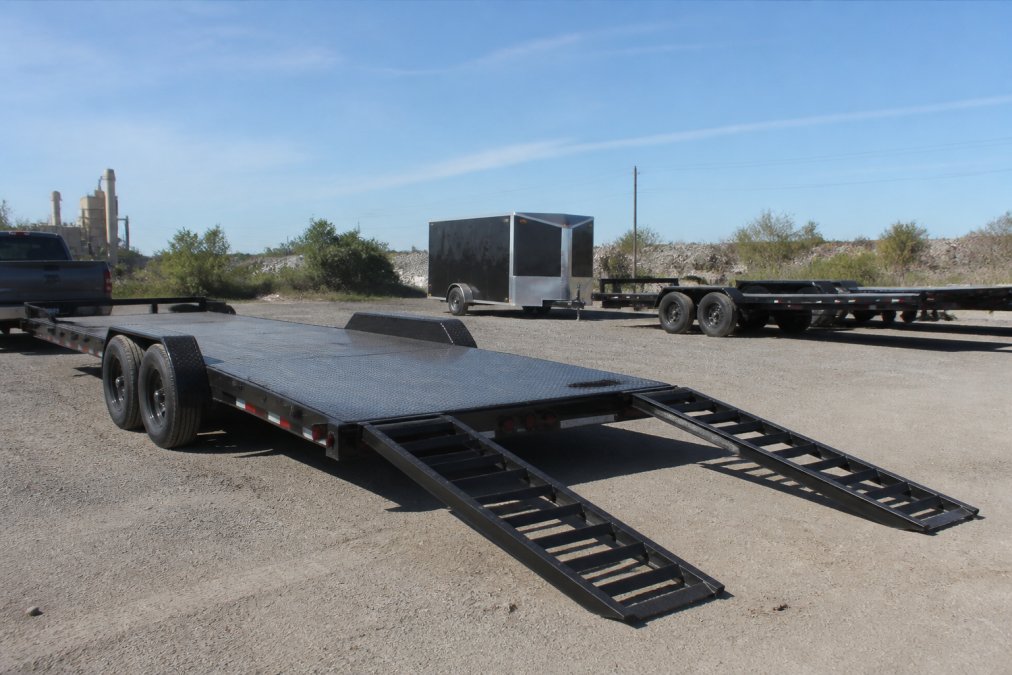
Renting secure car transport equipment starts with matching the trailer to the vehicle. A tow dolly, an open car carrier, and an enclosed trailer each solve a different problem, and picking wrong means paying for protection you don't need or risking damage you can't undo. This guide from 402 car hauler rentals covers selection, loading, weight limits, and returns.
Tow Dolly vs. Car Carrier: Which Fits Your Situation
A tow dolly lifts two wheels off the ground while the other two roll on the road. A car carrier, also called an auto transport trailer, holds all four wheels on the deck. That difference decides most rental decisions.
Open vs. Enclosed Trailers: Protection Levels Compared
An open trailer exposes the vehicle to road debris, weather, and UV. An enclosed trailer shields it completely but costs more and requires a larger towing vehicle because of added wind resistance and weight.
How to Secure a Car on a Trailer: Step-by-Step
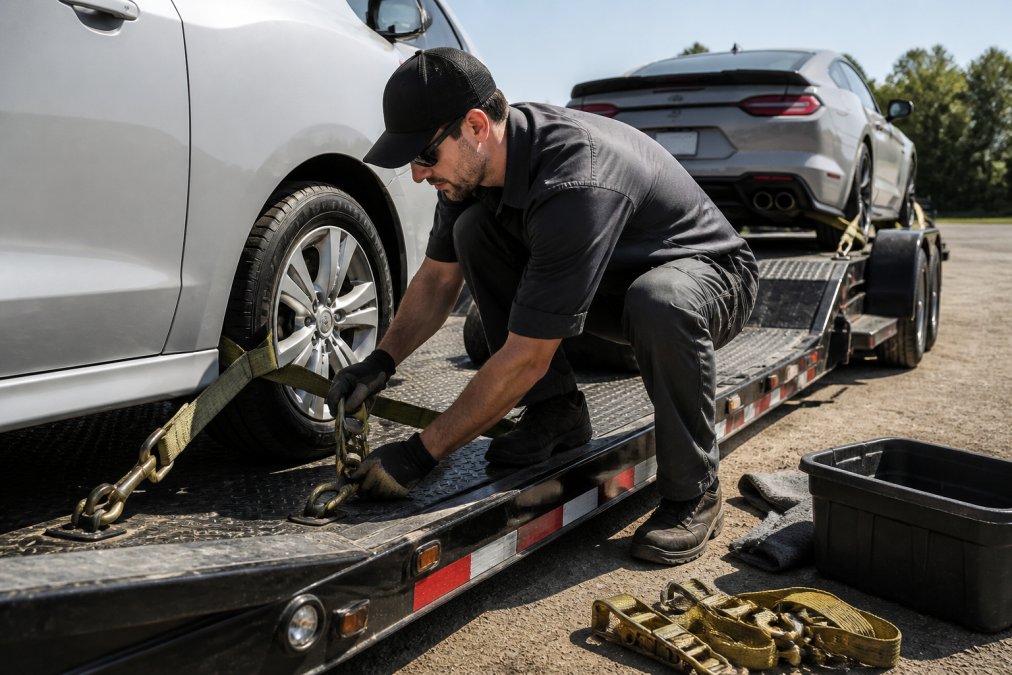
Securing a car takes four steps: position the vehicle, set the parking brake and immobilize it, attach four tie-downs at the correct points, then tension and re-check every strap. Skipping the re-check is the most common mistake, straps stretch and settle once moving.
- Drive or winch the vehicle onto the trailer, centering it over the axles.
- Set the parking brake, shift to park or first gear, and engage any steering lock.
- Attach ratchet-operated tire straps over each wheel, or cross the straps at the frame if you're using frame tie-downs.
- Connect safety chains in a crossed pattern under the hitch.
- Tension each strap until it's firm, then stop. Over-tightening bends wheels and stretches straps past recovery.
- Stop after the first few miles and re-tension every strap.
Tie-Down Points and Strap Tension Checks
Tie-down points are where straps connect on the trailer frame or over the tires. Use four minimum, one per wheel, and never rely on the parking brake alone.
Car Trailer Rental Weight Limits and Vehicle Compatibility
Car trailer rental weight limits come down to three numbers: the trailer's gross vehicle weight rating, the vehicle's curb weight, and your tow vehicle's rated capacity. All three must line up before you hook up, but drivetrain and body configuration determine whether a dolly or carrier is even an option.
Understanding GVWR, Curb Weight, and Hitch Class
Gross vehicle weight rating (GVWR) is the maximum total weight a trailer is designed to carry, including its own weight. Curb weight is how much your vehicle weighs with fluids but no passengers or cargo. Hitch class describes how much weight your towing vehicle's hitch can handle.
| Hitch Class | Typical Towing Capacity | Best For |
|---|---|---|
| Class I | Light loads | Small utility trailers |
| Class II | Moderate loads | Compact cars on dollies |
| Class III | Heavy loads | Full car carriers |
| Class IV/V | Very heavy loads | Enclosed trailers, large vehicles |
Vehicle-Specific Compatibility: What Actually Fits on a Dolly vs. a Carrier
Most rental sites stop at weight, but drivetrain layout, not pounds, is what damages drivetrains. Use this matrix as a starting filter.
| Vehicle Configuration | Tow Dolly | Open Car Carrier | Enclosed Carrier | Notes |
|---|---|---|---|---|
| Front-wheel drive (FWD) sedan or crossover | Yes, if rear wheels roll freely | Yes | Yes | Dolly lifts the driven axle; rear wheels free-spin. |
| Rear-wheel drive (RWD) | No, unless driveshaft is disconnected | Yes | Yes | Driven wheels on the ground will spin the transmission without lubrication. |
| All-wheel drive (AWD) / 4WD | No, unless flat-towed per OEM procedure | Yes | Yes | Transfer case and center differential are the failure points. |
| Electric vehicle (EV), single-motor | No | Yes, with low-clearance ramps | Yes | Regenerative braking can engage if wheels spin; never dolly-tow. |
| EV, dual-motor AWD | No | Yes, with low-clearance ramps | Yes | Same as above, plus weight distribution concerns. |
| Lowered / low-clearance sports car | Usually no | Yes, with ramp extensions | Yes | Approach angle is the limiting factor, not weight. |
| Dually pickup or full-size van | No | Yes, wide-deck carrier | Yes, wide-body only | Track width exceeds most dolly and standard carrier decks. |
| Motorcycle or trike | No | Dedicated motorcycle carrier | Dedicated enclosed | Different tie-down geometry entirely. |
How to Verify Your Specific Vehicle Before You Reserve
- Find the curb weight on the driver's door jamb sticker or in the owner's manual.
- Confirm the drivetrain layout (FWD, RWD, AWD, 4WD), the most important filter.
- Measure ground clearance at the front bumper and the approach angle to the ramp.
- Check the tow vehicle's door-jamb sticker for gross combined weight rating (GCWR), not just tow rating.
- Call the rental desk with year, make, model, and trim, an AWD version of a normally FWD model changes the answer.
If any item is unclear, ask before you hook up. A five-minute call beats a transmission rebuild.
Daily Rates for Car Hauler Rentals: What Affects Your Bill
Daily rates for car hauler rentals depend on trailer type, duration, and whether you need a damage waiver. Enclosed trailers cost more, and multi-day rentals often price better per day.
Rental Requirements, Insurance, and Damage Waivers
Most rentals require a valid driver's license, proof of insurance on the towing vehicle, and a minimum age. A damage waiver isn't insurance, it limits your financial responsibility if the trailer is damaged during normal use.
DIY Transport vs. Hiring a Professional: Cost and Risk Comparison
Towing it yourself costs less on paper; hiring a professional removes the driving, fuel, and liability. The right call depends on distance, vehicle value, and your comfort backing a loaded trailer, but the on-paper comparison usually understates DIY.
The Hidden Costs of DIY That Don't Show Up in the Rental Quote
A rental quote covers the trailer, not the round trip to pick it up, fuel at towing mileage, time off work, or tow vehicle wear. First-time DIY haulers commonly end up 40-70% above the base rental rate once those are added.
| Cost Category | DIY Rental | Professional Transport |
|---|---|---|
| Trailer rental (base rate) | Quoted up front | N/A |
| Damage waiver / protection | Add-on, often 10-20% of base | Included in carrier's insurance |
| Fuel at towing MPG (typically 8-12 MPG loaded) | Paid by you | Included |
| Round trip to pick up and return trailer | Paid by you | N/A |
| Tow vehicle wear (brakes, transmission, tires) | Paid by you | N/A |
| Time off work | Paid by you | N/A |
| Damage liability if the load shifts | Borne by you | Borne by carrier |
| Roadside assistance for trailer failure | Varies by rental contract | Carrier's responsibility |
When DIY Rental Wins
- Short hauls under about 100 miles. Fuel and time costs stay small; the rental rate dominates.
- You already own a properly rated tow vehicle. No need to rent a truck on top of the trailer.
- The vehicle is a track car, project car, or work vehicle where cosmetic risk is acceptable.
- You need the trailer for multiple trips in the rental window, one rate, several uses.
- You're comfortable backing a loaded trailer and have done it before.
When Professional Transport Wins
- Cross-country or multi-day moves. Hotel, fuel, and time costs stack fast.
- High-value, restored, or collector vehicles. The carrier's cargo insurance is the deciding factor.
- Inoperable vehicles. A carrier with a winch handles a non-running car; a rental dolly does not.
- Enclosed transport needs. Renting an enclosed trailer usually requires a larger tow vehicle than most households own.
- Tight timelines. A professional carrier runs the route on a schedule; a DIY haul depends on your availability.
A Simple Break-Even Framework
Estimate DIY cost as: rental base + damage waiver + (round-trip miles ÷ towing MPG × fuel price) + (driving hours × your hourly value) + a wear/damage contingency. Compare to two or three professional quotes. If DIY is within about 20% of the professional quote, the professional usually wins on risk-adjusted terms, a small premium to move liability off your record.
Post-Rental Inspection and Return Protocols
A post-rental inspection protects you from charges for damage you didn't cause. Walk the trailer with the agent, photograph every panel, tire, and strap, and note existing damage on the return form before handing over the keys.
Emergency Troubleshooting During Your Rental
A blown tire, loosened strap, or dead trailer light doesn't have to end your haul. Pull over safely, assess, and call the rental company's roadside line before attempting a fix.
- Blown tire: Pull fully off the road, set warning triangles, and call for roadside assistance rather than changing it yourself on a shoulder.
- Loose strap: Re-tension at the next safe stop. If a strap has failed, replace it before continuing.
- Dead trailer lights: Check the connector first. A loose plug causes most light failures.
- Trailer sway: Slow down gradually and avoid hard braking. Sway usually means the load is positioned too far back.
Frequently Asked Questions
What features make car transport equipment secure for hauling?
Four-point tie-down systems with ratchet-operated tire straps, safety chains rated for the load, and a functioning breakaway kit are the core safety features. Look for trailers with retractable loading ramps, working blinker capabilities, and clearly marked tie-down points. Before renting, inspect strap condition, tire stops, and ramp hinges. A trailer with bent stops or frayed straps is not safe for secure transit regardless of its weight rating.
What are the weight requirements for renting a car transport trailer?
Your loaded vehicle and trailer combined must stay under the tow vehicle's rated towing capacity. Check the trailer's gross vehicle weight rating (GVWR) and subtract its own weight to find the payload limit. A typical car carrier handles 5,000 to 7,000 pounds of vehicle weight, but always verify against your specific trailer and hitch class. Exceeding these limits affects braking distance and towing stability.
Do rental companies provide tie-down straps for vehicle transport?
Policies vary. Some rentals include ratchet straps and safety chains; others charge extra or require you to bring your own. Always confirm before booking, and inspect any provided straps for fraying, missing ratchet teeth, or worn hooks. If you supply your own, use straps rated for at least 3,333 pounds working load per tie-down point. Four straps minimum for a standard car.
How do I ensure my vehicle is properly secured during transport?
Compress the suspension slightly with each strap, then check tension after the first five miles and again at every fuel stop. Straps should be tight enough that the vehicle cannot rock but not so tight that they crush body panels or brake lines. Use four tie-down points at the frame or dedicated wheel straps. Never secure a vehicle by its bumper, control arms, or exhaust.